FameEX Today’s Crypto News Recap | August 5, 2026
2026-08-05 07:09:38

Tether Gold reserves rose amid gold's slump, US-UK stablecoin ties advanced, and Galaxy found 15 Coldcard attackers; today’s BTC traded near $64K under Fear sentiment. The crypto market has recently been shaped by a combination of macroeconomic expectations and geopolitical developments. Price movements in BTC and ETH continue to influence capital flows and liquidation risks across the derivatives market. According to the CME FedWatch Tool, the probability that the Federal Reserve will leave interest rates unchanged at its September meeting stands at 41.6%. The probability of a cumulative 25-basis-point rate increase has reached 58.4%. These expectations continue to affect risk appetite across the market. On the institutional side, U.S. spot Bitcoin ETFs recorded total net inflows of USD 211 million yesterday. BlackRock’s IBIT led the group with USD 170 million in daily net inflows. U.S. spot Ethereum ETFs recorded USD 53.7474 million in total net inflows on the same day. BlackRock’s ETHA accounted for USD 42.4582 million of that amount. The Crypto Fear and Greed Index edged up to 27 but remained in the Fear zone. This suggests that investors continue to take a cautious approach to current market volatility. From a derivatives market perspective, the liquidation map shows that a drop below $60,962 could expose long positions on major CEXs to a total liquidation intensity of USD 1.432 billion. A move above $67,082 could expose short positions to a total liquidation intensity of USD 1.214 billion. On the geopolitical front, talks between Iran and Oman over a shipping corridor through the Strait of Hormuz have also drawn attention. Related statements from the United States have introduced further uncertainty for global energy transportation and broader macro market sentiment.
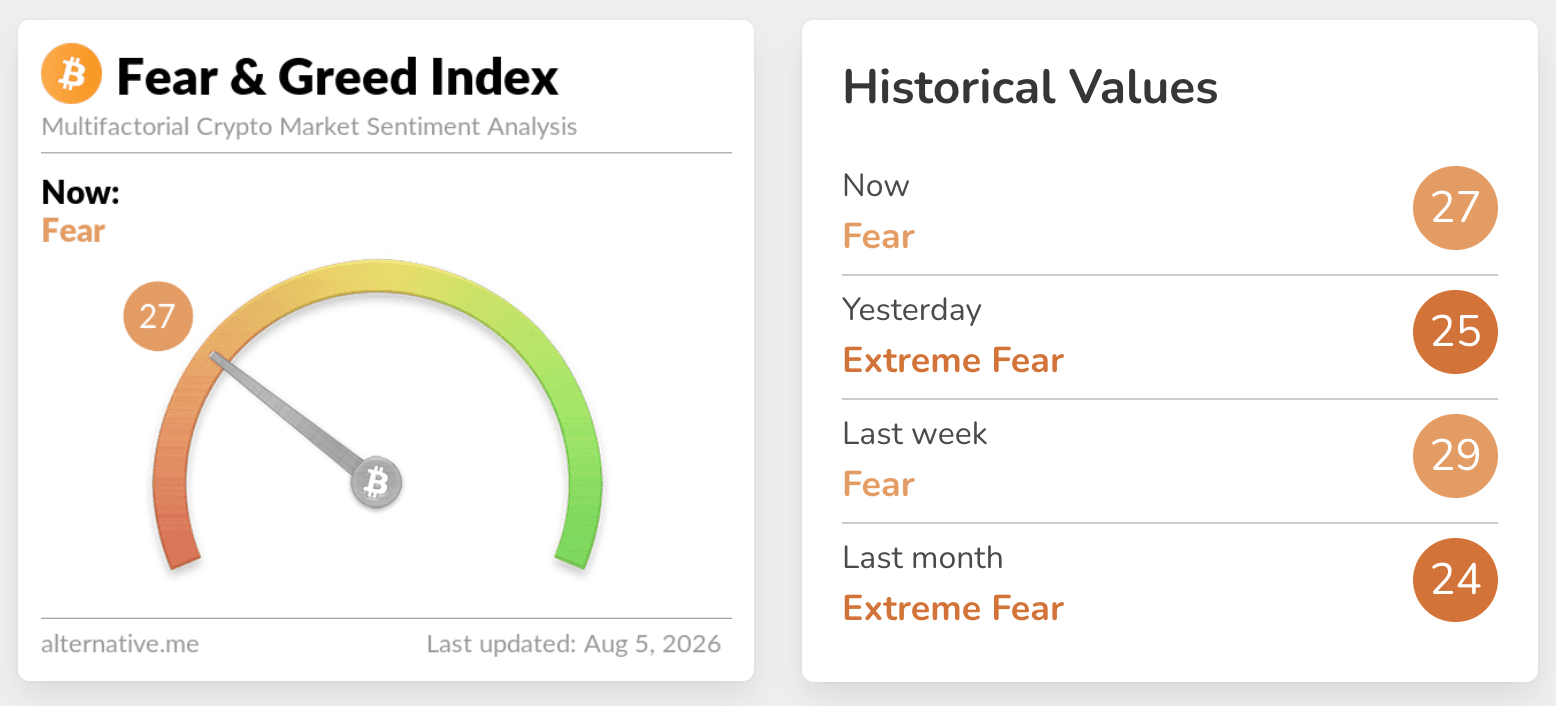
Source: Alternative
Key News Highlights:
Tether Gold Reserves Rise 9.5% During Gold’s Worst Quarter in 13 Years
Tether Gold, the gold-backed token issued by stablecoin company Tether, recorded a notable increase in reserves during the second quarter. The physical gold reserves backing XAUt rose by 9.5%, reflecting continued demand for tokenized gold exposure. This growth came as gold posted its worst quarterly performance since the second quarter of 2013. International gold prices fell by 14.1% during the period. Tether CEO Paolo Ardoino said XAUt holders do not only buy when gold prices are rising. They also use periods of market weakness to increase their exposure to physical gold through a fully backed and transparent product that can be transferred on-chain. Relevant data shows that the total value of distributed tokenized commodities fell by 4.2% over the past 30 days to USD 4.58 billion. However, the number of holders increased by 6.5% to 253,000 during the same period. XAUt’s physical gold reserves had already increased by 36% in the first quarter to 707,747 fine troy ounces. The reserves were valued at approximately USD 3.3 billion at the end of the quarter. XAUt also received Shariah certification from an Islamic finance advisory firm in July. This development may broaden compliance access to the product among Islamic financial institutions. XAUt remains the largest distributed tokenized commodity product, with a total value of approximately USD 2.4 billion.
US and UK Reaffirm Support for Stablecoins and Tokenization in Joint Regulatory Talks
The United States and the United Kingdom recently held a bilateral financial regulatory meeting and showed strong alignment on digital asset policy and regulatory coordination. Senior officials discussed stablecoin regulation, the U.S. digital asset market structure, tokenization, and the UK’s Wholesale Financial Markets Digital Strategy during the 13th meeting of the UK-US Financial Regulatory Working Group in London. A joint statement said U.S. officials updated their UK counterparts on the implementation of the GENIUS Act. They also outlined ongoing work on the country’s digital asset market structure. The meeting did not result in new regulatory restrictions or policy measures. However, it reinforced the commitment of both countries to supporting responsible digital asset innovation while maintaining financial stability and international regulatory cooperation. The Transatlantic Taskforce for Markets of the Future had previously published its initial recommendations and a joint statement on stablecoins. These initiatives are intended to support continued cooperation in financial innovation and capital markets. As U.S. legislation moves forward, UK policymakers and industry participants are also reassessing the country’s stablecoin framework. Some industry observers believe the UK is accelerating its response to remain competitive in the digital asset sector. The Bank of England has also adopted a more flexible regulatory stance. It is reviewing whether temporary stablecoin holding limits are necessary and whether proposed reserve allocation requirements should be adjusted.
Galaxy Digital Research Team Identifies at Least 15 Attackers Behind Coldcard Exploit
Crypto research firm Galaxy Digital recently said it had identified at least 15 actors who exploited a vulnerability in the Coldcard hardware wallet. Estimated losses from the incident have reached USD 100 million. After four separate waves of attacks, the total could rise to USD 130 million. Galaxy head of research Alex Thorn said new victim reports helped researchers uncover several attackers who had not previously been identified. One attacker allegedly transferred 12 BTC from 126 addresses after a victim reported losing less than 1 BTC. Unlike attacks involving centralized trading platforms, this exploit involved multiple independent addresses and actors. The decentralized movement of funds has made it more difficult to trace the transactions and identify everyone involved. The incident has renewed discussion around hardware wallet security and the role of artificial intelligence in vulnerability research. Some industry participants believe low-cost AI security testing might have helped identify the flaw earlier. Several AI models were reportedly able to rediscover the underlying issue within minutes after the vulnerability became public. However, data analysts have noted that the existing tests lacked rigorous validation conditions. The results do not prove that AI could have independently discovered the same flaw before it was disclosed. Security experts have also said that a firmware issue in Coldcard reduced the entropy used during private key generation. This may have been one of the main factors that made the vulnerability easier to exploit.
Disclaimer: The information provided in this section is for informational purposes only and doesn't represent any investment advice or FameEX's official view.