FameEX Today’s Crypto News Recap | October 21, 2026
2026-10-21 06:57:08

Qubic resumes after a hack while ZEC token jumps 11% on NU7 news and Solana's Alpenglow upgrade targets 150ms finality. Today’s BTC is near $82.7K amid Greed sentiment. The cryptocurrency market continued its short-term recovery, with Bitcoin (BTC) trading near $82,700 after gaining approximately 1.3% over the past 24 hours. Ethereum (ETH) traded around $2,447, up roughly 2.1% during the same period. As major cryptocurrencies recovered, the Crypto Fear & Greed Index rose from 55 to 63 and remained in the Greed zone. This shift indicated an improvement in investor risk appetite. According to Coinglass, total liquidations across the cryptocurrency derivatives market reached approximately USD 279 million over the past 24 hours. Long liquidations accounted for USD 84.7243 million, while short liquidations totaled approximately USD 194 million. The significantly higher volume of short liquidations reflected the forced closure of leveraged bearish positions during the market recovery. Bitcoin recorded approximately USD 48.83 million in short liquidations, while Ethereum saw around USD 64.3033 million. Meanwhile, spot ETF flows showed a different pattern. According to SoSoValue, U.S. spot Bitcoin ETFs recorded net inflows of USD 23.1624 million on October 20. BlackRock's IBIT led with daily net inflows of USD 29.865 million. In contrast, U.S. spot Ethereum ETFs registered net outflows of USD 26.1343 million on the same trading day, marking their fifth consecutive session of net outflows. BlackRock's ETHA recorded daily net outflows of USD 33.0183 million. The divergence between Bitcoin and Ethereum ETF flows suggests that institutional capital has yet to return consistently across both assets. Overall, the cryptocurrency market is currently characterized by recovering prices, increased short liquidations and diverging ETF capital flows. Short-term market conditions continue to reflect the combined effects of leveraged position adjustments and changes in spot market capital allocation.
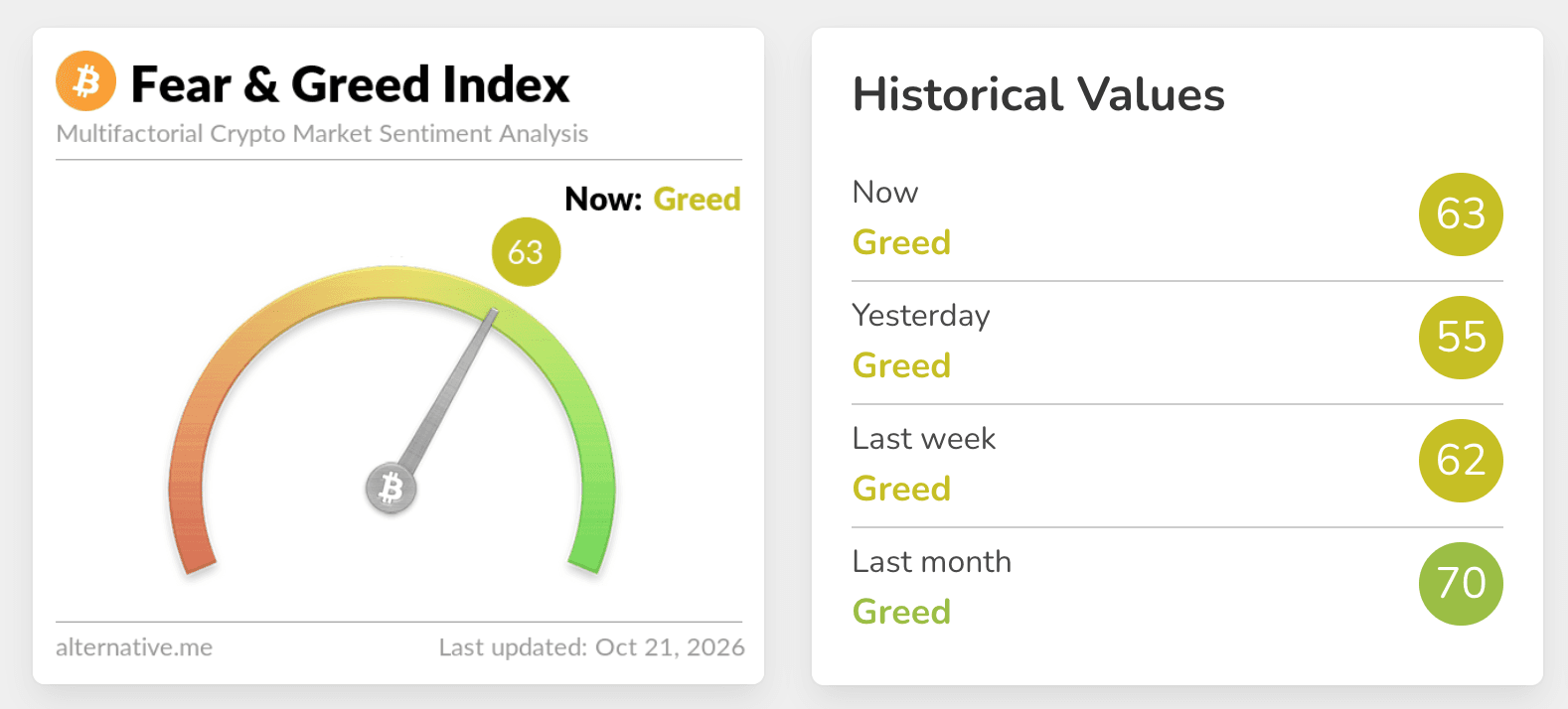
Source: Alternative
Key News Highlights:
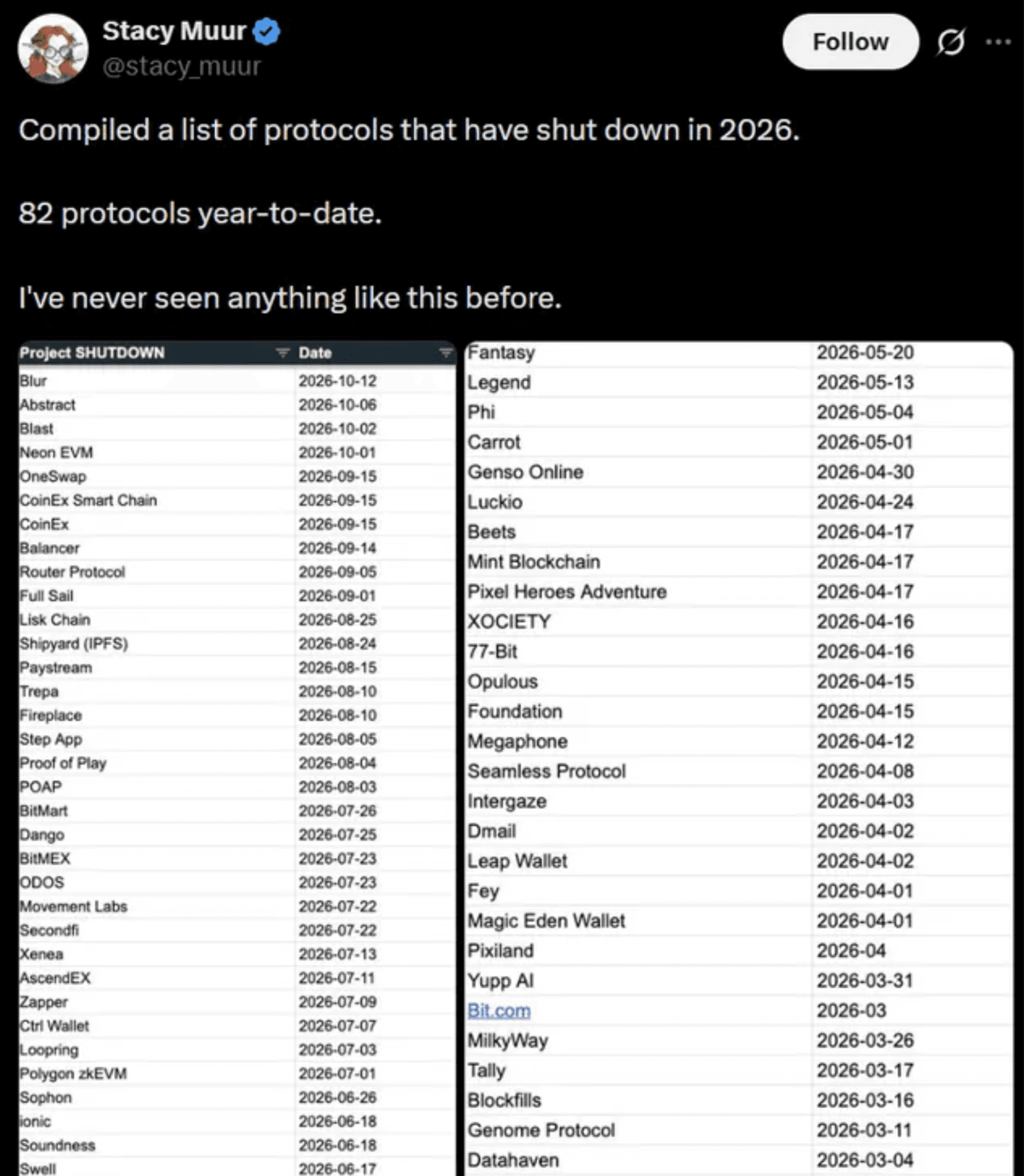
82 Crypto Projects Shut Down In 2026 As Funding Shortages And Weak Revenue Take Their Toll
According to data published by crypto researcher Stacy Muur, at least 82 cryptocurrency projects and protocols have been identified as having shut down in 2026. The closures span multiple sectors, including decentralized finance (DeFi), blockchain infrastructure and Web3 gaming. The list includes Balancer, Radiant Capital, Neon EVM and Step Finance. These cases highlight the financial and operational difficulties facing cryptocurrency businesses throughout the year. Among the notable examples is Blast, an Ethereum Layer 2 network that announced its shutdown earlier this month. The team stated that its existing business model no longer had a credible path to economic sustainability. Blast had previously attracted more than USD 2 billion in deposits. Other projects ceased operations following security incidents or financial difficulties. Step Finance shut down in February after suffering a major treasury security breach. Radiant Capital announced plans to wind down operations in June after failing to recover from a security exploit in 2024. Meanwhile, Satori Finance also discontinued its services after reviewing its existing revenue and operating costs. Its closure demonstrates how projects with established products and user bases can still struggle to generate enough revenue to sustain daily operations. A separate study published by DefiLlama in August identified 100 cryptocurrency projects that had announced shutdowns during 2026. Among them, 40 projects had announced closures within the preceding 90 days. The research identified a lack of product-market fit as the most frequently cited reason for these shutdowns. Other contributing factors included depleted operating capital, insufficient revenue and decisions to shift toward different business models. According to DefiLlama, the projects covered in its study had collectively raised approximately USD 1 billion in funding and generated around USD 250 million in cumulative fee revenue. These findings show that substantial financial backing does not necessarily ensure the long-term sustainability of cryptocurrency businesses.
Qubic Resumes Blockchain Operations After USD 1.4 Million Hack And Opens Asset Recovery Claims
Layer 1 blockchain project Qubic resumed network operations on October 19 and officially launched an asset recovery process following a security incident that resulted in the theft of approximately USD 1.4 million worth of QU tokens. According to information released by the project team, the incident affected 1,404 accounts. Attackers exploited a vulnerability involving predictable wallet seeds generated by certain wallet software. This weakness allowed them to gain control of affected wallets and transfer their assets. Wallet seeds contain essential information used to generate and recover cryptocurrency private keys. If the seed generation process lacks sufficient randomness, attackers may be able to reconstruct credentials that should remain private. Qubic explained that the vulnerability primarily affected web wallets created through certain Apple devices and browsers. The issue was linked to an insecure random-number generation process in specific environments. To prevent further movement of stolen assets, Qubic temporarily halted blockchain operations on October 18. Following security fixes and coordination among validators, the network resumed processing transactions on the evening of October 19. Its validator group, known as Computors, also approved an asset recovery plan. According to Qubic's official announcement, affected users can verify their wallet addresses and submit claims through the project's official recovery platform. The submission deadline is May 1, 2027. However, the launch of the claims process does not mean that all losses have already been reimbursed. Qubic also confirmed that the wallet seed generation vulnerability was fixed in web wallet version 4.26.4, released on October 19. The team warned that wallets created using older versions should still be considered potentially compromised even if no unauthorized transactions have been detected. Affected users are advised to update their wallet software, create new wallet addresses and transfer their assets to wallets generated using the secure version. These measures are intended to prevent continued use of potentially vulnerable wallet credentials.
Bitcoin Recovers Toward $83K As ZEC Jumps 11% Following NU7 Upgrade Announcement
Most cryptocurrencies recorded a broad recovery as Bitcoin climbed above $82,700 and approached the $83K level. The cryptocurrency gained approximately 1.3% over the past 24 hours. During the same period, Asian technology stocks advanced following earnings announcements from major U.S. technology companies. AI-related equities showed particularly strong performance, while South Korea's KOSPI index rose approximately 3.7%. In the cryptocurrency market, Zcash (ZEC) emerged as one of the strongest-performing major assets. Its price surged approximately 11% and briefly approached $1,260. The increase followed confirmation from Zcash developers of the mainnet activation block height for the upcoming NU7 network upgrade. The activation height specifies the block at which network nodes begin processing transactions under the updated protocol rules. According to the development roadmap, NU7 will reduce Zcash's block production time from approximately 75 seconds to 25 seconds. This adjustment will triple the frequency of new block production and shorten the waiting time for transactions to be included in a block. The upgrade also introduces changes to the network's transaction fee distribution mechanism. Under the proposed structure, approximately 60% of transaction fees will be allocated to a reserve and distributed over subsequent periods according to the protocol's rules. NU7 has been running on the testnet since early October. The announcement of its mainnet activation height provides a clearer schedule for the transition to the new protocol rules. Beyond ZEC, HYPE and DOGE each gained more than 3%, while XRP advanced nearly 3% to approximately $1.33. Ethereum rose around 2% to nearly $2,450, and both BNB and SOL recorded gains of approximately 1% to 2%. The broader cryptocurrency market recovered alongside the rebound in technology stocks and announcements of several blockchain network upgrades. However, price performance continued to vary across individual assets. These figures reflect market conditions during the reporting period and do not indicate future price direction.
Solana Prepares To Launch Alpenglow Mainnet Upgrade With 150-Millisecond Finality Target
Solana is scheduled to activate its Alpenglow mainnet upgrade on October 21. The upgrade represents one of the network's most significant consensus mechanism changes since 2020. Its primary objective is to improve how validators confirm transactions and reduce the time required for transactions to reach finality. Under the proposed framework, Alpenglow will replace Solana's long-standing TowerBFT consensus mechanism with a new validator voting process. The upgrade aims to reduce transaction finality from approximately six seconds to around 150 milliseconds. Transaction finality refers to the point at which a transaction has been confirmed by the network and can no longer be reversed under normal protocol conditions. This process is particularly important for payments, asset transfers and transaction settlement. Under Solana's existing architecture, validators submit their votes directly to the blockchain. Alpenglow introduces an alternative approach that moves the voting process off-chain and uses aggregated voting certificates to finalize transactions. This mechanism is intended to reduce the amount of on-chain block space consumed by consensus voting. Because validator votes currently account for a substantial share of recorded on-chain transactions, publicly reported transaction counts may decline significantly after the upgrade. However, such a decline would not necessarily indicate a reduction in actual user transaction activity. The upgrade is also expected to change the operating costs for validators. Under the existing mechanism, validators may spend approximately 2 SOL per day on voting fees. Alpenglow plans to replace these charges with a fixed validator admission fee of 0.8 SOL per epoch. This change is expected to reduce the relevant costs by approximately 60%. Before its planned mainnet deployment, Alpenglow underwent several months of testing. The testnet was restarted six times after its initial launch in May. One consensus migration attempt failed and required a rollback before subsequent testing successfully completed the transition. According to the deployment schedule, the upgrade process will begin at epoch 1064. The network is expected to transition to the new consensus mechanism at slot 459,653,000 following a 5,000-slot transition period. The actual activation status and performance improvements will need to be confirmed through mainnet operating data. Therefore, the 150-millisecond finality figure remains a technical target rather than a performance level already verified on the live network.
Disclaimer: The information provided in this section is for informational purposes only and doesn't represent any investment advice or FameEX's official view.