DEGO (Dego Finance) Token Price & Latest Live Chart
2026-03-12 11:11:51
What is DEGO (Dego Finance)?
Dego Finance is a Web3 innovation incubator and decentralized protocol built on blockchain infrastructure. Its core vision is to create a stack of decentralized financial building blocks that can be combined much like LEGO pieces. When the project entered the market in 2020, its original focus was to address two structural limitations in the NFT and DeFi sectors. Unlike traditional NFTs that were often treated as little more than digital collectibles, DEGO was designed to give virtual assets real financial properties. Under this model, each NFT could function as an asset with embedded economic value rather than a static token of ownership. That design challenged the market’s early view of NFTs as simply images and pushed them toward a more functional role where ownership and economic utility are tightly linked. Therefore, Dego Finance positioned itself as foundational infrastructure for a more standardized decentralized economy.

As a multi-chain infrastructure layer, Dego Finance extends across Ethereum, BNB Chain, and the Bitcoin ecosystem, which has been expanding more actively in recent years. It is not just a marketplace or a token issuance venue. It operates more like an incubation environment for new blockchain-native projects, with exposure to sectors such as DePIN, DeSci, and the GameFi sector. By offering modular development tools, DEGO allows other teams to plug in NFT minting, staking, and auction features without rebuilding the entire underlying framework from scratch. This open architecture lowers the technical barrier for product deployment and makes it easier to combine complex financial logic with digital asset interaction. The result is a framework that helps move blockchain applications closer to practical adoption rather than keeping them locked inside isolated experiments.
Across its longer development cycle, Dego Finance has shown a strong ability to adapt and reposition itself. The project launched in 2020, at a time when demand for NFT infrastructure was rising in the aftermath of the DeFi boom. By 2021, it had become one of the better-known examples of a hybrid NFT and DeFi narrative. Its development path did not stop at early liquidity mining or NFT experimentation. It gradually expanded into a broader incubator model that brought in BRC-20, DePIN, DeSci, GameFi, and AI-related use cases. That shift changed the meaning of the project itself. Dego was no longer just a single product line tied to one market cycle. It evolved into an onchain framework that can incubate new projects, distribute assets, package them into NFT-based interactive forms, and connect them to community governance and incentive systems. That broader function is what gives DEGO relevance beyond its original niche.
How does DEGO (Dego Finance) work?
The easiest way to understand Dego Finance is through its modular structure. The platform is not built as a monolithic application that handles everything internally. Instead, different functions are assigned to separate modules, and those modules are connected through DEGO tokens and onchain smart contracts. This architecture gives each module room to serve a different use case while still sharing the same economic and governance layer. Delta is used for project launches and staking-based distribution. Defusion focuses on AI-generated content and NFT creation. NFT Foundry is responsible for asset packaging and minting. NFT Mining turns NFTs into productive assets. Auctions handle bidding and price discovery. Governance tools such as DeVote allow the community to participate in decision-making. For users, this means Dego is not limited to one narrow action. It is a system that can connect issuance, participation, creation, trading, governance, and rewards into one continuous experience. For outside projects, it means they can build on top of existing modules instead of spending time rebuilding core infrastructure.
One of Dego Finance’s most recognizable mechanisms is its deposit-backed NFT minting model. In NFT Foundry, users can deposit DEGO, ERC-20 tokens, or BEP-20 tokens and mint NFTs with different attributes and rarity grades. The key point is not the visual output or the collectible label. What matters is that the NFT is backed by real underlying token deposits locked into the minting process. That gives the NFT a clearer economic foundation. When the holder chooses to decompose the NFT, the originally deposited assets can be released. This two-way structure between minting and decomposition makes the NFT function more like an asset wrapper or a basket-like instrument rather than a purely speculative collectible. It reduces the extent to which value depends only on subjective market pricing and gives the NFT a more direct link to embedded onchain capital.
Once an NFT is treated as an onchain asset with economic backing and programmable attributes, it can be used in more productive ways. That is where NFT Mining becomes important. In Dego’s earlier design, NFTs with different grades and power values influenced mining efficiency and reward allocation. Users who held different classes of assets could join mining pools and turn NFTs from static ownership records into yield-generating instruments. This matters because Dego did not treat NFTs as decorative extras attached to the protocol. It integrated them into DeFi logic itself. In this system, NFTs are not just for display but also for trading. They become part of reward generation, participation incentives, and user retention inside the protocol. That creates a real distinction between Dego Finance and a standard NFT marketplace, because Dego is built around asset function rather than simple asset circulation.
Beyond basic asset interaction, DEGO also built a broader product matrix that includes the Delta launchpad, the Defusion generative AI layer, and the DeVote governance platform. Delta acts as the ecosystem’s entry point for project distribution and token staking. Defusion uses AI tools to help users generate original visual assets and convert them into NFTs, which brings creative production and tokenized ownership into the same workflow. All of these processes are executed through decentralized smart contracts, with public and private key cryptography ensuring that asset transfers can only be authorized by the owner. As the project expands toward Bitcoin Layer 2 infrastructure, this modular model is increasingly taking the form of a cross-chain service layer. That allows assets from different networks to interact with the DEGO protocol and participate in more complex financial flows and governance structures.
DEGO (Dego Finance) market price & tokenomics
The DEGO token sits at the center of the ecosystem, and its total supply is capped at 21,000,000 tokens. That fixed supply introduces a scarcity framework that echoes the broader logic seen in supply-limited digital assets. The token allocation structure is clearly defined. Half of the total supply, or 50%, is reserved for mining rewards, which is meant to attract long-term participants and support network activity. The remaining supply is distributed across the treasury, public sale, DAO-related allocation, airdrop rewards, and liquidity provisioning. An especially notable part of DEGO’s earlier design is its deflationary and value capture model. In the earlier token structure, each transaction carried a fee, with one portion burned to reduce circulating supply and another directed into a dividend pool for token holders. This meant the token’s value logic was not designed to rely only on speculation. It was also tied to actual ecosystem usage.
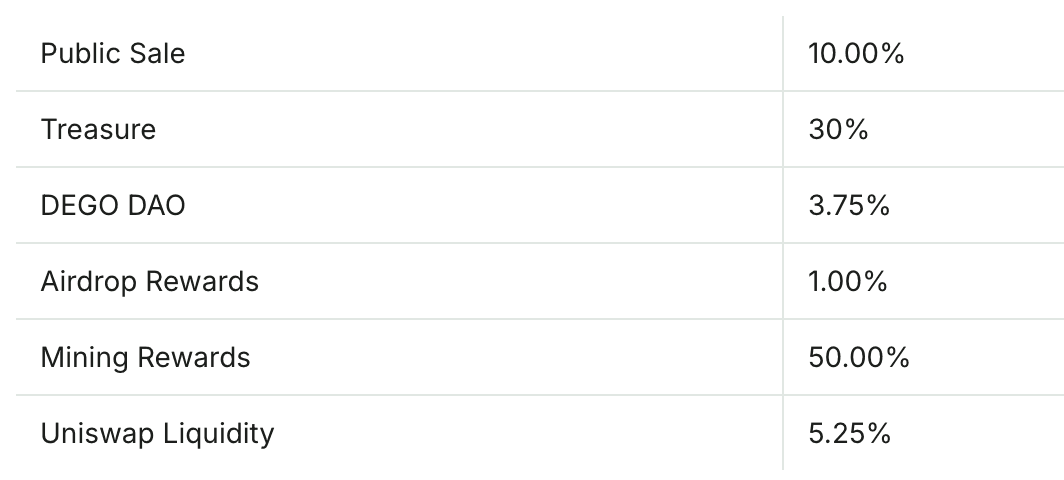
$DEGO Token Allocation, Source: https://docs.dego.finance/master/token
At the functional level, DEGO serves multiple roles inside the protocol. First, it is a required medium for core NFT-related actions. Whether users are adding value during minting or placing bids in auction environments, the token plays an operational role. Second, it acts as the governance credential for the platform. Through governance tools such as Snapshot, token holders can vote on parameter changes, feature rollouts, and treasury-related decisions. As of March 2026, DEGO had already been deployed across Ethereum, BNB Chain, and Solana, which significantly improved its cross-chain circulation and made it easier for the token to move across different decentralized trading environments. On March 10, 2026, DEGO showed a clear intraday rally with the 24-hour gain of 15.72%. Circulating supply stood at 20,997,213 tokens. That move was widely linked to changes in internal supply structure, especially as a higher staking ratio locked more tokens out of liquid circulation and amplified price sensitivity. At the same time, rising community attention and stronger trading activity reflected growing market focus on DEGO’s next phase.
Why do you invest in DEGO (Dego Finance)?
The core appeal of participating in Dego Finance comes from its role as a Web3 incubator and the early-stage exposure that model can create. For users, DEGO opens a lower-friction path into emerging blockchain projects, especially through the Delta Launchpad. Users who hold and stake DEGO can gain access to allocation opportunities tied to new assets, including projects connected to the BRC-20 and Bitcoin ecosystem. That is not just passive exposure to a token. It is a way to participate more directly in the rollout of new onchain narratives and infrastructure. Because Dego continues to position itself around Bitcoin ecosystem expansion and AI-related development, the assets moving through its ecosystem can carry both narrative relevance and early-mover value. This shift from simple platform user to ecosystem participant is one of the clearest ways DEGO differs from a standard exchange-driven model.
Another important part of the DEGO framework is the multifunctional nature of its assets. Capital inside the ecosystem is not designed to remain idle. Tokens can be turned into NFTs, used for mining, entered into auctions, or circulated in secondary markets. This NFT and DeFi combination increases capital efficiency by allowing the same asset base to serve different roles across multiple contexts. At the same time, the project’s decentralized governance structure gives community members actual influence over the direction of the protocol. Through voting, participants can help shape future development and major ecosystem decisions. That bottom-up structure reflects one of the original principles of blockchain systems, the idea that participants should not only use the network, but also have a voice in how it evolves. In that sense, the value of DEGO is tied not only to token exposure but also to the ability to take part in a broader onchain coordination system.
Is DEGO (Dego Finance) a good investment?
The reason DEGO is worth studying does not come from its size or from whether it sits inside the most dominant group of crypto assets. Its value as a research subject comes from the fact that it offers a clear example of how a platform-style Web3 project can move across multiple narrative cycles without becoming structurally irrelevant. Its significance comes from three main areas. First, it combined NFTs and DeFi at an early stage and served as an experiment in functional NFTs. Second, it later evolved into a broader incubator model, which shows how a mid-sized protocol can extend its lifecycle through modular expansion. Third, even after security setbacks and a loss of earlier market momentum, it continued trying to define a new phase through Delta, Defusion, and broader ecosystem collaboration. That makes DEGO more than a token for price tracking. It is also a useful case for understanding product evolution, narrative migration, and the relationship between platform demand and token utility. Its importance does not come from any promise of guaranteed upside. It comes from how clearly it illustrates the attempt to place asset issuance, NFT utility, community governance, and project incubation inside one coordinated design.
Dego’s strengths are relatively clear. It has a fixed total supply, a defined token role, and a modular product structure that can expand across new sectors. It has also retained development and partnership activity after moving through several market phases. Its limitations are equally clear. The key questions are whether its modules can sustain meaningful real usage, whether the incubator model can continue producing relevant projects, whether its NFT and AIGC tools can build lasting retention in a competitive market, and whether confidence has been fully rebuilt after earlier security events. The most useful way to assess DEGO is not to ask whether the token can rise in price. A better question is whether the product still creates demand that cannot be easily replaced, whether the DEGO token remains necessary for accessing that demand, and whether ecosystem partnerships can translate into stable users and asset flows rather than short-lived attention. If those conditions are not met, the token risks reverting to a purely tradable symbol. If they are met over time, DEGO has a stronger case for functioning as the core asset of a real platform economy.
Explore the latest DEGO (Dego Finance) price and live chart, trade DEGO on FameEX, and access real-time market data! Get started now with a seamless trading experience!
Disclaimer: The information provided in this article is intended only for educational and reference purposes and should not be considered investment advice. Conduct your own research and seek advice from a professional financial advisor before making any investment decisions. FameEX is not liable for any direct or indirect losses incurred from the use of or reliance on the information in this article.