FameEX Today’s Crypto News Recap | July 27, 2026
2026-07-27 07:05:29

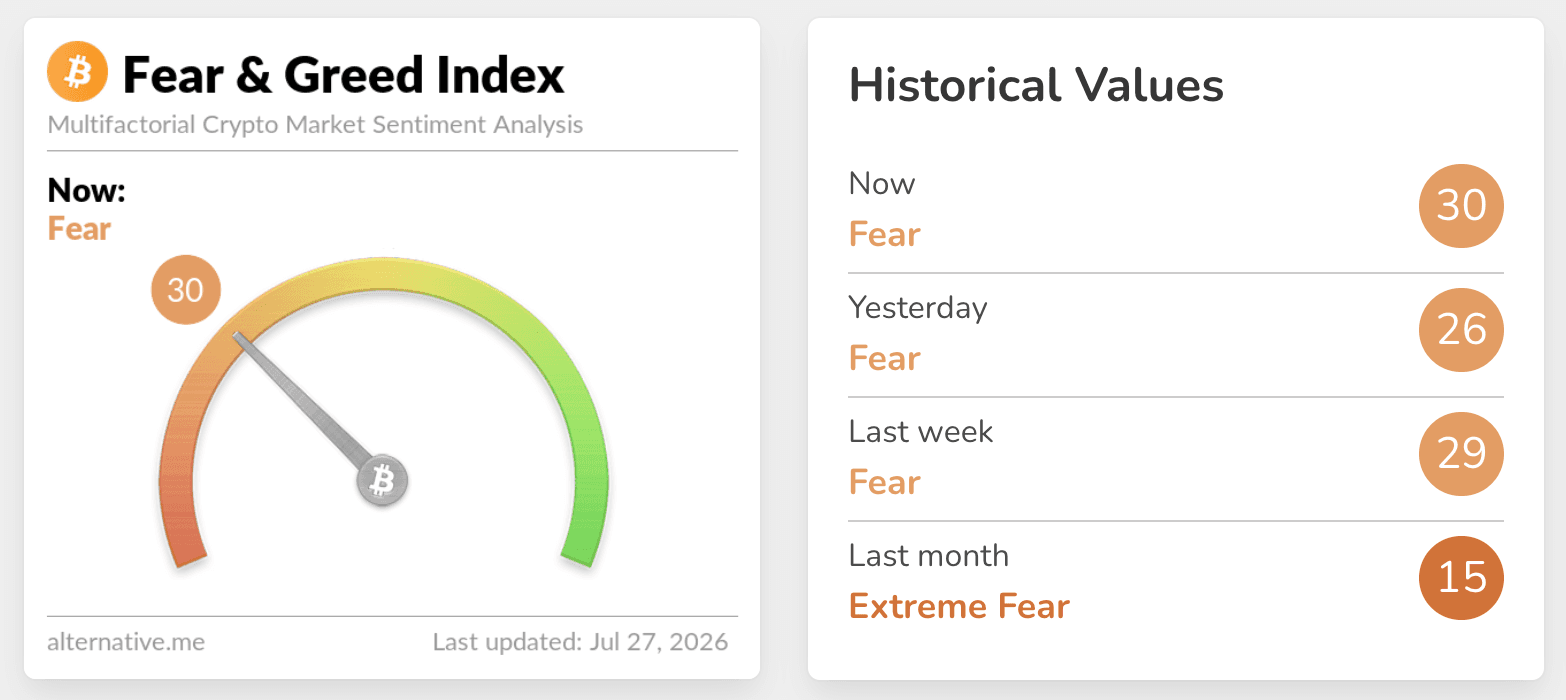
Garden Finance paused its app after a solver breach, Storj filed for Chapter 11, while Sberbank advanced crypto infrastructure; today, the BTC rose above $65K. Bitcoin has staged a technical rebound after its Relative Strength Index (RSI) fell into oversold territory near 30. The indicator has since recovered to around 50, while the spot price has moved back above $65K with a modest 24-hour gain of approximately 1.07%. However, the descending trendline that has remained in place since Bitcoin reached a high of around $125,000 in June 2025 continues to limit the recovery. Whether Bitcoin can achieve a sustained breakout will depend on the strength and continuity of market inflows. In the derivatives market, total liquidations reached USD 215 million over the past 24 hours. Short liquidations accounted for USD 160 million, far exceeding the USD 54.824 million recorded in long liquidations. This suggests that short-covering activity contributed to the recent price recovery. If Bitcoin moves above $67,456, cumulative short liquidation intensity across major CEXs could rise to USD 614 million. A decline below $61,627 could expose an equivalent amount of leveraged long positions to liquidation. For Ether, a move above $2,001 could bring cumulative short liquidation intensity across major CEXs to approximately USD 342 million. A drop below $1,818 could place up to USD 720 million in leveraged long positions under liquidation pressure. Institutional capital flows continued to provide broader market support. U.S. spot Bitcoin ETFs recorded USD 33.79 million in net inflows last week, while spot Ether ETFs attracted USD 104 million. Both categories have now posted net inflows for three consecutive weeks. Spot Solana ETFs also received USD 7.2 million in net inflows during the same period. On-chain data showed that large holders continued to build positions. One whale withdrew another 120 WBTC over the past several hours, bringing the combined value of its ETH and WBTC positions accumulated since July to USD 156 million. Meanwhile, the Crypto Fear and Greed Index rose from 26 yesterday to 30, but remained in the Fear zone. Whale accumulation, institutional buying at lower price levels, and a higher opening in U.S. stock futures have collectively supported the market’s current stabilization process.
Source: Alternative
Key News Highlights:
Garden Finance Pauses App After Independent Solver’s Off-Chain Database Is Compromised
Cross-chain bridge and atomic swap protocol Garden Finance recently announced the temporary suspension of its application after the off-chain database of an independent solver within its network was accessed without authorization. Blockchain security firm Blockaid initially reported that an attacker had transferred approximately USD 450,000 in USDT from hash time-locked contracts (HTLCs) deployed across Ethereum, Base, Arbitrum, and BNB Chain. However, a Garden Finance spokesperson later clarified that the incident only affected assets owned by the independent solver. The protocol itself and its underlying HTLC smart contracts were not compromised. User funds were not lost or placed at risk. According to Garden Finance, the attacker gained access to the solver’s off-chain database and inserted fraudulent transaction records. This caused the solver’s system to release assets for swap transactions that had not been funded by the counterparties. Garden Finance paused the application as a precaution while it isolated the affected infrastructure and conducted a full system review. The protocol is working closely with security teams, including zeroShadow, Quantstamp, and Blockaid together to investigate the incident and trace the transferred assets. Garden Finance said services would resume after all security checks had been completed and the affected systems had been fully contained.
Decentralized Storage Project Storj Files for Chapter 11 and Explores Equity Path for Tokenholders
Decentralized cloud storage provider Storj Labs has formally filed for Chapter 11 bankruptcy protection in the U.S. Bankruptcy Court for the Northern District of West Virginia. The filing is intended to restructure liabilities accumulated during the company’s earlier operating periods. In an open letter to its community, Storj said most of its current obligations were created before the implementation of its present business strategy. The company concluded that normal business growth alone would not be sufficient to resolve these liabilities. It therefore chose a court-supervised restructuring process to reorganize its financial and capital structure. Storj said its network operations and customer services would continue as usual during the proceedings. Its parent company, Inveniam, will also continue to support the business. The utility of the STORJ token within the network remains unchanged. Storj management is also exploring a mechanism that could allow STORJ tokenholders to participate in the equity of the reorganized company. The proposal could become a rare example of a decentralized infrastructure project attempting to connect tokenholder interests with corporate ownership during bankruptcy proceedings. However, details such as eligibility requirements, snapshot criteria, lockup conditions, and equity allocation have not been disclosed. Any final arrangement would also require approval from the bankruptcy court. The market reaction remained limited following the announcement, with STORJ trading near $0.072.
Russia’s Largest Bank Plans to Launch Crypto Trading Infrastructure by December 2026
Sberbank, Russia’s largest state-owned commercial bank, has announced plans to complete its cryptocurrency trading infrastructure by December 1, 2026. The project will include the establishment of a dedicated digital depository. This system will record clients’ ownership rights over crypto assets and process a significant portion of transaction settlements outside the main blockchain. Sberbank will also operate active wallets to execute client instructions for deposits, withdrawals, and cross-border transfers. The initiative comes as Russian lawmakers accelerate the final review of legislation intended to bring cryptocurrency trading, custody, and settlement into the country’s regulated financial system. The proposed framework would also allow crypto assets to be used in certain cross-border trade settlements. The Bank of Russia is expected to receive broad authority over the regulated market and will determine which assets may be offered through licensed intermediaries. It has also established specific liquidity requirements. Eligible assets must maintain an average market capitalization of more than 5 trillion rubles, or approximately USD 64 billion, and an average daily trading volume above 1 trillion rubles, or approximately USD 12.8 billion, over two years. With the regulatory framework expected to take effect on September 1, 2026, Russia is accelerating the development of domestic crypto infrastructure to support cross-border payments under an increasingly restrictive international sanctions environment.
Payment Firm Triple-A Confirms Treasury Wallet Breach and USD 11.8 Million Loss
Singapore-based regulated stablecoin payments company Triple-A has confirmed that unauthorized access to its internal treasury wallets resulted in the transfer of company-owned digital assets. On-chain investigators estimated that the incident caused losses of approximately USD 11.8 million. Triple-A placed certain services into maintenance mode for around three hours to isolate the affected systems and implement additional security measures. All payment and settlement services were subsequently restored. The company emphasized that no client funds were affected. Triple-A does not custody digital assets on behalf of its customers, and client funds are held separately in safeguarded trust accounts. This structure keeps customer assets fully segregated from the company’s operational funds. Triple-A said the losses would be absorbed through its internal treasury reserves and would not affect normal business operations. The company is currently working with external cybersecurity specialists, blockchain forensics firms, and law enforcement agencies, including the Singapore Police Force. The investigation is focused on determining how the wallets were accessed, tracing the transferred assets, and supporting potential recovery efforts.
Disclaimer: The information provided in this section is for informational purposes only and doesn't represent any investment advice or FameEX's official view.