FameEX Today’s Crypto News Recap | October 6, 2026
2026-10-06 07:28:56

Today’s most important crypto market developments center on U.S. regulation, regulated crypto investment products, Ethereum infrastructure, and corporate crypto treasuries. The U.S. Commodity Futures Trading Commission (CFTC) has launched an early-stage rulemaking process for retail crypto asset transactions and related markets. The initiative seeks to establish a clearer federal regulatory framework under the agency’s existing authority in the Commodity Exchange Act. Meanwhile, the U.S. Securities and Exchange Commission (SEC) has formally approved a Cboe BZX rule change covering 3x Bitcoin and Ether products. Ethereum’s Glamsterdam upgrade is scheduled to activate on the Sepolia testnet later today, while a mainnet date has not yet been set. On the corporate treasury side, the latest regulatory filings from Strategy and Strive both show higher Bitcoin holdings.
Bitcoin and Ethereum Market Overview
As of around 13:00 (UTC+8) today, Bitcoin was trading near $82,700. Data tracked by Coinalyze showed Bitcoin futures open interest at approximately $27.7 billion, while Ethereum open interest stood near $18.3 billion. Cross-exchange average funding rates were approximately +0.0029% for BTC and +0.0045% for ETH. Both remained slightly positive. Over the same period, Coinalyze recorded approximately $124.8 million in futures liquidations during the past 24 hours. Bitcoin accounted for roughly $40.5 million, while Ethereum accounted for about $17.3 million. The data indicate that leveraged positioning remains substantial, although funding rates have not moved into a clearly one-sided extreme. Market sentiment also remained the same while the Crypto Fear and Greed Index stood at 73 on October 6, placing the market in Greed zone. This was up from 70 a day earlier. U.S. spot ETF flow pages showed temporary cache differences while October 5 data were being updated. Subsequent cross-checks indicated net outflows of approximately $89.8 million from Bitcoin ETFs and $18.9 million from Ether ETFs.
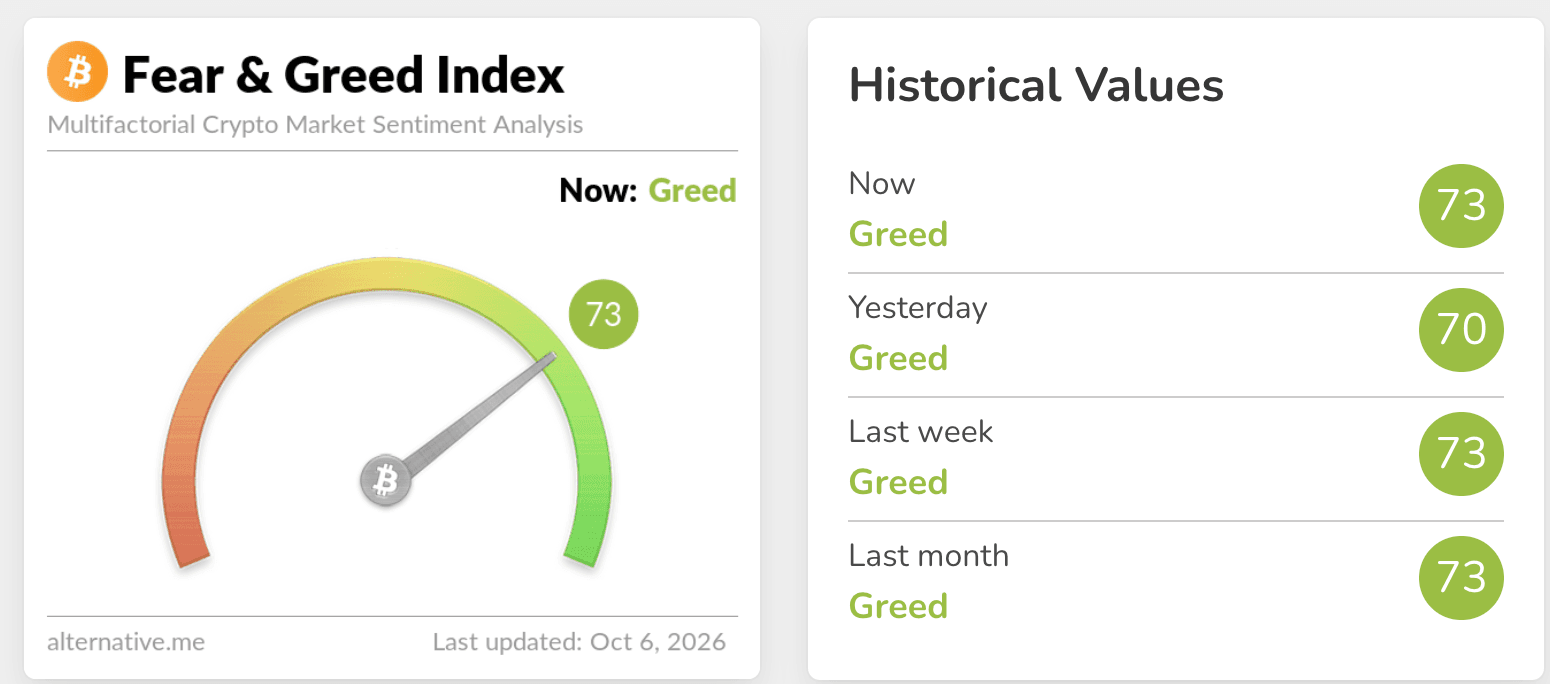
Source: Alternative
Key News Highlights:
CFTC Launches Crypto Asset Market Rulemaking Process, With Policy Still at an Early Public-Comment Stage
Key Developments
The U.S. Commodity Futures Trading Commission issued an Advanced Notice of Proposed Rulemaking on October 5 to seek public input on a future regulatory framework for crypto assets. The CFTC is primarily examining retail commodity transactions covered by Section 2(c)(2)(D) of the Commodity Exchange Act. This includes certain crypto asset transactions involving margin, leverage, or financing.
The agency plans to consider Regulation Crypto Asset Transactions (Regulation CTX). It is also evaluating a specialized Crypto Asset Market category within the existing Designated Contract Market registration framework. This could create a federal regulatory pathway for qualifying trading platforms. The CFTC said public comments will be due within 60 days after the notice is published in the Federal Register.
The most important distinction is that this remains an early consultation stage before formal rulemaking. The CFTC has not yet issued a proposed rule, and no final rule has taken effect. CFTC Chairman Michael Selig has also said that existing law allows the agency to regulate certain retail commodity transactions involving leverage, margin, or financing. However, only Congress can require all crypto asset trading platforms to register with the CFTC. The initiative therefore should not be interpreted as giving the agency comprehensive authority over the entire U.S. crypto spot market.
Sources
https://www.cftc.gov/PressRoom/PressReleases/9307-26
Background
Regulatory authority over the U.S. crypto spot market has long been fragmented. The SEC primarily oversees securities markets, while the CFTC regulates commodity derivatives. Certain leveraged, margined, or financed retail commodity transactions may also fall within the CFTC’s existing jurisdiction.By launching this early-stage rulemaking process, the CFTC is attempting to use its current statutory authority to create a clearer framework for trading platforms and consumer protection before Congress completes broader crypto market structure legislation. However, the final design remains uncertain. Registration requirements, capital standards, custody rules, and trading restrictions have not yet been determined. Feedback from market participants and the content of any future proposed rule will shape the eventual framework.
Why It Matters
The significance of this CFTC action is not that new crypto rules have already taken effect. Instead, a U.S. federal regulator is beginning to outline a more concrete framework for parts of the crypto asset market. If the rulemaking process moves forward, it could affect how retail crypto transactions involving leverage, margin, or financing are structured. It could also influence the compliance paths available to relevant trading platforms operating in the United States.
FameEX Analysis
The key development is not that the United States has introduced a new set of crypto rules. Rather, the CFTC is beginning to test how far its existing authority under the Commodity Exchange Act can be used to create a clearer federal framework for certain retail crypto asset transactions. Because the process remains at the advanced-notice stage, the market cannot yet determine the final registration requirements, capital standards, or trading restrictions. The limits of the CFTC’s jurisdiction are equally important. This initiative focuses on certain retail commodity transactions involving leverage, margin, or financing. It should not be interpreted as giving the CFTC authority over the entire U.S. crypto spot market. The next key issue is how any formal proposed rule defines the transactions that fall within scope. Market structure legislation from Congress will also remain important because it could further expand or redraw the regulatory boundaries between the SEC and CFTC.
SEC Approves Listing Rules for 3x Bitcoin and Ether Products Using Futures-Based Daily Leverage
Key Developments
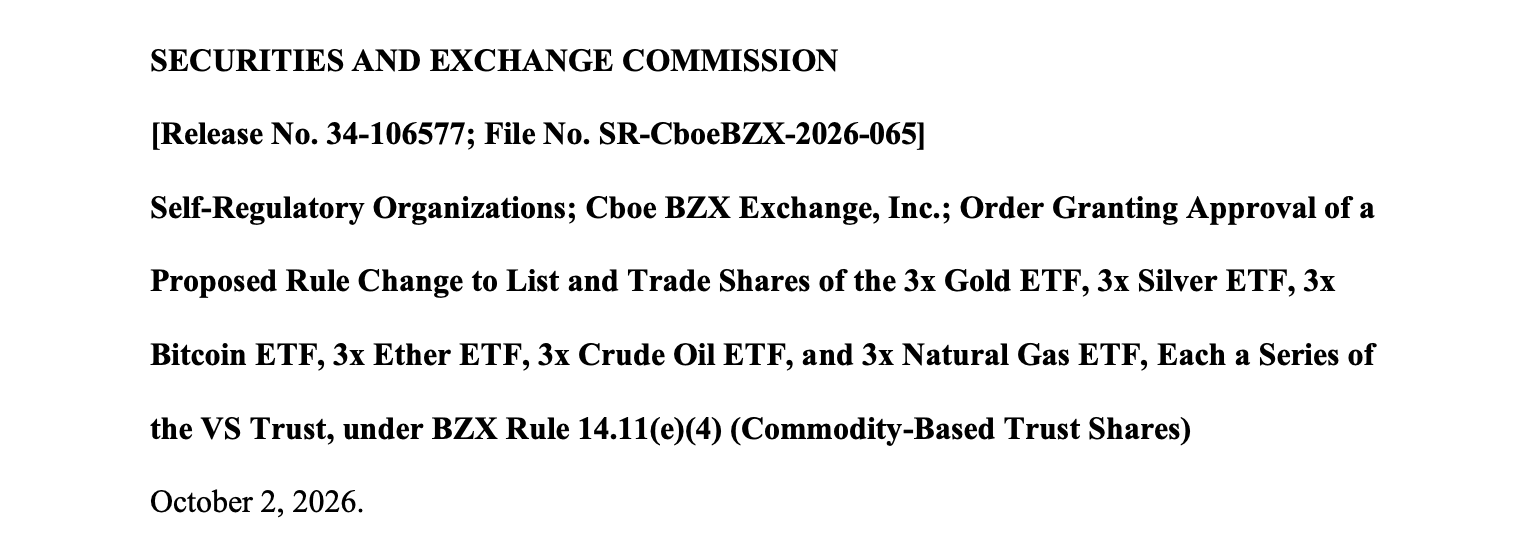
The SEC issued Release No. 34-106577 on October 2 and formally approved a rule change submitted by Cboe BZX Exchange. The approval allows products including 3x Bitcoin and 3x Ether products to be listed under BZX Rule 14.11(e)(4). Similar products covering gold, silver, crude oil, and natural gas are also included. Cboe BZX originally submitted the rule change on August 10. The related notice was published in the Federal Register on August 19. The SEC’s latest approval order explicitly confirms that the proposal has been approved.
The SEC document also explains an important structural distinction. Although the products use “ETF” in their names, they are classified as Commodity-Based Trust Shares under BZX Rule 14.11(e)(4). They therefore fall within the broader category of exchange-traded products. The Bitcoin and Ether products seek investment results equal to three times the daily performance of their respective benchmarks before fees and expenses. Those benchmarks are primarily constructed using first- and second-month futures contracts. The products do not simply hold three times as much spot BTC or ETH. Their leveraged exposure is created through a futures-based structure.
Sources
https://www.sec.gov/rule-release/34-106577
Background
Leveraged exchange-traded products generally target a multiple of a benchmark’s daily return. Their exposure is typically reset each day through derivatives and portfolio rebalancing. As a result, a product labeled 3x does not necessarily deliver three times the cumulative return of the underlying asset over several days. Higher volatility can make the effects of daily rebalancing and compounding more significant over longer holding periods. The SEC approval covers the exchange rule change. It is not an endorsement of the investment merits of the individual products. The actual start of trading will still depend on the issuers, the exchange, and any remaining procedural requirements.
Why It Matters
The approval expands the range of leveraged crypto exchange-traded products that may be offered in the regulated U.S. market. It could eventually allow investors to obtain higher-multiple daily BTC and ETH exposure through traditional securities-market infrastructure. However, three distinctions remain important: the products target 3x daily benchmark exposure, they rely on a futures-based structure, and approval of the listing rules does not automatically mean trading has started.
FameEX Analysis
Regulated crypto exposure in the United States is continuing to expand beyond spot products into more highly leveraged derivative-based structures. These products carry a materially different risk profile from conventional spot ETFs. Daily rebalancing and futures exposure are especially important. Over multiple trading days, actual returns can diverge significantly from three times the cumulative move in the underlying asset.
For that reason, the market impact of these products should not be assessed solely through the “3x” leverage multiple. Their assets under management, trading volume, futures positioning, and rebalancing activity will become more relevant once trading begins. At this stage, the SEC has approved the exchange rule change. The actual launch date and level of investor demand still need to be confirmed separately.
Ethereum Glamsterdam Scheduled to Activate on Sepolia, With Mainnet Date Still Undecided
Key Developments
The Ethereum Foundation has confirmed that Glamsterdam is scheduled to activate on the Sepolia testnet at epoch 353,024 and slot 11,296,768. The official activation time is October 6, 2026 at 13:53:36 UTC. The Ethereum Foundation has also made clear that activation dates for the Hoodi testnet and Ethereum mainnet have not yet been determined. The current schedule applies only to Sepolia. The testnet deployment should therefore not be described as a completed Glamsterdam mainnet upgrade.
Glamsterdam combines changes from the Amsterdam execution-layer upgrade and the Gloas consensus-layer upgrade. Two of the most important features are Enshrined Proposer-Builder Separation (ePBS) and Block-Level Access Lists (BALs). ePBS is designed to bring part of the coordination between block proposers and block builders directly into the Ethereum protocol. This process has historically relied in part on external infrastructure. BALs are designed to make the accounts and state data accessed by a block clearer before execution. This could help clients process and verify state data more efficiently in parallel.
Sources
https://blog.ethereum.org/en/2026/09/17/glamsterdam-testnet-announcement
Background
Sepolia is one of Ethereum’s main public testnets. Major protocol upgrades are usually deployed on test networks before mainnet activation. This allows developers to observe client compatibility, block production, execution payload delivery, and other network behavior in a live testing environment. The Sepolia activation is therefore an important stage in the Glamsterdam upgrade process, but it is not equivalent to a mainnet deployment. The Ethereum Foundation has also asked Sepolia node operators to update both their execution-layer and consensus-layer clients before activation. Client readiness and network stability will remain key areas to watch after the upgrade.
Why It Matters
Glamsterdam introduces changes to Ethereum’s underlying block-building process, state access, and execution efficiency. Its impact goes beyond a single application or product update. The most important questions after the Sepolia activation will be whether the new block-building rules operate as expected and whether clients remain compatible. Network stability will also be closely watched. The testnet milestone should not be interpreted as proof that the mainnet upgrade is ready. A clearer mainnet schedule is likely to depend on subsequent test results and client readiness.
FameEX Analysis
The value of the Sepolia deployment goes beyond the activation date itself. Both ePBS and Block-Level Access Lists involve fundamental changes to Ethereum’s block-building and execution processes. The key question is whether different clients can operate reliably together under these new rules in a public test environment. A successful Sepolia activation would still be insufficient to determine the mainnet timeline. The next signals to watch include validator participation, block-production stability, client issues, bug fixes, and the schedule for the Hoodi testnet. Only after these stages progress successfully will the timing of a Glamsterdam mainnet deployment become more certain.
Editorial Information
Written by: FameEX Research & Editorial Desk
Market Data as of: October 6, 2026, around 13:00 (UTC+8)
ETF Flow Data: Based on the latest completed U.S. trading session on October 5, 2026
Disclaimer: The information provided in this section is for informational purposes only and doesn't represent any investment advice or FameEX's official view.