FameEX Today’s Crypto News Recap | October 29, 2026
2026-10-29 07:03:35

CFTC weighs AI agent oversight as the Fed issues a hawkish rate hold and Samsung misses chip profit forecasts. Today’s BTC price is $80K amid Neutral sentiment. The cryptocurrency market faced renewed pressure as the U.S. Federal Reserve held interest rates steady, technology stocks grew more volatile, and leveraged positions adjusted further across derivatives markets. Both BTC and ETH declined as risk appetite weakened and capital allocation shifted across financial markets. Bitcoin retreated from above $81.7K in the previous trading session and briefly fell below $80K. The price reached a low of approximately $79.7K before fluctuating around the $80K level. Ether also came under pressure and declined from around $2,360 to the $2,300 - $2,330 range. The movements reflected the continued sensitivity of major cryptocurrencies to macroeconomic uncertainty. On October 28, the Federal Reserve maintained its benchmark interest rate at 3.75%–4%. However, its policy statement continued to emphasize inflation risks and strengthened market expectations for another rate hike before year-end. Meanwhile, Samsung Electronics shares declined following its quarterly earnings announcement. The broader technology stock selloff spread to other major risk assets and coincided with renewed weakness in the cryptocurrency market. According to Coinglass data released on the morning of October 29, total cryptocurrency liquidations reached approximately USD 259 million over the previous 24 hours. Long liquidations accounted for USD 103 million, while short liquidations totaled USD 156 million. These figures showed that price volatility continued to affect leveraged positions on both sides of the market. The Fear and Greed Index stood at 51 today, indicating Neutral sentiment. The reading was unchanged from yesterday but significantly lower than 68 a week earlier. With monetary policy expectations, technology stock valuations, and crypto derivatives positioning all undergoing adjustments, market participants are reassessing their near-term risk exposure. Price movements across major cryptocurrencies remain closely connected to global financial liquidity conditions.
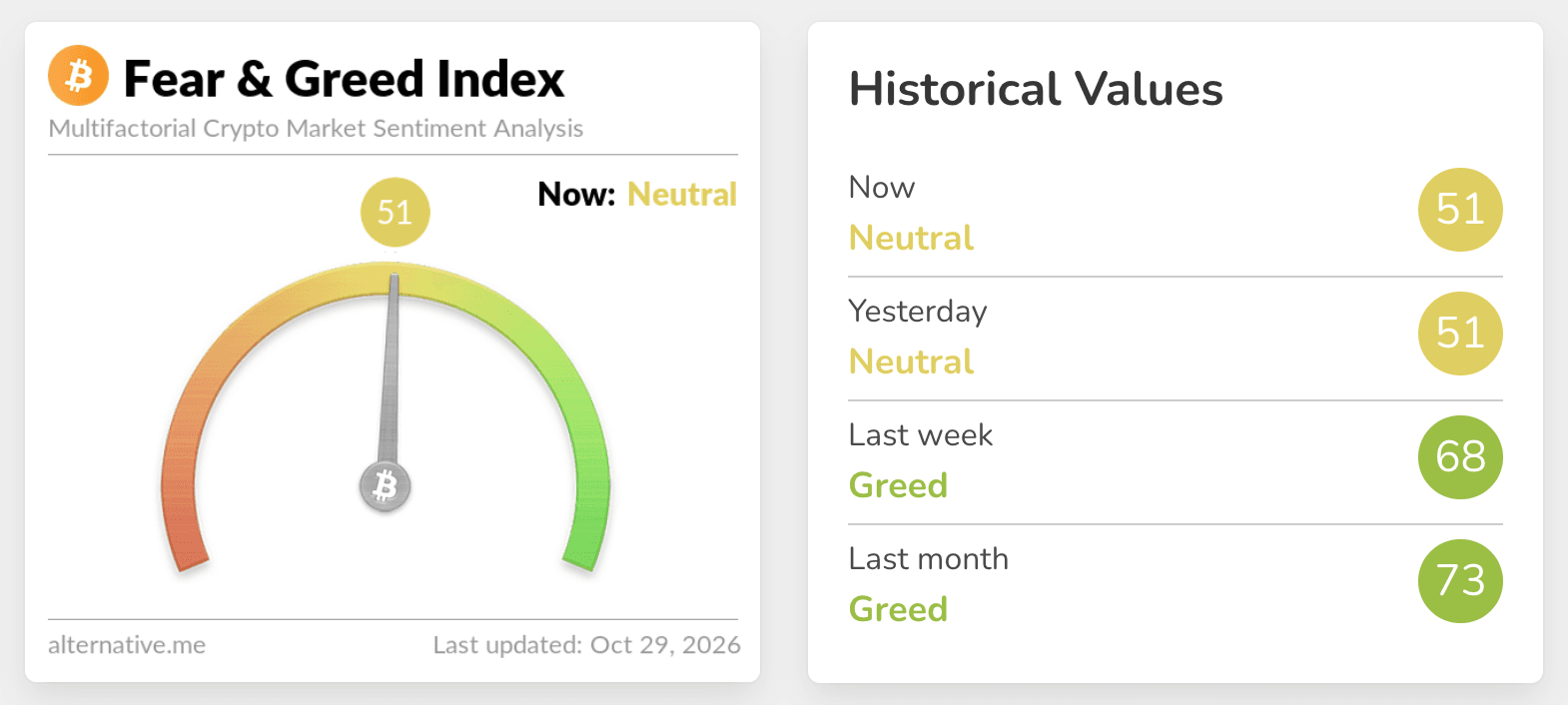
Source: Alternative
Key News Highlights:
CFTC Chair Raises AI Trading Oversight Concerns as Autonomous Agents Could Stake ETH and Launch Memecoins
Commodity Futures Trading Commission (CFTC) Chair Michael Selig addressed the regulatory challenges surrounding autonomous artificial intelligence agents during the inaugural Frontier Forum in Washington, D.C. He explained that AI-driven financial systems are changing how markets operate and may require adjustments to regulatory frameworks originally designed around human traders and traditional financial institutions. Selig used a hypothetical smart refrigerator to illustrate how autonomous devices could eventually participate in financial activities. Such a device could potentially earn income by staking Ether and use those funds to purchase groceries automatically. It might even launch its own memecoin without direct human involvement. He emphasized that these scenarios are no longer purely science fiction. Advances in AI, automated financial services, and blockchain infrastructure have made them increasingly relevant to regulatory discussions. Existing financial regulations generally require market participants to have identifiable legal identities and impose specific obligations on brokers, trading firms, and other financial intermediaries. However, determining regulatory responsibility becomes more complicated when autonomous software makes trading decisions and executes transactions independently. Selig raised several questions about whether AI agent developers should be subject to registration requirements and who should be held accountable when autonomous systems execute unauthorized or unexpected transactions. He also questioned how regulators could identify the individuals or organizations represented by these agents. One potential approach involves developing a Know Your Agent (KYA) framework to complement existing identity verification requirements in financial markets. Beyond legal accountability, Selig warned that AI agents using similar models could generate highly correlated trading behavior under the same market conditions. Faster automated execution could also introduce new challenges for market surveillance and risk management. At the same time, AI systems could help financial institutions analyze market data and identify unusual activity. These technologies may also provide smaller market participants with access to risk management tools previously available mainly to large institutions. The CFTC continues to examine regulatory issues involving autonomous AI agents, cryptocurrencies, and derivatives markets. However, these discussions do not indicate that new registration requirements or trading regulations for AI agents have been formally introduced.
Fed Holds Rates Steady but Signals Hawkish Stance as December Rate Hike Expectations Rise
The U.S. Federal Reserve concluded its latest Federal Open Market Committee (FOMC) meeting on October 28 and announced that it would maintain the federal funds target range at 3.75%–4%. The decision was widely expected, although the accompanying policy statement continued to emphasize persistent inflation pressures. The committee voted 10–2 to leave rates unchanged. Federal Reserve Governor Lisa Cook and Cleveland Fed President Beth Hammack favored an immediate 25-basis-point increase. Their dissenting votes highlighted differences among policymakers over whether current interest rates are sufficiently restrictive to bring inflation under control. During the post-meeting press conference, Fed Chair Kevin Warsh acknowledged that U.S. inflation remained above the central bank's 2% target. He reiterated policymakers' responsibility to restore price stability. According to CME FedWatch data at the time, traders assigned approximately a 78.4% probability to a 25-basis-point rate hike in December. The probability of at least a 25-basis-point increase by the following March stood at around 67.3%. Warsh did not commit to another rate increase before year-end and emphasized that future policy decisions would depend on incoming economic data and broader developments. Market analysts noted that investors had already priced in the decision to hold rates steady. However, the Fed's continued hawkish stance renewed attention on U.S. Treasury yields, dollar movements, and capital allocation across risk assets. For Bitcoin, a prolonged period of elevated interest rates means that lower-risk fixed-income assets continue to offer relatively attractive yields. This has prompted market participants to reassess capital allocation between cryptocurrencies and traditional financial instruments. Several analysts also identified the October 29 release of the U.S. Personal Consumption Expenditures (PCE) inflation data and upcoming earnings reports from major technology companies as important developments to monitor. These releases could provide further insight into inflation trends and corporate profitability. With the next FOMC meeting scheduled for December 8–9, expectations surrounding the future interest rate path remain sensitive to economic data and Federal Reserve policy communications.
Samsung Chip Earnings Miss Elevated Expectations as Tech Selloff Pushes BTC Below $80K
Samsung Electronics shares fell sharply on October 29 following the release of its latest quarterly earnings report. The decline coincided with weaker sentiment across technology stocks as Bitcoin dropped below $80K during a broader adjustment in global risk assets. According to Samsung Electronics' third-quarter financial results, its semiconductor division reported operating profit of KRW 106.5 trillion. The figure represented substantial year-over-year growth but fell slightly short of some analysts' expectations of approximately KRW 108.5 trillion. Strong demand for AI-related semiconductors continued to support the company's revenue and earnings growth. However, investor reactions to the results and Samsung's future capital expenditure plans contributed to the share price decline. Samsung shares fell more than 5% at one point, while South Korea's KOSPI index dropped over 2%. Futures linked to the U.S. Nasdaq index also declined by approximately 1.4%. Weakness in technology stocks emerged alongside the Federal Reserve's continued hawkish policy stance. These developments prompted investors across global financial markets to reassess valuations and risk exposure in high-growth assets. In the cryptocurrency market, BTC retreated from above $81.7K to approximately $79.8K and reversed its previous two-day rebound. Other major cryptocurrencies, including ETH, XRP, and SOL, also experienced varying degrees of price declines. As Bitcoin fell below $80K, increased volatility affected leveraged positions in derivatives markets. Some traders holding long positions were liquidated as prices moved against their expectations. Market data indicated that the adjustment extended beyond individual cryptocurrencies and affected major technology shares, equity index futures, and leading digital assets. Market participants continue to monitor how technology stocks respond to corporate earnings announcements and how U.S. monetary policy expectations influence near-term price movements across different risk asset classes.
Utah Files 14 Criminal Charges Against Kalshi as Prediction Market Regulatory Dispute Deepens
The U.S. state of Utah recently filed 14 criminal charges against prediction market platform Kalshi and its two co-founders, Tarek Mansour and Luana Lopes Lara. The allegations involve the illegal promotion and operation of gambling-related activities within the state. According to state prosecutors, the charges include alleged violations of Utah gambling laws and unlawful financial gains from related activities. The case has intensified an ongoing legal dispute over whether prediction markets should be subject to traditional state gambling regulations. Prosecutors stated that investigators from the Utah Attorney General's Office registered an account on the platform using a local address, phone number, and debit card. The investigators then conducted a series of test transactions in September. They reportedly completed 12 transactions linked to sporting event outcomes. State authorities argue that these transactions demonstrate how the platform allowed Utah residents to participate in activities they consider illegal gambling. Kalshi has taken a different legal position. The company maintains that its event contracts are financial derivatives regulated by the Commodity Futures Trading Commission under federal law rather than gambling products subject to individual state oversight. Utah had previously filed a related civil lawsuit seeking to restrict the platform from offering certain event contracts to local residents and recover profits that state authorities allege were unlawfully obtained. Several other states, including Arizona, Connecticut, Massachusetts, Michigan, and Nevada, have also pursued legal action or imposed restrictions involving prediction markets. These developments show that the regulatory dispute now extends across multiple state jurisdictions. Meanwhile, the CFTC maintains that relevant event contracts fall primarily under federal regulatory authority. The agency has also challenged certain state-level enforcement actions through legal proceedings. The latest criminal charges have further intensified the conflict between state governments and federal regulators over jurisdiction in prediction markets. However, the allegations remain subject to judicial review and do not constitute a court finding that Kalshi has violated the law.
Disclaimer: The information provided in this section is for informational purposes only and doesn't represent any investment advice or FameEX's official view.