FameEX Today’s Crypto News Recap | November 3, 2026
2026-11-03 07:31:04

Australia hikes rates to 4.85% as North Korea denies ties to the Binance USD 6.3B CEX hack and tech stocks fall before US midterms; today’s BTC price is near $76.8K in fear sentiment. The cryptocurrency market continued its recent decline, with Bitcoin (BTC) falling below $77K and Ether (ETH) retreating toward $2,250 as major digital assets faced broad selling pressure. BTC traded near $76.8K, giving back its brief recovery as the market remained under pressure from price adjustments and tightening liquidity. ETH also weakened and traded between $2,240 and $2,260, reflecting a lack of meaningful demand recovery across major cryptocurrencies. In traditional financial markets, continued losses in US semiconductor stocks and a broader correction in technology valuations further weakened risk appetite. The US midterm elections are taking place on November 3, with investors closely watching potential policy changes and their implications for financial markets. According to ETF flow data cited by RootData, US spot Bitcoin ETFs recorded daily net outflows of approximately USD 399 million, while spot Ethereum ETFs saw net outflows of USD 140 million. These figures indicate continued adjustments to institutional crypto exposure. Market sentiment also deteriorated, with the Fear and Greed Index falling to 26 today and remaining in the Fear zone, down from 37 yesterday and 48 last week. On the macroeconomic front, the Reserve Bank of Australia raised its benchmark interest rate to 4.85%, its highest level in 18 years. The decision highlighted persistent inflationary pressures across major economies. Overall, the current cryptocurrency market correction reflects institutional fund outflows, declining technology stocks, and macroeconomic uncertainty. Trading activity continues to be driven by risk management and position adjustments.
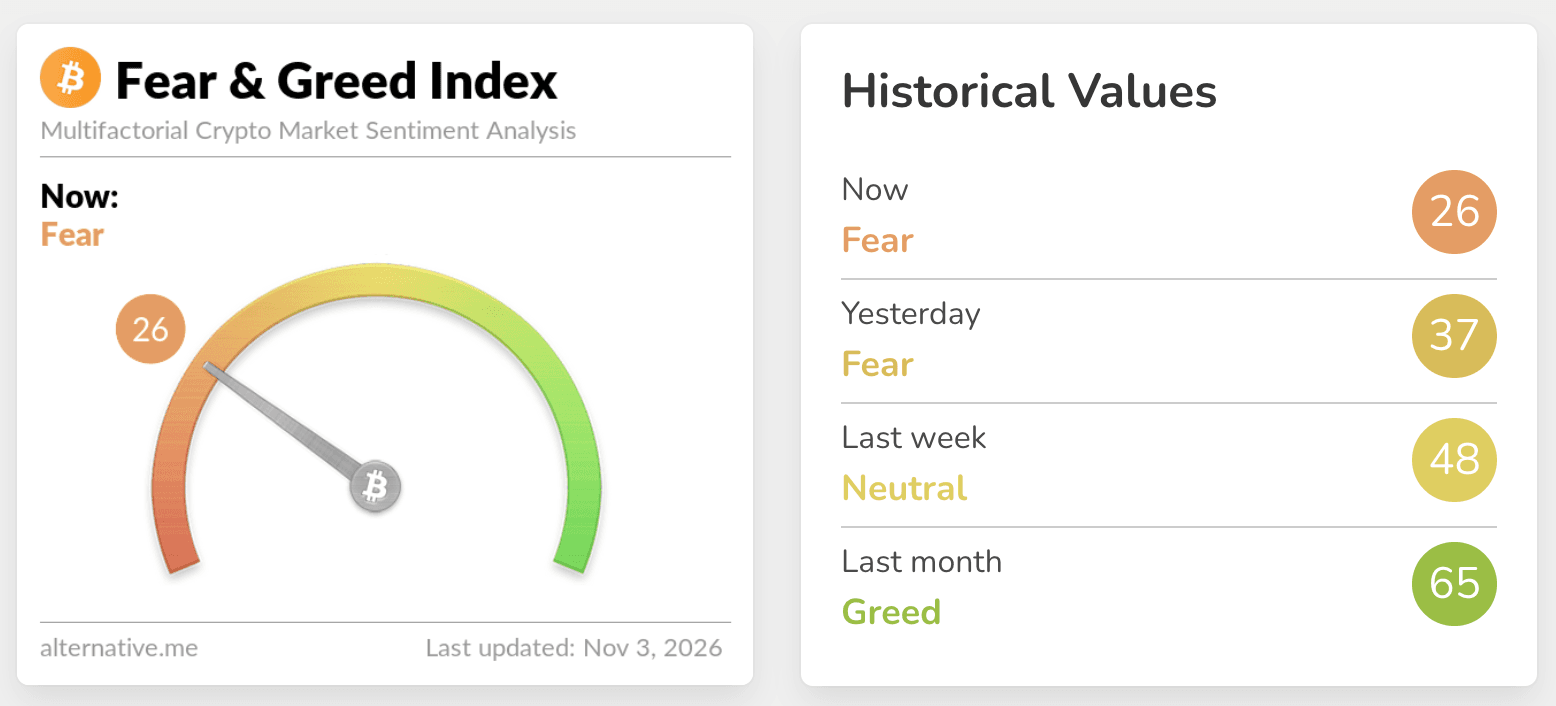
Source: Alternative
Key News Highlights:
Australia Raises Interest Rates to 18-Year High of 4.85% as AI Investment and Energy Costs Fuel Inflation
The Reserve Bank of Australia (RBA) raised its benchmark interest rate by 25 basis points from 4.60% to 4.85% on November 3, 2026, reaching its highest level since 2008. This marked the central bank's fifth rate increase of the year as domestic inflation remained above its target range of 2% to 3%. The monetary policy board approved the increase in a 6-3 vote, with three members favoring unchanged rates. The split decision reflected differing views among policymakers on further monetary tightening. The RBA noted that rising energy and fuel prices continued to increase costs for businesses and households, with some of the pressure linked to the ongoing conflict in the Middle East. Investment in artificial intelligence has also driven up the prices of technology equipment and related products. Data center construction and infrastructure spending have become additional factors influencing economic demand. According to its latest monetary policy report, the RBA expects both headline and underlying inflation to remain above 3% through the end of 2027. Inflation may not return to the midpoint of the target range until mid-2028. The central bank also emphasized the need to monitor slowing economic growth and rising unemployment while maintaining inflation control as its primary policy objective. In contrast, the US Federal Reserve kept interest rates unchanged at its previous policy meeting. The difference highlights how major central banks are responding to varying inflation and economic growth conditions. The RBA's latest decision and revised inflation forecasts have become a key monetary policy development for global markets in early November.
North Korea Denies Involvement in USD 6.3 Billion Hack of Major CEX and Rejects FBI Allegations
North Korea formally denied involvement in a cyberattack that resulted in the theft of approximately USD 6.3 billion in cryptocurrency from a major CEX on November 3, 2026. Pyongyang also accused the US Federal Bureau of Investigation (FBI) of making politically motivated allegations by attributing the attack to North Korea. According to a statement released by the Korean Central News Agency, Kim Yo Jong, the sister of North Korean leader Kim Jong Un, argued that the US had no reasonable basis for linking North Korea to major international cybercrime incidents. She described the allegations as a political provocation. Her remarks responded to earlier FBI findings that connected the USD 6.3 billion cryptocurrency theft to TraderTraitor, a hacking group believed to have ties to North Korea. The exchange disclosed the major security breach on October 30, prompting US law enforcement agencies and blockchain analytics firms to investigate the movement of stolen assets. Blockchain intelligence firm TRM Labs reported that on-chain and off-chain evidence revealed similarities between this attack and previous hacking operations linked to North Korea. Investigators identified activities involving cryptocurrency mixing services, previously obtained transaction signatures, and asset transfers across different blockchain networks. Kim also questioned the possible role of the United States in the incident but provided no evidence to support her suspicions. The FBI previously attributed another cryptocurrency theft worth approximately USD 1.5 billion in 2025 to North Korean-linked hackers, an allegation Pyongyang also denied. As US authorities, blockchain intelligence firms, and North Korean officials continue to present differing accounts, attention remains focused on identifying those responsible, tracing the stolen funds, and monitoring further investigative developments.
Technology Stocks Extend Losses Ahead of US Midterm Elections as Bitcoin Falls Below $77K
The US midterm elections are taking place on November 3, 2026, as global financial markets face continued declines in technology stocks and major cryptocurrencies. At the November 2 US market close, the Dow Jones Industrial Average gained approximately 0.42%, while the S&P 500 declined 0.50% and the Nasdaq Composite fell 1.07%. The figures showed that major technology stocks significantly underperformed several traditional sectors. The Philadelphia Semiconductor Index dropped approximately 3.3% during the session, with some semiconductor and technology companies experiencing even steeper losses. Meanwhile, the Nasdaq 100 had fallen roughly 10% from its recent high, entering what is commonly considered a correction range. Weakness in technology stocks also spread to other major equity markets. South Korea's KOSPI Index declined more than 3%, while the MSCI Asia Pacific Index lost nearly 1%. In the cryptocurrency market, BTC fell below $77K on November 3 and reversed its brief recovery from the previous day. ETH traded near $2,250 as selling pressure persisted across major digital assets. Other cryptocurrencies recorded mixed performance, with ZEC dropping nearly 10%, HYPE declining approximately 5%, and SOL losing around 3%. TRX moved against the broader market trend and gained approximately 2%. Beyond the technology sector selloff, investors are also monitoring potential changes in congressional control following the US midterm elections. The results could influence future discussions on digital asset regulation, fiscal policy, and industry legislation.
ENSv2 Launches on Ethereum Mainnet as More Blockchain Projects Reassess L2 Deployment Strategies
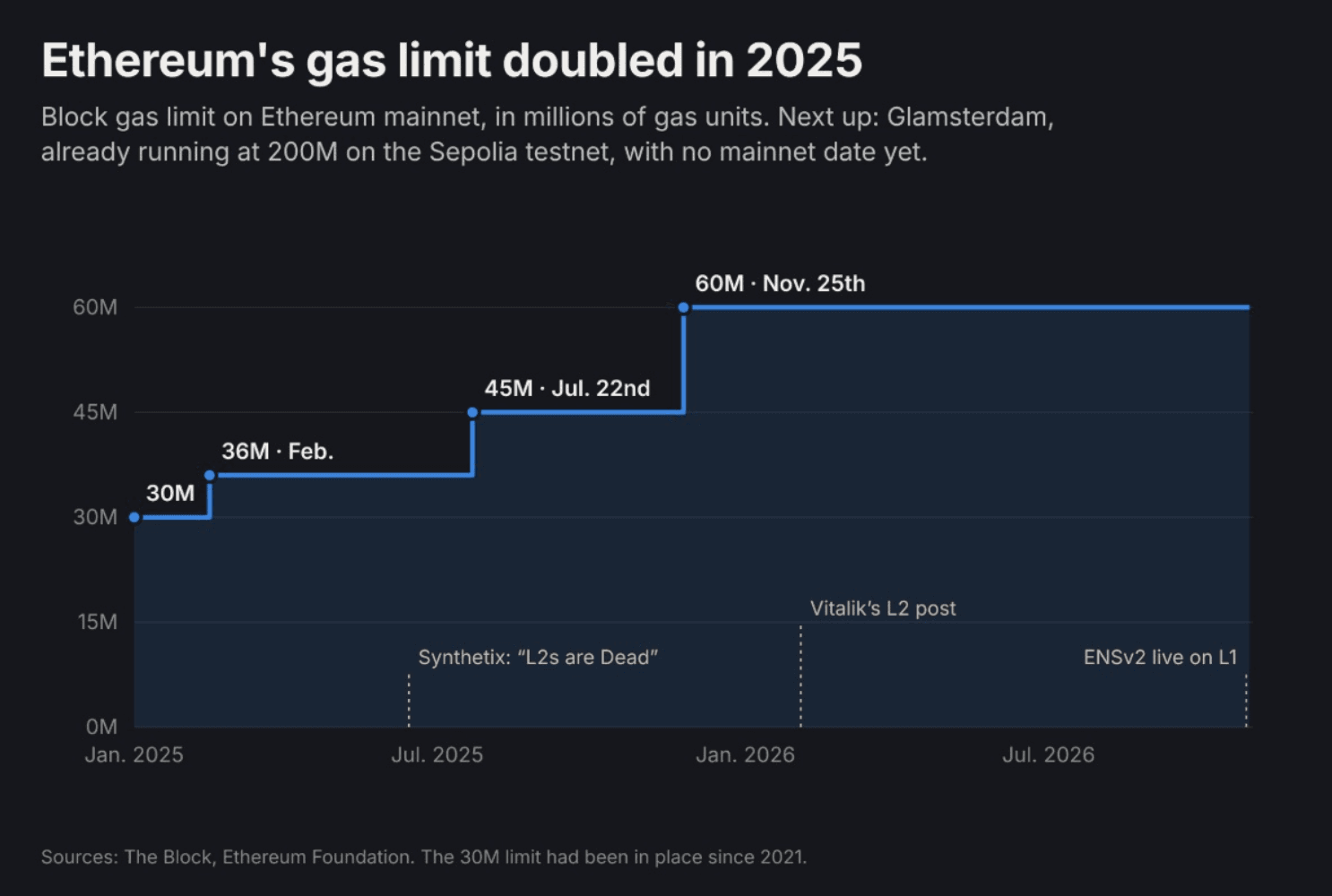
Ethereum Name Service (ENS) officially launched ENSv2 on October 27, 2026, choosing to deploy the upgrade directly on the Ethereum mainnet rather than on its previously planned dedicated Layer 2 network. ENS is a blockchain naming infrastructure that converts complex wallet addresses into human-readable names. For example, a .eth domain can be linked to a wallet address to simplify on-chain asset transfers and digital identity management. ENSv2 introduces a major architectural upgrade with a hierarchical registry system, more granular permission controls, and enhanced domain resolution and data-sharing capabilities. Under the new framework, individual ENS names can manage their own subdomain registries. This allows communities, businesses, and application developers to configure domain management and access permissions according to their specific needs. ENS Labs had previously planned to launch a dedicated Rollup called Namechain as the primary deployment environment for ENSv2. However, the team later abandoned that plan and moved the upgrade directly to Ethereum mainnet. ENS founder Nick Johnson previously explained that Ethereum's mainnet scaling had progressed faster than initially expected. This development became an important factor in reassessing the need for a separate L2 network. ENS is not the only project adjusting its deployment strategy. Synthetix has also moved some of its core operations back to Ethereum mainnet, while several independent L2 projects have announced plans to scale back or discontinue operations due to operating costs and revenue challenges. The ENSv2 launch also introduced updated versions of the ENS App and ENS Explorer, allowing users to manage domains, review ownership records, and inspect relevant settings. Existing ENS domains remain functional without requiring re-registration, although holders can choose to upgrade to ENSv2 to access the new features. These developments reflect a broader reassessment of how blockchain applications distribute responsibilities across mainnet, Layer 2 networks, and off-chain systems. Particular attention is being given to where core functions such as asset ownership, data storage, and transaction settlement should operate.
Disclaimer: The information provided in this section is for informational purposes only and doesn't represent any investment advice or FameEX's official view.