FameEX Today’s Crypto News Recap | November 4, 2026
2026-11-04 07:07:50

THORChain resumes swaps as RUNE gains +15%, Democrats sweep US midterms and BTC/ETH ETFs see USD 200.9M outflows. Today’s BTC price is near $77.3K amid Fear sentiment. Crypto markets remained volatile as U.S. midterm election results emerged, tech stock futures weakened, and spot ETF outflows continued. Bitcoin (BTC) briefly fell to $75.7K before recovering to around $77.3K, gaining approximately 0.8% over the past 24 hours. Ether (ETH) dipped below $2,250 before reclaiming $2,270, posting a 24-hour gain of around 1.2%. The balance of power in the U.S. Congress became a key focus for financial markets. Prediction markets showed a sharp increase in the implied probability of Democrats winning control of both chambers. U.S. stock futures and Treasury prices also experienced varying degrees of volatility. Institutional fund flows remained under pressure as U.S. spot Bitcoin ETFs recorded approximately USD 116 million in net outflows, while spot Ethereum ETFs saw USD 85.3 million in net outflows over the same period. In derivatives markets, traders continued to monitor leveraged positions around key BTC and ETH price levels alongside potential liquidation risks during sharp price movements. Today's Fear and Greed Index is at 34, indicating Fear sentiment. The index has recovered from yesterday's reading of 26 but remains below last week's level of 51. Overall, markets are absorbing developments in U.S. politics, traditional financial assets, and crypto fund flows. Although BTC and ETH have recovered from their intraday lows, short-term trading activity remains characterized by price rebalancing and risk position adjustments.
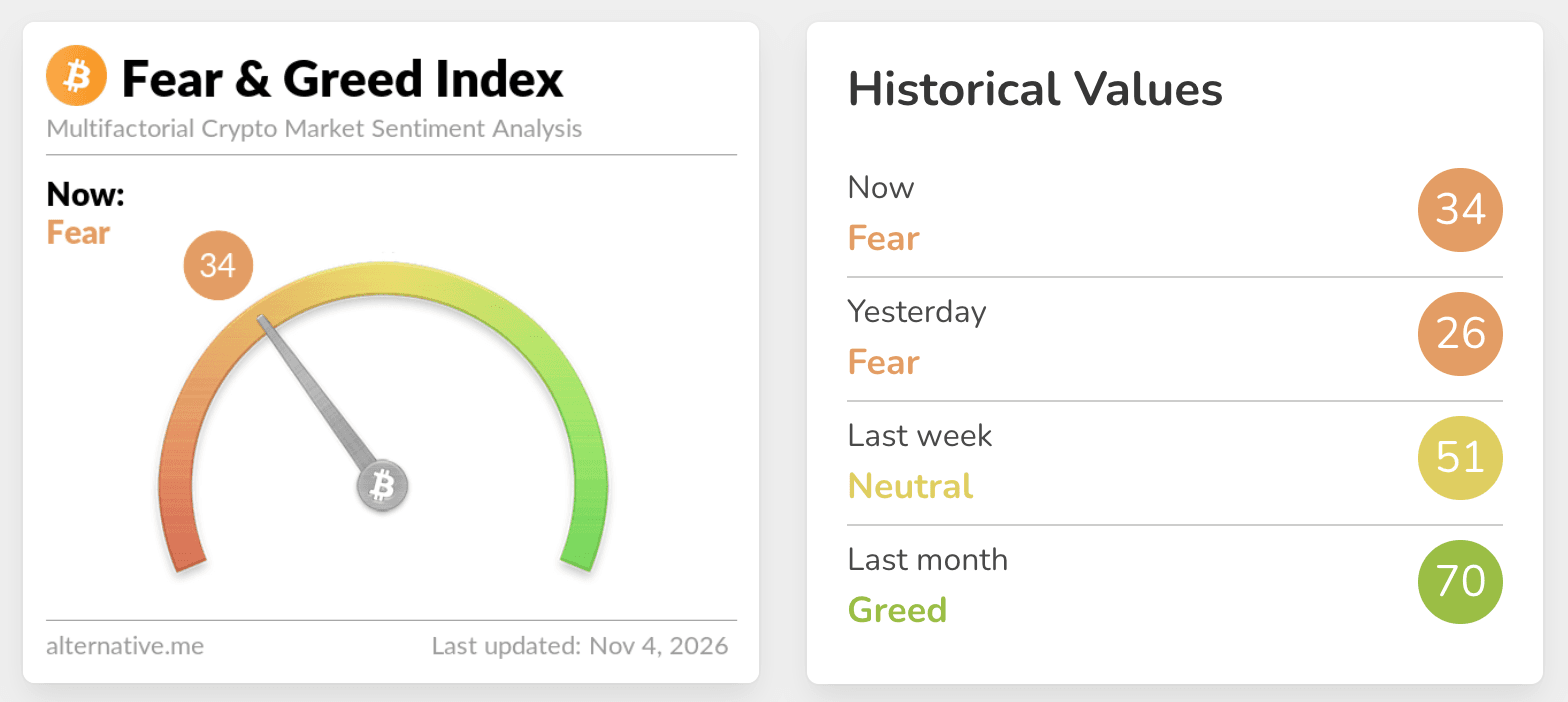
Source: Alternative
Key News Highlights:
THORChain Restores Most Cross-Chain Swaps as RUNE Gains 15% in 24 Hours
THORChain has gradually restored asset swaps across multiple blockchain networks after a system issue forced the cross-chain protocol to suspend some trading services. The recovery has drawn attention across the decentralized finance sector. According to reports, the disruption began when an Ethereum block reorganization triggered a refund processing error that affected certain asset swaps. Node operators subsequently suspended trading across multiple networks while investigating the issue. The incident involved a 10 ETH deposit that THORChain had already credited before an Ethereum block reorganization removed its original on-chain confirmation. When the swap failed to meet its specified price limit, the refund mechanism processed a repayment for funds that had never reached the protocol's vault. This resulted in an additional 10 ETH payout after the original deposit was also refunded. THORChain then activated its automatic protection mechanism, and node operators imposed further restrictions on cross-chain transactions. According to the protocol's network status page, trading and transaction signing had resumed on 10 of its 13 listed external networks. These included Bitcoin, Ethereum, Bitcoin Cash, Dogecoin, Litecoin, Tron, and Zcash. BNB Smart Chain, Cosmos Hub, and Solana continued to display service warnings as their cross-chain functions had not yet fully recovered. As most swap routes reopened, THORChain's native token RUNE gained approximately 15% over 24 hours and traded near $0.64 at the time of reporting. The incident also affected cross-chain fund transfers. Blockchain analytics firm Chainalysis noted that the service suspension had disrupted certain suspicious fund movements linked to a major CEX security breach. The protocol's recovery progress and security measures have since remained under scrutiny.
U.S. Midterm Prediction Markets Favor Democrats as Congressional Control and Crypto Regulation Take Center Stage
The U.S. held its midterm congressional elections as prediction market traders continued pricing the likelihood of different outcomes for control of the House of Representatives and the Senate. The trading activity attracted attention from both the crypto industry and traditional financial markets. During voting, Kalshi and Polymarket placed the implied probability of Democrats winning control of both chambers at approximately 75% and 75.5%, respectively. Both platforms assigned probabilities above 90% to a Democratic majority in the House. As polling stations began closing and early vote counts emerged, prediction markets increased their implied probabilities of a Democratic victory. Reuters cited prediction market data showing that the probability of a Democratic sweep briefly approached 100% during the evening in U.S. Eastern Time. Reuters also reported that cumulative trading volume in U.S. midterm election contracts had exceeded USD 1.48 billion that day, reflecting the growing scale of political event trading. Although several major U.S. media outlets had projected a Democratic majority in the House, control of the Senate remained uncertain pending results from additional races. For the crypto industry, attention centered on the future regulatory framework for digital assets. Key issues included the legislative progress of bills such as the CLARITY Act and congressional oversight of relevant regulatory agencies. In closely contested Senate races across Ohio, Maine, and other states, campaign spending by crypto-focused political action committees and candidates' positions on digital asset policies also became prominent election topics. Meanwhile, researchers at Talos highlighted limited market depth in certain political prediction contracts. They noted that relatively small trades could trigger significant price movements in individual contracts.
Bitcoin Briefly Drops to $75.7K as U.S. Stock Futures and Treasury Markets Fluctuate
Bitcoin experienced sharp price movements as early results from the U.S. midterm elections began to emerge. BTC briefly fell to approximately $75,700 before recovering to around $76,700 and subsequently climbing back above $77K. According to reports, Bitcoin had approached $78K during U.S. voting hours but dropped more than $2,000 within a short period as markets reacted to the possibility of a shift in congressional control. U.S. stock index futures also declined significantly. Nasdaq 100 futures fell as much as 2.3% during the morning session, while S&P 500 futures dropped approximately 1.3%. The movements reflected a broader reassessment of the election outcome across traditional financial markets. The U.S. dollar weakened against several major currencies, while Treasury prices rose and the 10-year Treasury yield briefly declined to around 4.90%. With stocks, bonds, and crypto assets experiencing simultaneous volatility, the congressional election results and the direction of future U.S. fiscal policy became major areas of focus across financial markets. By midday on November 4, U.S. stock futures had pared their losses. S&P 500 futures narrowed their decline to approximately 0.5%, while Nasdaq futures recovered to around 0.7% below their previous levels. Other major cryptocurrencies also recorded mixed price movements. ETH fluctuated near $2,250, SOL briefly fell below $90, and ZEC rebounded following losses in the previous trading session. These developments occurred as election updates continued to emerge, although the timing and magnitude of price movements varied across asset classes. Market data showed that incoming political developments and the repositioning of trading portfolios continued to influence short-term volatility across cryptocurrency and traditional financial markets.
U.S. Spot BTC and ETH ETFs Record Combined Daily Net Outflows Above USD 200 Million
The latest U.S. spot crypto ETF flow data showed that Bitcoin and Ethereum investment products both recorded net outflows, with combined daily outflows reaching approximately USD 200.9 million. According to Farside Investors, U.S. spot Bitcoin ETFs posted total net outflows of USD 115.6 million, indicating that aggregate fund flows remained negative. BlackRock's IBIT recorded USD 95 million in net outflows, making it the largest contributor to Bitcoin ETF outflows that day. Grayscale's Bitcoin Mini Trust ETF also reported net outflows of USD 52.6 million. Meanwhile, several other spot Bitcoin ETFs continued to attract inflows. Bitwise's BITB recorded USD 21.9 million in net inflows, while Fidelity's FBTC attracted USD 6.8 million. These figures highlighted differences in fund flows across individual investment products. For spot Ethereum ETFs, total net outflows reached USD 85.3 million on November 3. BlackRock's ETHA accounted for USD 74.4 million in net outflows and represented the largest source of withdrawals that day. Grayscale's Ethereum Mini Trust ETF recorded another USD 10.9 million in net outflows, while most other spot Ethereum ETFs reported no significant changes in fund flows. In the previous trading session on November 2, spot Bitcoin ETFs had recorded USD 398.6 million in net outflows, while spot Ethereum ETFs saw USD 139.7 million in net outflows. Both categories therefore experienced net outflows for two consecutive trading days. These figures reflect recent subscription and redemption activity in U.S.-listed crypto investment products. The data may be adjusted as funds update their daily filings and reporting figures. Since capital flows differ across individual funds, aggregate net outflows do not necessarily indicate that all investment products experienced redemptions. Fund-level movements should be assessed separately based on the relevant trading dates and reported data.
Disclaimer: The information provided in this section is for informational purposes only and doesn't represent any investment advice or FameEX's official view.