REZ (Renzo) Token Price & Latest Live Chart
2026-03-19 10:54:22
What is REZ (Renzo)?
Renzo is a decentralized liquid restaking protocol built on the Ethereum ecosystem. Its core function is to serve as an intelligent interface between users and underlying restaking layers such as EigenLayer. As staking infrastructure in crypto became more complex, Renzo emerged to simplify the technical burden that came with that evolution. At its core, the project is a strategy management platform that allows both individual and institutional users to deploy their tokens into network security without needing the expertise required to run validator infrastructure themselves. Through a modular system design, Renzo automates validator delegation, risk evaluation, and reward generation, allowing participants to engage in onchain capital deployment in a transparent and secure manner.

Image Source: https://docs.renzoprotocol.com/docs/products/staking-suite
Renzo traces its launch to December 2023, when it was brought to market by Lucas Kozinski, James Poole, and Kratik Lodha, three founders with strong industry backgrounds. Kozinski and Poole previously worked together at crypto infrastructure provider Tokensoft, where their shared interest in Ethereum-native applications and protocol architecture led to the foundation of the project. Lodha, an experienced investor with an economics background, added a more disciplined financial and market-oriented framework to the team. Their common objective was to build an onchain system that combined capital safety with financial discipline, while opening a genuinely innovative path within Ethereum’s liquidity landscape. The importance of the project lies in the way it addresses the long-standing tradeoff between yield generation and capital efficiency. Assets that once served only one function can now operate across multiple network layers at the same time. Traditional staking usually requires users to sacrifice liquidity, because capital remains locked inside a specific protocol. Renzo addresses that limitation by issuing liquid receipts tied to the underlying position. The protocol is not limited to Ethereum, either. It has expanded into other major blockchain ecosystems such as Solana, forming a cross-chain liquid restaking network. Through that structure, Renzo becomes a bridge between decentralized service providers and capital suppliers, while also advancing the broader adoption of shared blockchain security.
Renzo’s design philosophy is built around programmatic trust and permissionless innovation. That means any participant can use its tooling to access a deeper layer of crypto infrastructure. As an institutional-grade onchain platform, it is not focused only on convenience for retail users. It also provides large pools of capital with a verifiable and structured channel for managing onchain exposure. By abstracting away the complexity of the underlying protocol stack, Renzo gives users a unified interface for managing diversified yield strategies across different assets and networks. This highly integrated architecture places Renzo in an infrastructure role within the broader DeFi market, where the improvement of capital efficiency increasingly depends on systems that can combine security, transparency, and flexible execution.
How does REZ (Renzo) work?
Renzo begins with asset deposits and the issuance of liquid receipts, a process known as liquid restaking. When users deposit ETH or other supported liquid staking tokens into Renzo smart contracts, the protocol automatically mints the corresponding liquid restaking token, such as ezETH for Ethereum exposure or ezSOL for Solana exposure. These tokens do more than represent ownership of the underlying assets. They also reflect the rewards accumulated through staking and restaking over time. This design allows the asset to remain productive while still staying transferable. Users can take these receipt tokens into other decentralized finance protocols for lending, borrowing, or liquidity provision without losing exposure to the underlying yield stream.
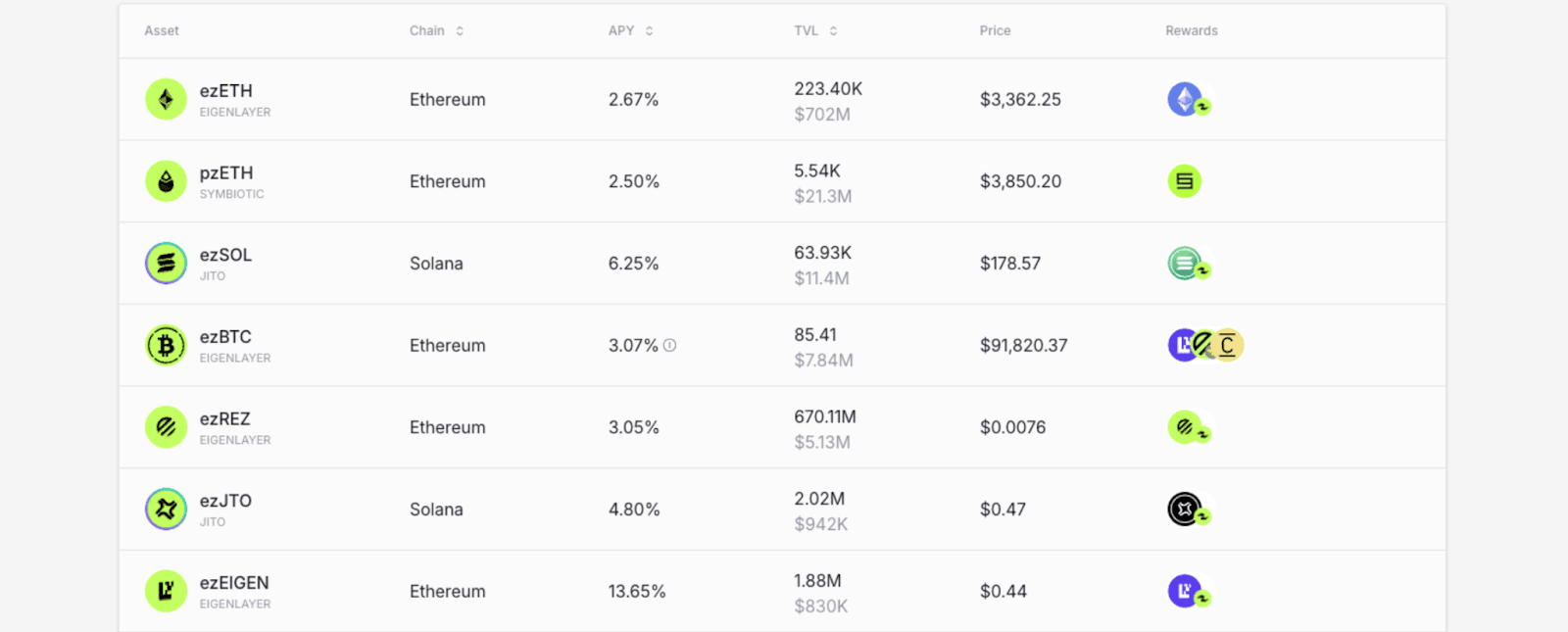
Users can stake supported assets and earn auto-compounding yield while retaining liquidity, source: https://docs.renzoprotocol.com/docs/products/staking-suite
Behind the interface, Renzo acts as a strategy manager that delegates pooled assets to approved node operators. These operators participate in securing Actively Validated Services, which are decentralized services that rely on Ethereum-aligned economic security. Renzo’s automated strategy layer dynamically adjusts capital allocation across different validation services based on changing market conditions and risk parameters. The objective is not simply to chase the highest nominal return, but to optimize compensation while keeping risk within a controlled framework. The protocol also incorporates auto-compounding, which removes the need for users to manually claim rewards and restake them. That lowers operational friction and improves long-term capital efficiency by keeping the position continuously productive.
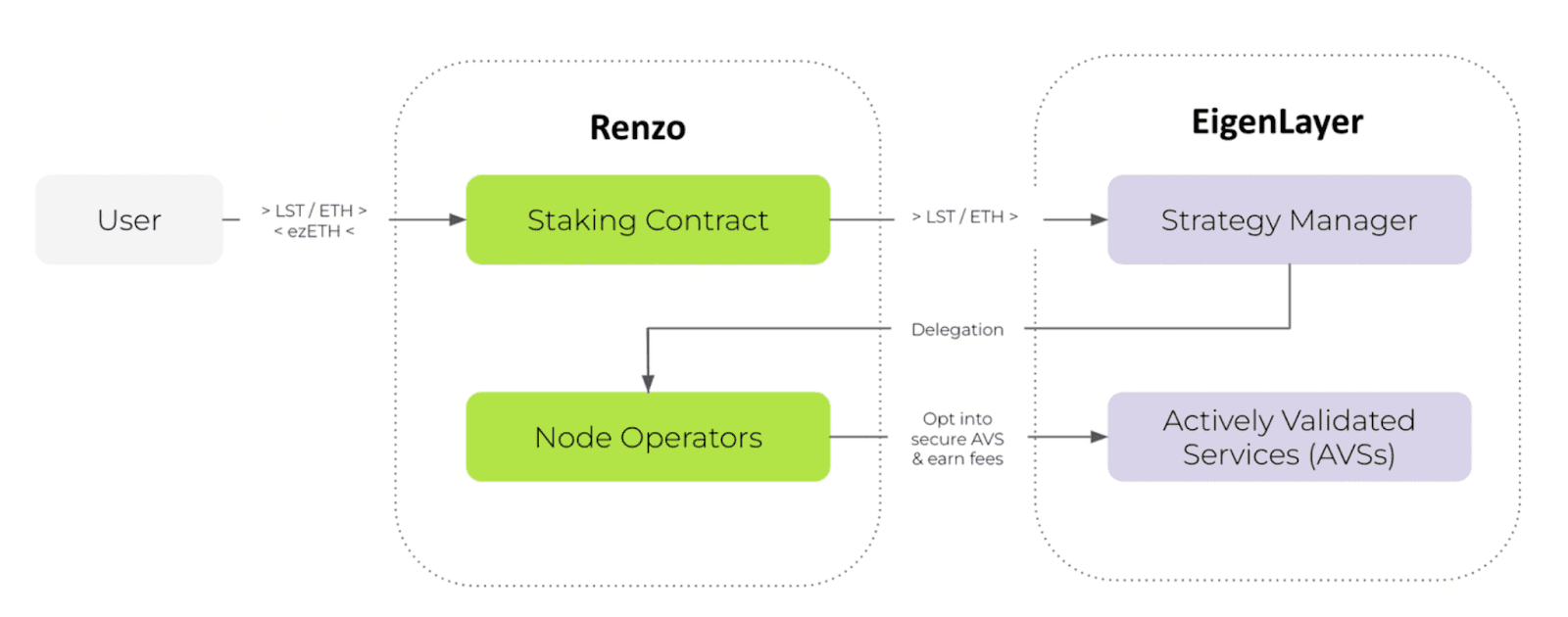
Renzo serves as a gateway to Ethereum restaking, using smart contracts and node operator coordination to optimize risk-adjusted returns, source: https://docs.renzoprotocol.com/docs/restaking-ecosystems/understanding-liquid-restaking
To support this ecosystem, Renzo has built three core product modules consisting of Reserve Vaults, the Staking Suite, and enterprise-grade services. Reserve Vaults are designed to manage the security and liquidity profile of underlying assets. The Staking Suite handles the technical interaction layer between user deposits and different blockchain networks. The enterprise layer is aimed at participants with compliance and reporting requirements, offering auditable asset flow records and structured risk management frameworks. Through this layered design, Renzo separates the technical complexity of validator infrastructure from the end-user experience. That not only improves usability, but also strengthens the network’s overall security profile and gives decentralized applications a more scalable way to access economic security.
REZ (Renzo) market price & tokenomics
REZ is the native governance token of the Renzo protocol, and its total supply is fixed at 10 billion tokens. Based on statistics referenced for March 2026, the protocol’s total restaked value had exceeded $700 million, indicating that the market had already assigned substantial weight to its mechanism and product design. The token distribution model is structured to balance the interests of early backers, core contributors, and the broader community. A total of 32% of supply is allocated to community development, including multi-phase incentive programs and cross-chain initiatives. Fundraising accounts for 31.56% of total supply. These tokens are subject to a two-year unlock structure consisting of a one-year cliff, followed by a 10% initial unlock and linear monthly vesting over the following year.
Core contributors and advisors account for 20% of total supply, and that allocation is also subject to strict vesting conditions designed to align the team with the long-term trajectory of the project. All contributor tokens are locked for one year and then released through a two-year linear vesting schedule. The Renzo Foundation holds 12.44% of supply, which is intended to support future development, risk assessments, and security audits. The remaining allocation is directed toward liquidity management and specific platform-related distribution programs. This structured distribution framework is meant to reduce the chance of severe liquidity shocks as tokens enter the market, while preserving enough strategic reserves to support the continued evolution of the protocol.
At the functional level, REZ token gives holders decision-making power over the future of the protocol. Governance participants can vote on risk management frameworks, deposit caps, collateral types, and operator whitelists. They also have authority over which Actively Validated Services are eligible to enter Renzo’s strategy set. This governance model reduces reliance on a centralized operating team and strengthens transparency in how the protocol evolves. REZ also plays a role in the incentive layer. Through the combination of reward points systems and governance participation, the protocol encourages users to hold liquid restaking positions for longer periods and remain engaged in the growth of the ecosystem.
Why do you invest in REZ (Renzo)?
In traditional crypto market structures, assets often face a strict tradeoff between different use cases. Once an asset is staked, its market liquidity is usually sacrificed. Renzo breaks that tradeoff through liquid restaking, allowing users to stack multiple forms of yield on top of a single position. That means users can earn Ethereum base staking rewards, additional compensation from restaking, and potentially further returns from deploying the receipt token across other DeFi protocols. This layered yield structure gives capital a stronger growth engine and creates a more efficient way to use assets in a competitive market environment.
Beyond the economic side, Renzo’s technical convenience is a major part of its appeal. For most users without a deep technical background, interacting directly with EigenLayer or similar systems involves operator selection, risk analysis, and manual compounding management. Renzo packages those steps into a simpler deposit-and-hold experience, which lowers the barrier to entry in a meaningful way. Its automated risk management and strategy adjustment framework allows users to access a professional-grade capital deployment system without constant manual oversight. For institutions, that same standardization, combined with support for auditing and structured reporting, makes Renzo a more practical route into the restaking market.
Renzo’s expansion across multiple blockchain ecosystems also adds a distinct strategic dimension. By supporting networks beyond Ethereum, the protocol allows users to access security premiums from different ecosystems through a single platform. This cross-chain structure does more than diversify technical exposure. It broadens the opportunity set for capital deployment. As blockchain infrastructure continues moving toward modular and specialized architectures, the need for shared security is likely to become more important rather than less. Renzo is positioned around that trend by offering a more efficient way to allocate security-linked capital, which gives it relevance not just as a yield product, but as a long-term infrastructure layer for decentralized networks.
Is REZ (Renzo) a good investment?
From a technical and market positioning standpoint, Renzo can be understood as an engineering solution to the tension between blockchain security and capital liquidity. It is more than a simple asset deposit tool. It functions as an onchain coordinator of resources. Any long-term evaluation of its value depends on its market share and technical resilience within EigenLayer and the broader restaking sector. Renzo’s use of auto-compounding and multi-chain support gives it a meaningful competitive edge among similar protocols. As more Actively Validated Services enter the market, the value of platforms with strategy optimization capabilities is likely to become more visible, because they help direct capital toward stronger security opportunities while filtering out weaker services. Renzo has also built a more disciplined risk framework through work with top-tier auditors and institutional-grade node operators. Restaking as a category still involves layered smart contract complexity, but Renzo’s transparent governance and automated risk adjustment mechanisms reduce some of that structural uncertainty. In the longer term, its role is likely to resemble that of a security aggregator that provides plug-and-play economic security for emerging blockchain services, while giving capital access to diversified onchain return paths.
As result, Renzo reflects the broader shift in decentralized finance from simple token exchange toward more advanced capital orchestration. It creates an efficient connection between low-level blockchain security infrastructure and front-end user demand, making yield opportunities that were once limited to technically sophisticated participants available to a much wider user base. The crypto market remains volatile by nature, but the logic behind Renzo’s model, which centers on capital efficiency and shared security, aligns with the deeper structural direction of blockchain development. As an evolving protocol, its long-term place in crypto infrastructure will depend on whether it can continue to maintain an edge in strategy design as the underlying technology stack keeps changing.
Explore the latest REZ (Renzo) price and live chart, trade REZ on FameEX, and access real-time market data! Get started now with a seamless trading experience!
Disclaimer: The information provided in this article is intended only for educational and reference purposes and should not be considered investment advice. Conduct your own research and seek advice from a professional financial advisor before making any investment decisions. FameEX is not liable for any direct or indirect losses incurred from the use of or reliance on the information in this article.