FameEX Today’s Crypto News Recap | March 3, 2026
2026-03-03 06:00:57

Iranian crypto capital flight, Nasdaq’s new index prediction options, and OpenZeppelin’s audit of OpenAI’s EVMbench drive market caution as Bitcoin consolidates near $68,600 amid extreme fear. The cryptocurrency market is currently in the phase of high-level volatility and profit-taking as Bitcoin struggles to maintain momentum after failing to breach the $70K psychological resistance level. BTC is now consolidating within a tight range near $68,600 amid persistent macroeconomic uncertainty and geopolitical tensions. Despite these headwinds, the bullish market structure remains technically intact, bolstered by a significant USD 458.2 million net inflow into U.S. spot Bitcoin ETFs. The current landscape is characterized by a "leverage-driven" environment where liquidation zones for both long and short positions are extremely dense. Investor sentiment continues to reside in the "Extreme Fear" zone, indicating that while price action remains relatively stable, market participants are exercising high levels of caution. Consequently, trading behavior has shifted toward short-term hedging and tactical positioning rather than aggressive trend expansion or long-term capital commitment.
Crypto Markets Overview
The latest data from the Crypto Fear & Greed Index shows a current at 14, which places market sentiment in the "Extreme Fear" category. This suggests that risk-aversion remains the dominant force as participants weigh the combined impact of regional conflicts and ongoing macroeconomic pressures. In this environment, Bitcoin continues to serve as a market anchor for defensive capital, attracting flows from investors seeking to avoid the heightened volatility seen in the altcoin sector. Conversely, Ethereum's performance is currently constrained by a heavy leverage structure within the derivatives market. Significant long liquidation clusters situated just below current price levels are creating substantial structural selling pressure during attempted upside moves. The broader market continues to oscillate in tandem with fluctuations in U.S. equities and commodities markets. High sensitivity to recent news headlines continues to suppress overall risk appetite among institutional and retail traders alike.
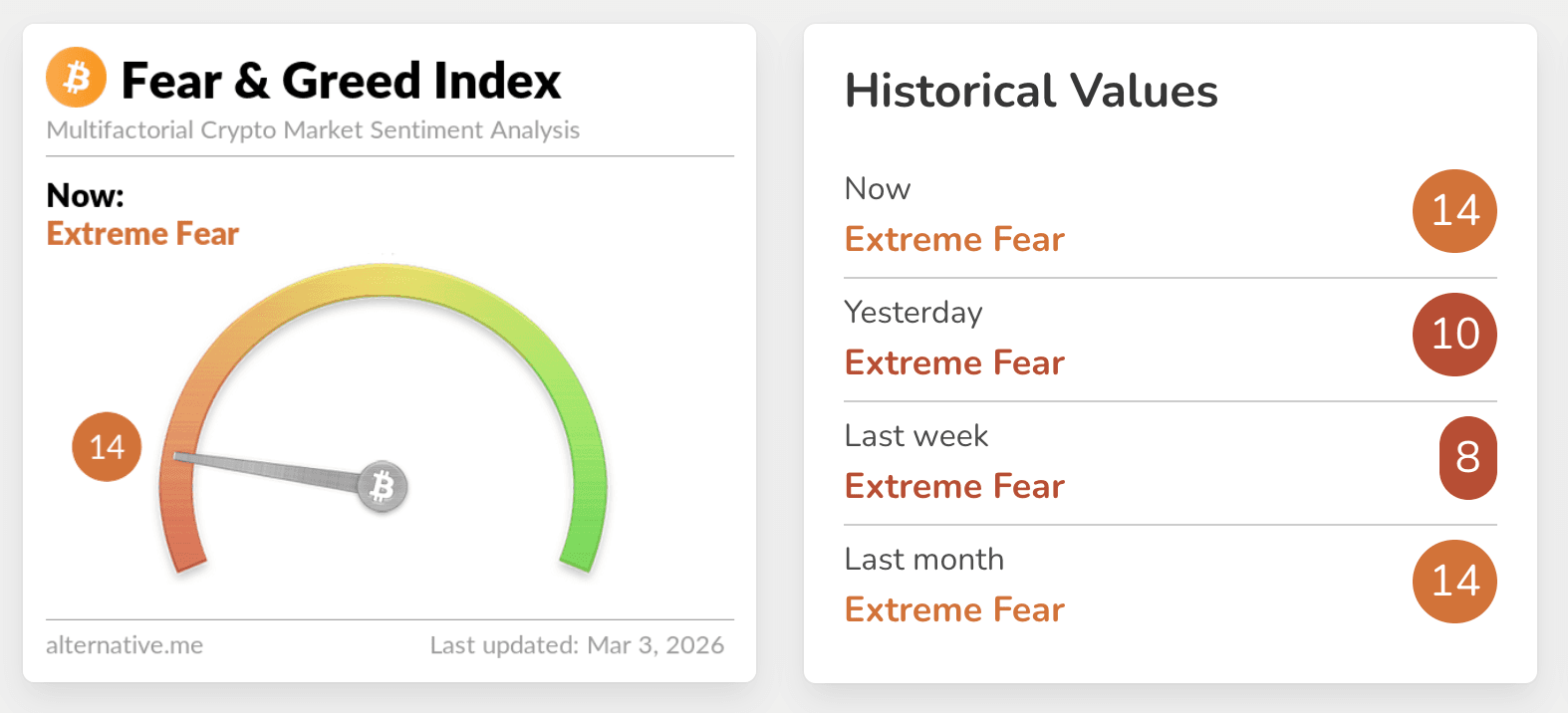
Source: Alternative
BTC and ETH Market Analysis
Bitcoin is currently locked in a month-long consolidation phase as bulls and bears engage in a fierce tug-of-war between $67K and $70K. Looking at the Volume Profile, the $67K to $68K region represents a major High Volume Node (HVN) and is widely recognized as the market's "fair value" zone. This area now serves as a critical defensive line that bulls must protect to maintain the current technical posture. According to Coinglass data, a drop below $65,018 would trigger a massive USD 1.92 billion in long liquidations across major CEXs, while a breakthrough above $71,786 would liquidate approximately USD 1.19 billion in short positions. Ethereum's market structure appears equally fragile, with a decline below $1,911 potentially leading to USD 1.01 billion in multi-order liquidations. These dense liquidation clusters explain the recent lack of pump as leverage-driven shakeouts often precede any legitimate trend breakout. The market remains in a state of high tension, waiting for a definitive catalyst to break the current liquidity stalemate.
Key News Highlights:
Iranian Crypto Outflows Spike Amid Regional Geopolitical Tensions
The onset of airstrikes in Tehran by U.S. and Israeli forces triggered an immediate and massive surge in cryptocurrency outflows from Nobitex, Iran’s largest digital asset exchange. Data from Elliptic indicates that withdrawal volumes spiked by over 700% to more than USD 500,000 within minutes of the initial strikes, eventually reaching nearly USD 3 million in a single hour. Tracing efforts suggest that much of this capital was transferred to foreign exchanges, pointing to a classic case of capital flight as citizens sought to protect their wealth from regional instability. This movement of funds allowed users to bypass some of the scrutiny inherent in the global banking system during times of crisis. Although the Iranian regime later enforced strict internet blackouts that cut connectivity by 99% and effectively halted further outflows, the event highlights the critical role of crypto. For millions of Iranians living under a fragile banking system and heavy international sanctions, digital assets remain a vital tool for preserving value and maintaining financial mobility in extreme conditions.
Nasdaq Proposes Prediction Market Style Options for Nasdaq-100 Index
Nasdaq MRX has officially filed a proposal with the U.S. Securities and Exchange Commission to launch cash-settled, binary-style contracts known as "Outcome Related Options" for the Nasdaq-100 Index. This move would allow traders to take yes-or-no positions on the stock performance of major tech entities such as Nvidia, Apple, Google, and Tesla. These contracts are expected to be priced between 1 cent and USD 1, mimicking the structure of popular prediction markets like Polymarket and Kalshi. While the initial offering is strictly limited to financial index outcomes rather than political or cultural events, it signals a major entry by a Wall Street giant into the rapidly growing event-contract sector. As the industry awaits a regulatory decision from the SEC, this filing demonstrates a strategic effort by traditional exchanges to integrate high-frequency, low-stakes trading tools. This development not only marks a significant innovation in exchange product lines but also reflects a deep-seated demand for retail-friendly, event-driven speculation tools within the institutional framework.
OpenZeppelin Audit Reveals Methodological Flaws in OpenAI EVMbench
Blockchain security firm OpenZeppelin recently conducted an audit of EVMbench, an AI benchmark for smart contract security developed by OpenAI and Paradigm, uncovering significant data contamination and classification errors. The audit found that the dataset used to evaluate models like Claude, GPT, and Gemini likely included vulnerability reports that the AI models had already encountered during their pre-training phases. Because the benchmark relied on 120 audits from 2024 to mid-2025, it failed to truly test the models' ability to identify novel, unseen code vulnerabilities. Furthermore, OpenZeppelin identified at least four "high-severity" vulnerabilities in the EVMbench dataset that were actually non-exploitable in practice, yet the benchmark was rewarding AI agents for "finding" them. These factual inaccuracies raise concerns about the reliability of current AI security evaluations in the blockchain space. OpenZeppelin emphasized that while AI will eventually transform smart contract security, the industry must hold these testing tools to the same rigorous standards as the contracts they are designed to protect.
Trending Tokens:
- $ROBO (OpenMind)
OpenMind is currently attracting significant market attention due to its strategic positioning at the intersection of decentralized infrastructure and artificial intelligence. The primary catalyst for this surge is the confirmed listing of the Fabric Protocol token on major exchanges scheduled for February 27, 2026. This high-profile debut allows eligible users to claim airdrops using Alpha Points, which drives immense participation and trading volume anticipation. Supported by reputable investors including Pantera Capital and Coinbase Ventures, the project aims to build a decentralized operating system for smart machines. The narrative centers on creating a verifiable coordination layer for robotics to ensure transparency and trust in AI-driven actions. Investors are focused on the $20M funding foundation and the project's ability to facilitate real-world robotic collaboration through its FABRIC layer. The market is keenly observing whether this token listing will solidify ROBO's position as a foundational asset in the evolving AI DePIN sector.

- $KAT (katana)
Katana has emerged as a trending asset by addressing liquidity fragmentation within the Ethereum ecosystem through its specialized DeFi-first Layer 2 blockchain architecture. Backed by industry giants Polygon Labs and GSR, the project is attracting intense market interest as a graduate of the Agglayer Breakout program. Investors are focusing on Katana's unique value proposition, which utilizes Agglayer as a canonical bridge and VaultBridge to generate actual sustainable yield rather than relying on token inflation. The recent focus on deep liquidity bootstrapping has attracted institutional liquidity providers and DeFi users seeking efficient capital deployment. While the project is currently in its growth phase, the backing by Polygon Labs provides a strong narrative regarding infrastructure reliability and interoperability. Market attention is driven by the potential for high-volume DeFi activity once full public mainnet functionalities are widely adopted. The narrative centers on the collaboration between Polygon and GSR to create a unified liquidity hub for decentralized finance.
- $SYND (Syndicate)
Syndicate is gaining traction by offering a robust application-chain infrastructure that enables developers to build custom interoperable blockchains with programmable on-chain sequencers. The project's narrative is driven by its evolution from a decentralized investment protocol to a foundational tool for custom application-specific blockchains. Market interest has been revitalized due to its ability to allow developers to create custom transaction ordering rules and economic systems that directly benefit tokenized communities. With total funding of $27.8M from investors like a16z and Variant Fund, Syndicate is positioned as a critical infrastructure provider in the appchain sector. The attention is triggered by the practical application of its technology in facilitating value flow directly back to on-chain communities. Developers are increasingly exploring Syndicate to build custom economic engines that prioritize native interoperability and capital efficiency. The current focus is on how Syndicate will enable customized scaling solutions for complex community-driven decentralized applications.
Disclaimer: The information provided in this section is for informational purposes only and doesn't represent any investment advice or FameEX's official view.