FameEX Today’s Crypto News Recap | March 12, 2026
2026-03-12 06:45:58

Ripple’s USD 750 million buyback and Circle’s stock decoupling coincide with a liquidation-driven for Bitcoin at the $70K threshold. The cryptocurrency market entered a pivotal liquidity restructuring phase on Thursday as macroeconomic data and geopolitical tensions intertwined. Bitcoin (BTC) battled repeatedly for dominance above the $70,000 threshold, illustrating a tug-of-war between steady spot ETF inflows and external risk-off sentiment. While the spot market benefited from three consecutive days of net inflows, risk aversion in the derivatives market remained high. Professional traders expressed reservations about a near-term breakout through their options pricing, as overall volatility stayed suppressed by inflation expectations stemming from regional conflicts. Ethereum (ETH) faced more pronounced structural pressure with its price action closely shadowing high-density liquidation zones across major CEXs. Market participants are now closely monitoring the outcome of the struggle within the $1,950 to $2,122 range. Overall, the market is shifting from an era of simple sentiment-driven moves to a complex macroeconomic hedging model. Bitcoin’s role as an anchor has become increasingly prominent amid a contraction in altcoin liquidity, while investor behavior reflects a unified focus on risk hedging and extreme vigilance toward liquidation events.
Crypto Markets Overview
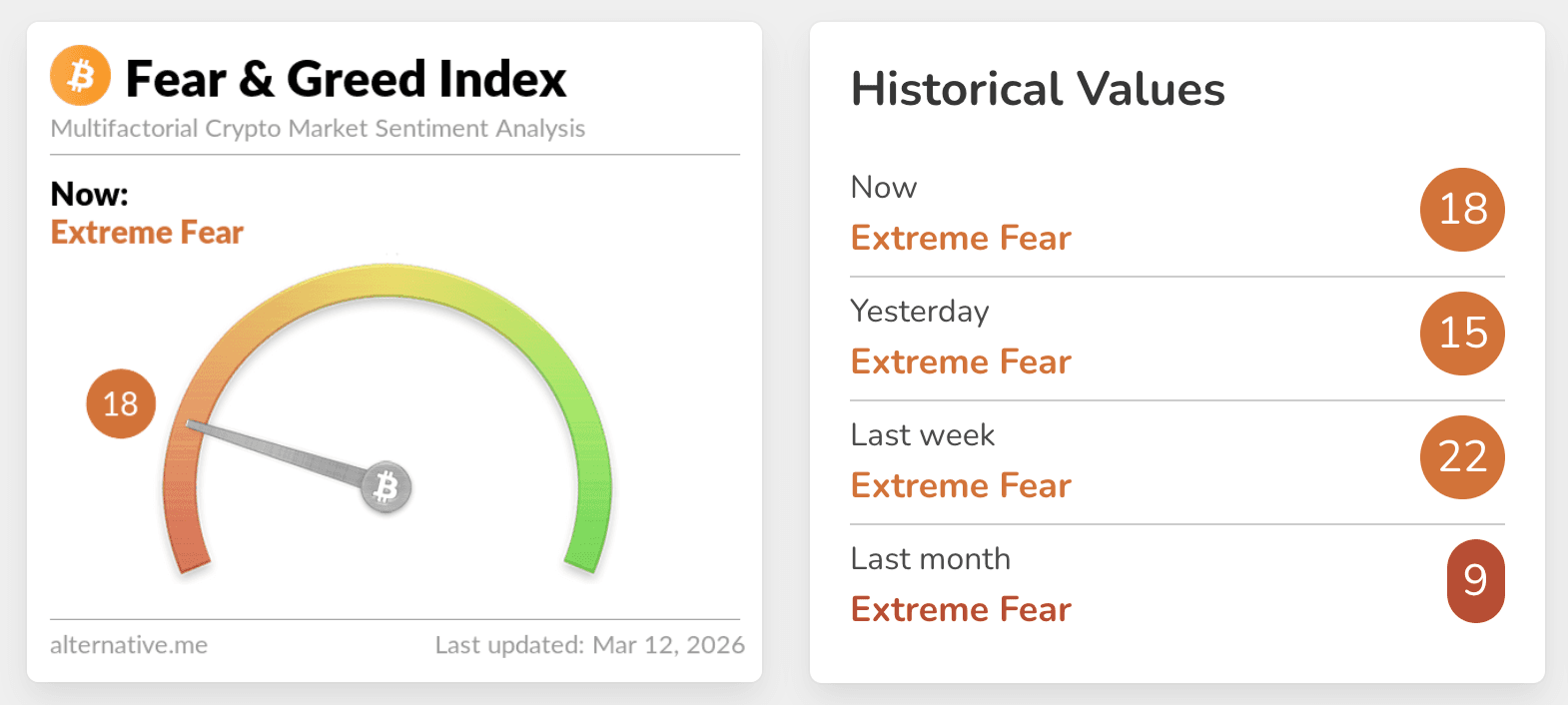
The Crypto Fear & Greed Index is currently at 18, remaining deep within the Extreme Fear zone. This reflects extreme investor caution regarding potential security risks in California and the ongoing uncertainty surrounding Middle East ceasefire negotiations. Despite several failed attempts to break $74,000 which dampened short-term sentiment, Bitcoin has maintained robust resilience compared to other digital assets. Conversely, Ethereum remains constrained by a heavy leverage structure in the derivatives market. Without a powerful fundamental catalyst, its elasticity is significantly weaker than that of Bitcoin. Current market behavior is characterized by the continuous flushing of speculative positions and the gradual entry of long-term defensive capital. Risk appetite for digital assets remains low, leaving the overall market structure in a suppressed state. Investors appear to be adopting a "defend and counter-attack" posture under the shadow of extreme fear.
Source: Alternative
BTC and ETH Market Analysis
The price trajectories of Bitcoin and Ethereum are currently strictly dictated by the liquidation maps of the derivatives market, showing clear characteristics of range-bound consolidation and leverage-driven movement. According to Coinglass data, Bitcoin faces USD 1.502 billion in short-liquidation pressure near $72,851, while a drop to $66,265 would trigger USD 1.202 billion in long liquidations. This symmetrical liquidation distribution makes it difficult for prices to break out of the existing framework in the short term. Ethereum’s structure is equally fragile. A move above $2,122 would trigger USD 825 million in short liquidations, whereas a break below the $1,929 support level would face USD 729 million in long liquidations. This market structure reflects a severe lack of momentum for capital to chase higher prices and a lack of substantial spot demand to break the deadlock. Without clear macroeconomic guidance, prices often experience sharp volatility following fake breakouts at key levels, indicating the market is in a brutal stage of leverage flushing.
Key News Highlights:
SEC and CFTC Sign Memorandum to End Regulatory Turf War
The US Securities and Exchange Commission (SEC) and the Commodity Futures Trading Commission (CFTC) recently signed a landmark memorandum of understanding to end decades of regulatory disputes. The two agencies announced they will now seek coordinated oversight of the cryptocurrency and digital markets. The memorandum emphasizes that the rise of automated onchain systems and new trading models has blurred traditional jurisdictional lines. Consequently, the agencies will adopt a “minimum effective dose” regulatory strategy to maintain market integrity while minimizing interference with technical innovation. SEC Chair Paul Atkins noted that past duplicative registrations and inconsistent regulations forced many market participants to move overseas. This collaboration serves as a vital administrative pillar to establish the US as the global crypto capital. Moving forward, the agencies will establish a crypto-specific task force to provide consistent compliance standards for trading platforms, clearinghouses, and digital asset products. This move is expected to clear the final hurdles for institutional investors who were previously deterred by legal uncertainty.

Source: Mike Selig
Ripple Launches USD 750 Million Share Buyback to Signal Capital Strength
Despite a correction of over 50% in the price of XRP over the past six months, Ripple Labs plans to execute a share buyback program of up to USD 750 million by April. This move will push the company's valuation to a new high of USD 50 billion. The buyback is intended to provide liquidity for investors and employees while demonstrating capital confidence following the expansion of its financial services footprint. Ripple has recently acquired institutional-grade service providers such as Hidden Road and GTreasury to successfully extend its business from cross-border payments to prime brokerage and treasury management systems. According to the company's latest report, its stablecoin RLUSD has rapidly surpassed a market capitalization of USD 1 billion since its December launch, and its total transaction volume has exceeded USD 100 billion. While speculation about an IPO continues, Ripple is currently focused on obtaining a US national trust bank charter. Having received preliminary approval from the OCC, the company is transitioning from a crypto-native firm into a regulated global financial infrastructure provider.
Circle Stock Decouples from Crypto Market as Stablecoins Shift to Settlement Layer
Circle's stock price has recently shown a significant decoupling from Bitcoin's price action due to a fundamental shift in how the market values the USDC model. Following the passage of the GENIUS Act in the US, which established a clear regulatory moat for compliant issuers, USDC demonstrated remarkable counter-cyclical growth. Its circulation has surpassed USD 75.3 billion and it has exceeded competitors in terms of onchain transaction volume for the first time. This reflects a transition for stablecoins from speculative trading units to global payment infrastructure. Major financial institutions like Visa and JPMorgan have embedded USDC into their cross-border settlement pipelines, shifting its growth driver toward the USD 150 trillion global payment market. Furthermore, Circle is actively positioning itself for the "machine economy" by developing programmable payment infrastructure for AI agents to solve the high friction costs of traditional banking. Although AI-related revenue remains a small percentage of total earnings, the market is betting on this structural transition from a simple cryptocurrency to a global digital settlement layer, viewing Circle as a pure entry point into the future digital economy.
Trending Tokens:
- $NIL (Nillion)
Nillion is gaining significant market attention as a core privacy infrastructure project. It utilizes decentralized blind computation to process private data without any exposure. The recently launched Nillion Blacklight introduces a decentralized verification layer for the community. This allows nodes to verify workloads within secure execution environments effectively. Users must stake at least 70,000 $NIL tokens on the Ethereum Layer 2 network to participate. This mechanism directly links token utility to network security and scaling efforts. Demand for $NIL is driven by its role in governance and private compute pricing. The integration with Phala Network further confirms its ambition to become a universal trust layer for Web3.
- $LAB (LAB)
LAB has emerged as a prominent multi-chain trading terminal focused on execution efficiency. The project recently announced major expansions into prediction markets through integrations with DFlow and Kalshi. This move brings real-world probabilities directly into the trading interface for all users. Traders can now place prediction orders alongside traditional spot and perpetual positions. This integration allows users to trade real-world outcomes as actionable signals on the platform. By tokenizing these markets on Solana, LAB enables hedging against narratives before consensus is reached. The addition of CFTC-regulated event contracts provides institutional-grade compliance and liquidity. Therefore, the utility of $LAB tokens continues to grow as the platform becomes a comprehensive financial hub.
- $RIVER (River)
River is currently leading the chain abstraction narrative with its unified stablecoin system. The core stablecoin satUSD uses an innovative omni-CDP module for cross-chain functionality. This allows users to collateralize assets on one chain and mint stablecoins on another without bridges. A recent distribution of 250,000 $RIVER tokens to early users has significantly boosted community engagement. This incentive has successfully deepened liquidity across networks like BNB Chain, Base, and Arbitrum. Market interest remains high following the strategic rebrand from the former Satoshi Protocol. The $RIVER token serves as the primary coordination layer for capturing protocol fees. Growing adoption of the satUSD stablecoin continues to drive long-term value for the entire ecosystem.
Disclaimer: The information provided in this section is for informational purposes only and doesn't represent any investment advice or FameEX's official view.