FameEX Today’s Crypto News Recap | March 16, 2026
2026-03-16 06:56:37
Market News Aave deploys safety shield, Vitalik proposes node simplification, and Gold vs. BTC hedge analysis, as Bitcoin reclaims its 200-week trend line and briefly reaches the $73K mark. Over the past 24 hours, the cryptocurrency market has demonstrated strong recovery momentum as both Bitcoin and Ethereum successfully broke through key psychological resistance levels. This movement has significantly bolstered overall market sentiment. According to the latest data, Bitcoin briefly reclaimed the $73,000 level while Ethereum surged past the $2,200 support line, indicating an effective weekend offensive by the bulls. However, this price surge triggered intense liquidation activity totaling USD 193 million across the network. Short liquidations accounted for nearly 75% of this total. This reflects a massive squeeze on bearish leverage during the rapid price ascent. Despite the strong short-term performance, institutional investors remain cautious due to ongoing macroeconomic uncertainties, particularly the impact of geopolitical tensions in the Middle East on energy prices and inflation expectations. The market currently exhibits a leverage-driven recovery, but the appetite for chasing prices at local highs remains modest. Volatility is expected to expand further as the CME futures market opens on Monday.
Crypto Markets Overview
The Crypto Fear & Greed Index currently stands at 23, placing the market firmly within the Extreme Fear zone. While this is an improvement from yesterday’s reading of 15 and last week’s 8, it continues to reflect deep investor anxiety regarding macroeconomic geopolitics and monetary policy. In the current market structure, Bitcoin’s rally is primarily driven by short covering and retaliatory buying following large-scale liquidations rather than pure safe-haven demand. In contrast, Ethereum’s open interest grew by 5.85% over the past 24 hours to reach USD 292 million, turning it into a primary battleground for bulls and bears. This tug-of-war has resulted in high volatility and liquidation tremors, leading to a "step-like" technical recovery for ETH. Overall risk appetite remains locked in a conservative consolidation mode. Although sentiment has thawed alongside the price rebound, the market is undergoing a technical repair rather than a bullish reversal due to the dual pressure of rising Treasury yields and a strong US dollar. Any further upward trajectory will depend heavily on a substantive improvement in macro liquidity.
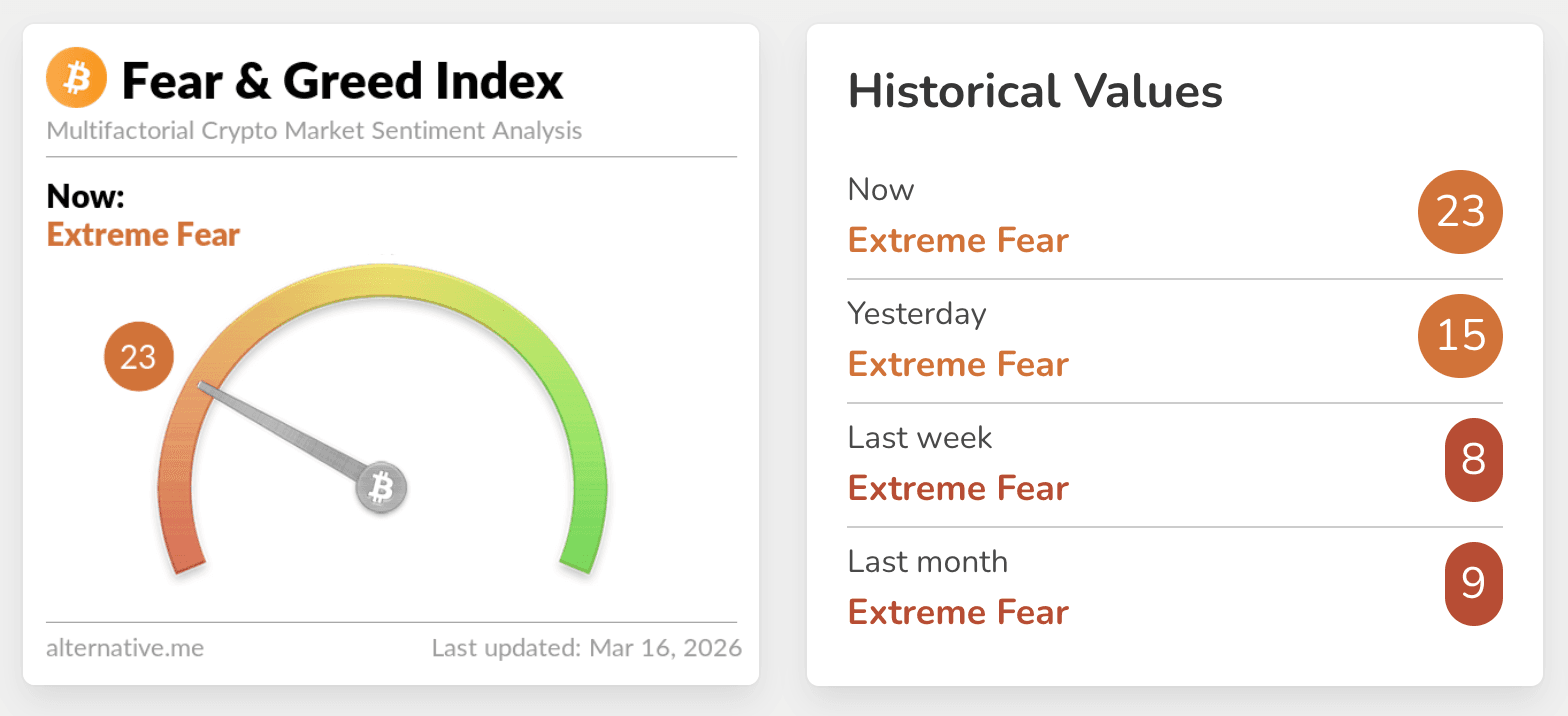
Source: Alternative
BTC and ETH Market Analysis
Bitcoin and Ethereum have displayed distinct structural characteristics today. BTC successfully secured a weekly close above $70,000 and touched a local high near $73,000, completing a crucial retest of its 200-week trend line. Data monitoring suggests that if BTC falls below $68,921, major exchanges will face long liquidation intensity totaling USD 1.391 billion. Conversely, a breakout above $76,049 would trigger approximately USD 570 million in short liquidations. Regarding Ethereum, although ETH broke above $2,200, its total open interest surged by 5.85% in 24 hours to USD 29.281 billion. This indicates that leverage is accumulating rapidly within the ecosystem. The critical liquidation zone for ETH sits below $2,060, where a breach could trigger USD 1.07 billion in cascading long liquidations. This leverage-driven rally lacks a solid foundation of spot accumulation, as investors are opting for steady profit-taking at local highs rather than aggressive buying. This behavior confirms that the market remains within a broader range-bound consolidation.
Key News Highlights:
Aave to Launch Aave Shield Following Major Token Swap Incident
The decentralized finance protocol Aave has officially announced the upcoming deployment of a new safety feature called Aave Shield. This initiative follows a recent incident where a user suffered a catastrophic financial loss during a token swap. Last week, a user attempted to convert USD 50.4 million worth of USDT into AAVE tokens via the Aave interface. Due to insufficient market liquidity and infrastructure failures, the user received only USD 36,500 worth of tokens, resulting in a loss of USD 50 million. Aave’s post-mortem revealed that this was not merely a slippage issue, as the user ignored multiple high-risk warnings on the interface and manually confirmed a transaction with an extreme price impact. The new Aave Shield feature will automatically block any swap requests with a price impact exceeding 25% to protect participants. Users must manually disable this protection to proceed with such high-risk trades. This incident highlights ongoing challenges in the DeFi ecosystem regarding Maximal Extractable Value (MEV) sandwich attacks and liquidity depth monitoring.
Vitalik Buterin Proposes Simplified Ethereum Node Architecture to Enhance Decentralization
Ethereum co-founder Vitalik Buterin recently introduced a pivotal technical optimization proposal aimed at streamlining node operations. The proposal suggests merging the backend programs for the consensus layer (Beacon Chain) and the execution layer into a single unified code structure. Currently, Ethereum validators must run and synchronize two separate programs, which increases technical complexity and hardware requirements. This high barrier to entry often prevents ordinary users from participating in node operations and forces a reliance on professional service providers. Buterin emphasized that running personal infrastructure should be a fundamental right for every individual and household rather than a task reserved for DevOps professionals. To further lower the threshold, he advocated for the development of partially stateless nodes. These nodes would not need to store the full history of the blockchain, effectively solving the disk space bottleneck that currently plagues node operators. This reform aims to reduce dependence on a few remote procedure call (RPC) providers and prevent potential censorship risks arising from excessive centralization.
Geopolitical Conflicts Trigger Global Asset Volatility to Compare Bitcoin and Gold as Safe Havens
The escalation of tensions in the Middle East during 2026 has become a defining moment for the "Digital Gold" narrative of crypto assets. As the conflict with Iran sparked fears of a blockade in the Strait of Hormuz and energy supply disruptions, global capital flows diverged significantly. Gold, the traditional safe-haven benchmark, initially benefited from crisis-driven demand. However, those gains were later erased as the US dollar strengthened and Treasury yields rose, demonstrating that macroeconomic forces can sometimes override safe-haven buying. In contrast, Bitcoin experienced a brief sell-off and sharp volatility at the onset of the conflict, reaching a low of $63,106 before rapidly rebounding to the $73,156 range. This recovery showcased Bitcoin’s growing market resilience. Analysts note that while Bitcoin remains closely tied to global liquidity and general risk sentiment, it has not yet fully evolved into a stable hedge like gold. Nevertheless, Bitcoin’s ability to recover quickly under extreme geopolitical stress has prompted institutional investors to further investigate its role as a modern alternative store of value.
Trending Tokens:
- $PI (Pi Network)
The Pi Network ecosystem gained strong momentum following its seventh anniversary announcements in 2026. This update introduced major infrastructure upgrades and expansion plans. The transition of the Mainnet blockchain to Protocol 20 marks a technical milestone. This protocol provides the essential foundation for smart contract capabilities and decentralized applications. Additionally, the Pi Launchpad MVP launched on the Testnet to establish a structured mechanism for ecosystem tokens. It aims to achieve user acquisition and product utility. Market attention increased significantly due to the start of second migrations and the first round of KYC validator rewards. These rewards totaled over 26 million PI. These developments reflect a strategic shift toward utility-driven growth and sustainable on-chain activity. The project continues to bridge the gap between mobile mining and functional decentralized finance.

- $UP (Unitas)
Unitas became a focal point in decentralized finance after securing 13.33 million dollars in seed funding. This funding round included prominent investors like Amber Group and SevenX Ventures. It highlights the market demand for sustainable and market-neutral yield infrastructure. Unitas aims to solve structural challenges like yield compression and opacity. It achieves this by building an execution layer for long-term capital deployment. Its protocol supports yield-generating stablecoins and synthetic assets. These assets are backed by transparent risk management and unified custody standards. The narrative focuses on making stable assets productive through delta-neutral strategies. It also expands support to tokenized commodities and real-world assets. Investors are monitoring its integration within the Solana ecosystem. They view it as a potential pillar for institutional-grade on-chain liquidity and settlement.
- $ION (Ice Open Network)
Ice Open Network is gaining traction within the Layer 1 narrative again. This follows the beta launch of the real-time crypto prediction game Bao Rush. This application was introduced by ecosystem partner Bao Trader. It integrates the ION token through direct utility and automated burning mechanisms. These features further enhance its deflationary pressure. The project emphasizes its high-performance characteristics. It utilizes a multi-threaded sharding architecture and the TON Virtual Machine for complex smart contracts. ION aims to demonstrate horizontal scalability and efficiency as network participation grows. It achieves this by fostering a diverse range of utility-focused dApps. The current beta phase and the upcoming live mode serve as catalysts for increased on-chain activity.
Disclaimer: The information provided in this section is for informational purposes only and doesn't represent any investment advice or FameEX's official view.