FameEX Today’s Crypto News Recap | August 18, 2026
2026-08-18 07:58:10

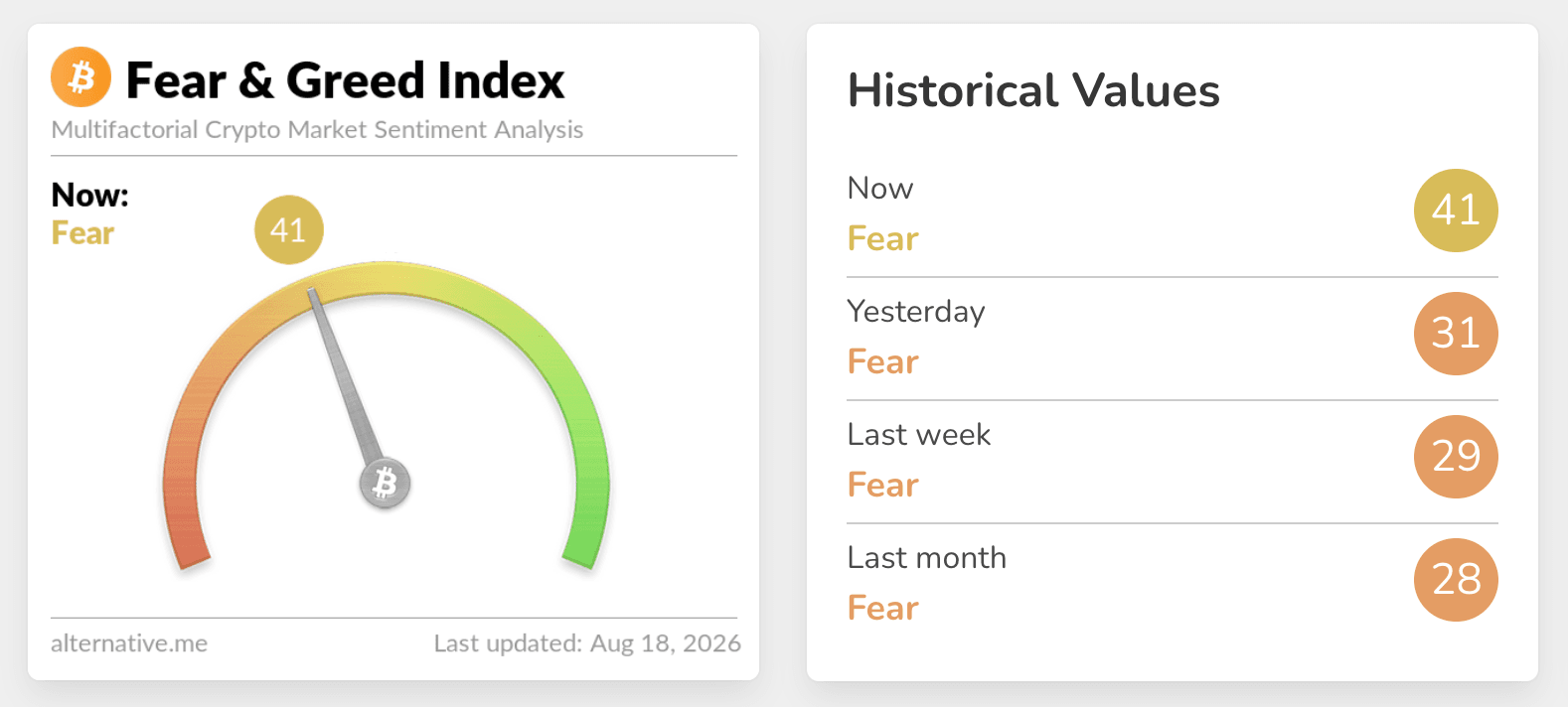
CFTC seeks input on AI compute futures as OCC backs WLFI’s trust charter and EU widens crypto sanctions; today’s BTC price trades near $64K in Fear sentiment. Bitcoin and Ethereum have remained in the price range as macro conditions and on-chain market structure continue to interact. The Crypto Fear & Greed Index has risen to 41, remaining in the Fear zone. This marks a notable improvement from 31 yesterday and 29 last week, although overall market sentiment remains cautious. According to research data, Bitcoin’s 30-day price volatility has fallen to historically low levels. Historical comparisons show that similar periods of compressed volatility have often been followed by significant price moves within the next 60 days. Based on a Bitcoin price of around $64,000, a 30% upward move would place the price near $83,200, while a move of the same magnitude to the downside would bring it near $44,800. Meanwhile, 10x Research identified $63,000 as a key level in determining whether the market is forming a bottom or moving toward a deeper decline. In the derivatives market, Coinglass data shows that a drop below $60,941 could expose approximately USD 1.265 billion in cumulative BTC long liquidation intensity across major CEXs. A move above $67,145 could instead expose around USD 970 million in cumulative short liquidation intensity. For Ethereum, a move above $1,986 could bring cumulative short liquidation intensity to about USD 809 million, while a decline below $1,809 could expose approximately USD 734 million in long liquidation intensity. Total crypto liquidations over the past 24 hours reached USD 212 million. Long liquidations accounted for USD 36.9863 million, while short liquidations totaled USD 175 million. Separately, Bank of America’s second-quarter 13F filing showed that it reduced its Strategy (MSTR) holdings by about 70%. At the same time, its holdings in BlackRock’s spot Ethereum ETF increased roughly 29-fold to a reported quarter-end value of USD 23.6 million. Citadel Securities also warned that the Federal Reserve’s reluctance to tighten policy while inflation remains above target has kept long-term U.S. Treasury yields near multi-year highs, leaving broader markets exposed to continued macroeconomic risk.
Source: Alternative
Key News Highlights:
CFTC Seeks Public Input on AI Compute Futures Contracts
The U.S. Commodity Futures Trading Commission is preparing to seek public feedback on futures contracts linked to artificial intelligence computing capacity. The move signals that AI compute is beginning to enter the regulatory framework for traditional derivatives markets. The request for comment has been submitted to the White House Office of Management and Budget for review. Once that process is completed, the CFTC is expected to open a formal public comment period. Reports indicate that the consultation could last 30 or 60 days, which may affect the launch timelines of planned compute futures products. CME Group and Intercontinental Exchange have both been developing products tied to computing capacity, although any launch remains subject to regulatory approval. CME previously announced plans to introduce two compute futures contracts on October 5. Market intelligence firm Silicon Data is expected to provide the benchmarks used for pricing. These contracts are designed to turn the computing capacity required to train and operate AI models into a tradable and hedgeable asset. This could allow companies and market participants to manage future changes in compute costs. As investment in data centers, chips, and computing infrastructure continues to expand, the availability and cost of AI compute are becoming increasingly important. Some estimates put U.S. AI infrastructure spending in 2026 at roughly 2% to 2.5% of GDP. This is bringing compute pricing into greater focus for both financial markets and regulators.
OCC Conditionally Approves World Liberty Financial for a National Trust Bank Charter
The U.S. Office of the Comptroller of the Currency has conditionally approved World Liberty Financial’s application for a national trust bank charter. The decision moves the company’s banking plans one step closer to implementation. According to documents released by the OCC, the company would be permitted to operate under the name World Liberty Trust Company, National Association once it satisfies specific regulatory and policy requirements. World Liberty’s application includes plans to issue U.S. dollar-backed stablecoins and provide custody services for digital assets related to its USD1 token. Because the approval is conditional, the company must meet the OCC’s requirements before beginning those operations. The review has drawn attention from some U.S. lawmakers because the U.S President Donald Trump and his three sons are affiliated with World Liberty Financial. A Trump family-related entity has also been reported to hold an equity interest in the company. The OCC said its officials and staff acted in accordance with their statutory duties and ethical obligations throughout the review process. OCC head Jonathan Gould had previously stated that the application would be reviewed through an apolitical and nonpartisan process. Following the approval, Senator Elizabeth Warren and nine other senators introduced the Ending Presidential Corruption in Banking Act. The bill seeks to impose additional restrictions on banking charter applications involving the financial interests of a sitting president or their family. The OCC has reviewed several trust charter applications from digital asset companies in recent years. As a result, the path for crypto firms to enter the regulated U.S. banking and custody system remains an important policy issue.
EU Expands Sanctions Powers Over Third-Country Crypto Platforms
The European Union approved its 21st package of sanctions against Russia on July 23, further expanding the role of crypto-asset services in sanctions enforcement. The measures introduced transaction restrictions on 14 offshore crypto service platforms across jurisdictions including Georgia, Panama, the United Arab Emirates, the Marshall Islands, Kyrgyzstan, and Belarus. The EU also added four designations linked to the Russian ruble-based A7 network. These measures are intended to restrict the movement of assets through overseas institutions connected to the network. Another provision will take effect on August 25. It further restricts Russian and Belarusian nationals from owning, controlling, or holding certain positions in EU-based crypto-asset service providers. The scope of the restrictions has also been expanded to cover additional services defined under MiCA. These include advisory services, portfolio management, and crypto-asset transfers conducted on behalf of clients. A new Article 5bc creates an additional enforcement mechanism. It allows the EU to impose broader crypto transaction bans on third countries that are found to have systematically and persistently failed to prevent sanctions evasion through crypto services. The country-level list is currently empty, so no third country has yet been formally designated under this mechanism. Any future addition would depend on a determination by the Council of the European Union. Because the framework could extend sanctions enforcement beyond individual companies and into the broader crypto-service environment of a third country, it has also raised questions about cross-border regulation, secondary sanctions, and potential conflicts between different legal jurisdictions.
Disclaimer: The information provided in this section is for informational purposes only and doesn't represent any investment advice or FameEX's official view.