FameEX Today’s Crypto News Recap | August 31, 2026
2026-08-31 07:17:17

Cronos halts after Tectonic exploit as Bitcoin tests quantum defenses and Russia’s Sber expands crypto lending; today’s BTC trades near $77.5K in Greed sentiment. Bitcoin is currently trading at around $77.5K, down about 0.8% over the past 24 hours. The price has returned to the consolidation zone after previously reclaiming $80K. Ethereum is trading at around $2,413, with a 24-hour decline of approximately 1.7%. ETH briefly fell below $2,400 before staging a modest recovery. The Crypto Fear and Greed Index currently is at 62, placing market sentiment in the "Greed" zone. This is down from 69 yesterday and 73 last week, indicating that overall sentiment has cooled from recent levels. Total crypto market liquidations reached approximately USD 399 million over the past 24 hours. Long liquidations accounted for about USD 276 million, while short liquidations totaled around USD 123 million. This left long positions facing greater liquidation pressure. Bitcoin futures open interest stands at approximately USD 54.82 billion and remains higher over the past 24 hours. This suggests that leveraged positions remain relatively elevated despite the recent price pullback. The maximum pain level for major September Bitcoin options is concentrated between $70K and $73K. Put options also accounted for a larger share of trading volume than call options during the same period, reflecting ongoing adjustments in derivatives positioning. In the spot market, U.S. spot Bitcoin ETFs recorded approximately USD 924 million in net inflows last week. Spot Ethereum ETFs posted about USD 824 million in net inflows over the same period. However, Bitcoin spot trading volume across major trading platforms remains near a three-year low despite the strong price gains recorded in August. This highlights a continued gap between price performance and spot market activity.
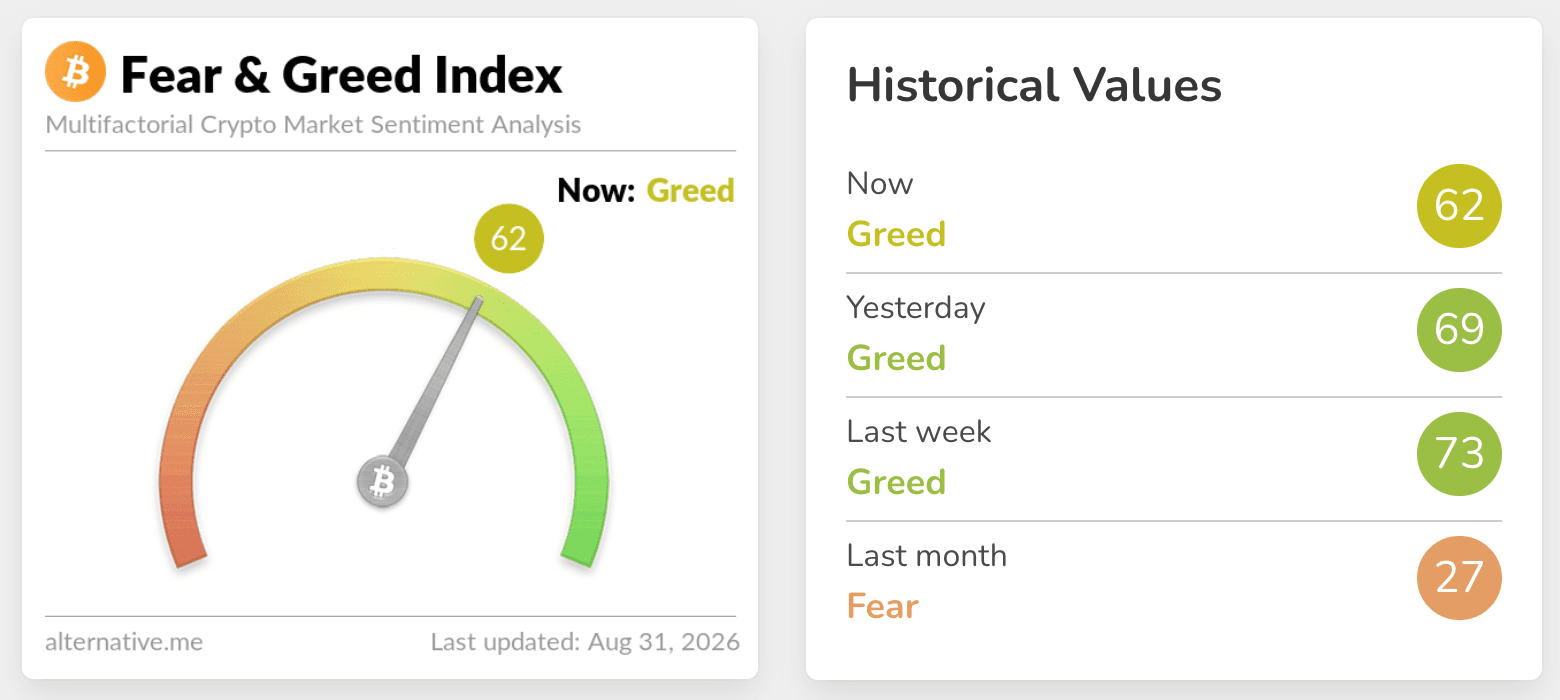
Source: Alternative
Key News Highlights:
Cronos Halts Blockchain After Tectonic Exploit Involving an Estimated USD 75 Million
Cronos halted its blockchain after decentralized lending protocol Tectonic suffered an exploit. External researchers currently estimate that approximately USD 75 million in assets were involved. Tectonic subsequently advised users not to interact with the protocol while it investigated the cause of the exploit and tracked the movement of funds. Security researchers said the attack may have involved TONIC's 20% collateral factor and limited market liquidity. According to their analysis, the attacker sharply pushed up the market price of TONIC within about 20 minutes. The inflated tokens were then used as collateral to borrow other assets. Initial estimates placed the affected assets at around USD 66 million. Approximately USD 6 million was transferred to Ethereum, while most of the remaining assets were still on Cronos when the network was halted. Researchers later identified another attacker-controlled address holding roughly USD 8 million. This raised the estimated total involved in the incident to around USD 75 million. At the time of publication, neither Cronos nor Tectonic had officially confirmed the final loss amount. They had also not announced a specific timeline for restarting the blockchain. Cronos and Tectonic have yet to disclose whether the attacker-controlled addresses will be restricted, whether transferred assets can be recovered, or whether affected users will receive compensation.
Bitcoin Mainnet Completes Quantum-Resistant Transaction Test as Post-Quantum Signature Development Advances
Two recent developments have advanced research into quantum-resistant security for Bitcoin. The work is beginning to move beyond conceptual discussions toward mainnet testing and protocol-level upgrade proposals. StarkWare researcher Avihu Levy tested an experimental quantum-resistant transaction on the Bitcoin mainnet. The goal was to reduce potential security risks during the brief period when a public key is exposed after a transaction enters the mempool. On-chain records show that the test used a 10,000-satoshi output protected by the Quantum Safe Bitcoin scheme. The technology combines hash-based one-time signatures with computational searches to bind transaction authorization to a specific transaction. The test was successfully executed, but the current design still has major efficiency limitations. Each transaction can take several hours to complete and may cost between USD 150 and USD 200. Separately, Blockstream researchers published a new Bitcoin Improvement Proposal on August 27. The proposal introduces the SHRINCS signature scheme as another potential path toward post-quantum protection for Bitcoin. Researchers have reduced the size of the original hash-based post-quantum signature by about 13.23 times. Even so, a SHRINCS signature remains at least nine times larger than Bitcoin's current signatures. Further development will therefore need to balance data size, verification costs, and overall network efficiency. Together, the two projects show that Bitcoin's quantum-resistance research is moving toward practical testing and more concrete protocol design.
Sber Plans to Add ETH and USDT to Crypto-Backed Lending
Russia's largest bank, Sber, is preparing to expand its crypto-backed lending services. The bank plans to accept ETH and USDT as collateral alongside Bitcoin. Sber Deputy Chairman Anatoly Popov said the bank will adapt its existing products to Russia's new cryptocurrency law and gradually expand the range of supported digital assets. ETH and USDT can only be added as collateral after the Bank of Russia approves them for public trading within the regulated market. Russian President Vladimir Putin signed the relevant cryptocurrency law on August 4. Its core provisions are scheduled to take effect on September 1. Under the new framework, the Bank of Russia will determine which crypto assets can be traded on regulated venues. The central bank previously proposed BTC, ETH, and USDT for the regulated market. It cited factors including market capitalization, trading volume, and at least five years of overseas price history. Sber has taken a more cautious position on the broader rollout of the digital ruble. Sber Chief Financial Officer Taras Skvortsov said the bank has not seen clear demand for the central bank digital currency among retail users, corporate clients, or financial institutions. Once the new law takes effect, regulated crypto trading, bank-issued crypto-backed loans, and the digital ruble will continue to develop as separate parts of Russia's evolving digital financial framework.
Stellar Tokenized RWA Market Nears USD 4 Billion After Growing About 360% in 2026
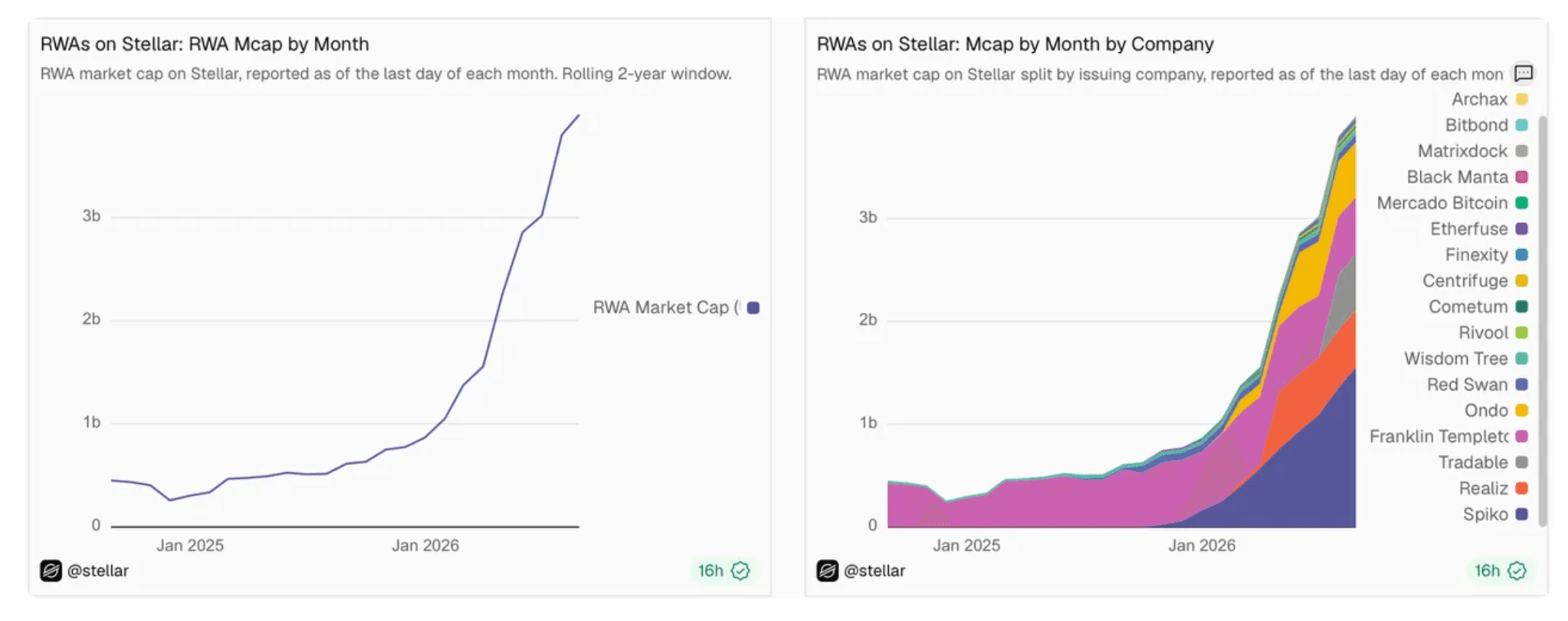
The value of tokenized real-world assets on Stellar has continued to expand this year. The total market size approached USD 4 billion as of August 29. Data from a Dune Analytics dashboard maintained by Stellar shows that the network's RWA market capitalization reached approximately USD 3.996 billion. This was up from USD 868.8 million at the end of 2025 and represented growth of about 360% in 2026. Assets currently issued on Stellar include U.S. Treasurys, private and public credit, non-U.S. government debt, and other tokenized financial products. Issuance remains concentrated among several major institutions. Spiko accounted for approximately USD 1.55 billion, while Realiz, Tradable, Franklin Templeton, and Ondo were also among the largest issuers. Stellar has also expanded its presence in tokenized government debt outside the United States. This segment reached approximately USD 490 million as of August 20 and included assets such as Mexican CETES and Brazilian government bonds. On the infrastructure side, DTCC plans to connect its tokenization service to Stellar. DTC-tokenized assets are expected to become available on the network as early as the first half of 2027. Tradable has also announced plans to bring up to USD 1 billion in private credit assets to Stellar. The initiative is designed to support compliance processes, investor onboarding, and asset lifecycle management. Stellar's role in on-chain payments has also expanded. MoneyGram launched its U.S. dollar stablecoin MGUSD on the network in June, allowing users to hold dollar-denominated balances and transfer funds through its payment network. Stellar currently hosts approximately USD 438 million in reserve-verified stablecoins. RWA tokenization, stablecoins, and payment services have therefore become key institutional use cases across the network.
Disclaimer: The information provided in this section is for informational purposes only and doesn't represent any investment advice or FameEX's official view.