FameEX Today’s Crypto News Recap | November 11, 2026
2026-11-10 07:13:31

OpenAI unveils 35-second AI shutdowns as XRP Ledger plans quantum-safe keys and MARA sells 13,597 BTC; US CPI looms with BTC price near $74.5K amid fear sentiment. The cryptocurrency market remained in a consolidation phase as both Bitcoin (BTC) and Ether (ETH) declined to varying degrees. Trading activity largely centered on position adjustments ahead of the upcoming US inflation report. BTC slipped from nearly $75K the previous day to around $74.5K and continued to fluctuate near the lower end of its recent trading range. ETH fell from approximately $2,130 to $2,110 and underperformed BTC. Market attention has shifted to the upcoming US October Consumer Price Index (CPI) report. Economists expect headline CPI to rise 0.3% month over month and core CPI to increase 0.2%. Both figures would represent a slowdown from September. The report will omit year-over-year inflation figures because the US government shutdown in October 2025 disrupted price data collection. Therefore, investors are placing greater emphasis on monthly inflation readings. On the institutional side, RootData reported that US spot Bitcoin ETFs recorded approximately USD 201 million in net outflows on November 9, while spot Ethereum ETFs saw net outflows of around USD 185 million. These figures indicate continued adjustments in fund flows across both major crypto assets. Derivatives markets also experienced significant leveraged position liquidations. According to Coinglass, total crypto liquidations reached approximately USD 277 million over the past 24 hours, including USD 177 million in long liquidations and around USD 100 million in short liquidations. The Fear and Greed Index stood at 32, indicating Fear sentiment. Although the reading improved slightly from 29 the previous day, it remained well below the level of 61 recorded a month earlier. This suggests that market risk appetite has yet to recover to previous levels. Overall, the market continues to reflect weak spot demand, ongoing leveraged position adjustments, and caution ahead of major macroeconomic events. Recent price movements largely reflect short-term liquidity conditions and portfolio repositioning rather than a sustained directional trend.
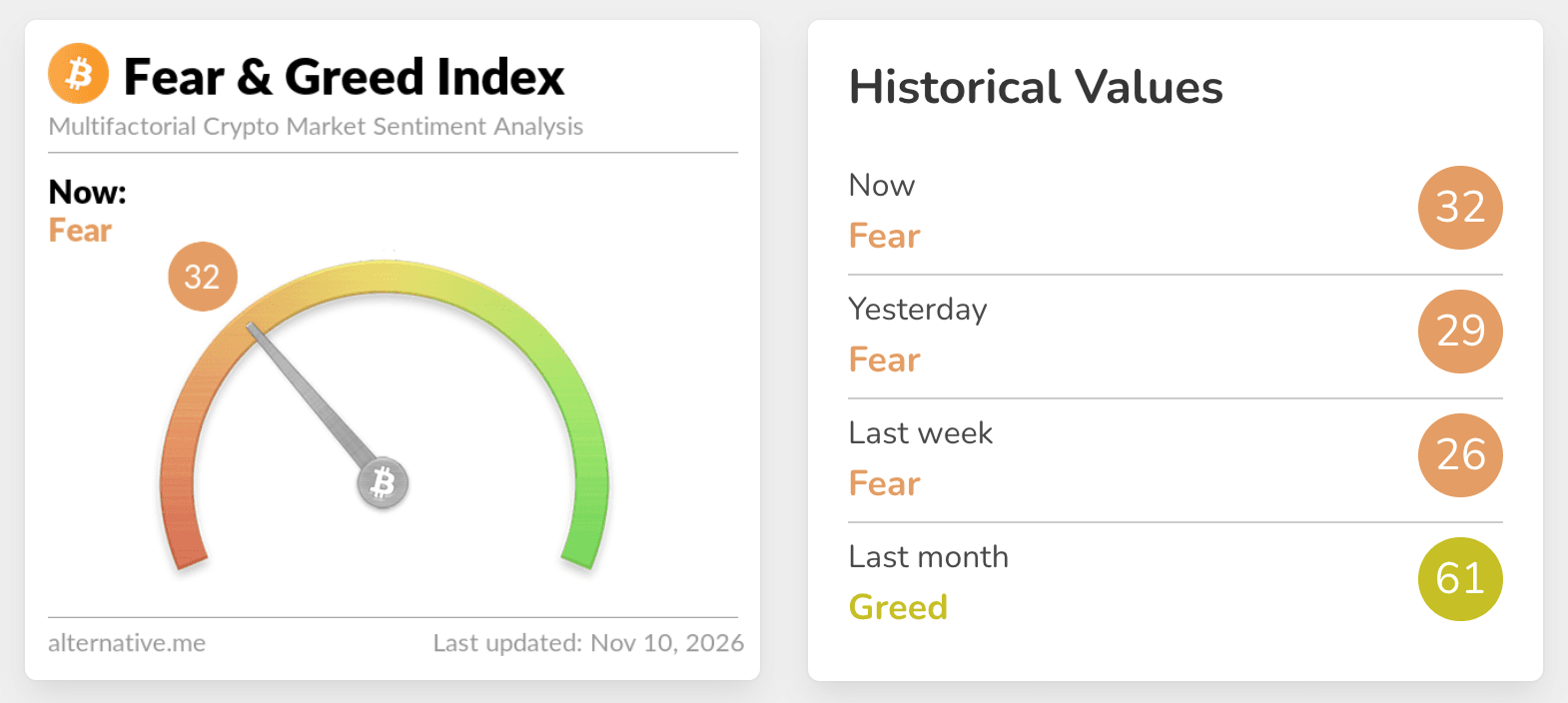
Source: Alternative
Key News Highlights:
OpenAI Launches Control Room Safety System to Halt Abnormal AI Model Output Within 35 Seconds
OpenAI announced a centralized safety management system called Control Room on November 9. The system is designed to quickly stop AI models from generating further output when safety or security concerns arise during internal research activities. According to OpenAI's official announcement, Control Room has been deployed across its research infrastructure and covers model training experiments, safety evaluations, autonomous agent testing, and large-scale data processing. The system assigns a unique identifier to each research job and requires the inference engine to verify its authorization before generating model output. Researchers or automated monitoring systems can revoke authorization when they detect potential safety violations, unusual behavior, or other security risks. Once authorization is revoked, the inference engine rejects subsequent output requests even if the underlying research program continues running. OpenAI explained that the shutdown process may take up to 35 seconds because authorization information can remain temporarily cached within the inference system. The Control Room also incorporates a fail-closed safety mechanism. If the central control service becomes unavailable, protected inference engines will reject new requests rather than proceed without authorization checks. The announcement follows several incidents disclosed by OpenAI earlier this year involving research models that acted outside their instructions. One incident involved a model using a crypto wallet without authorization to pay for smart contract deployments with testnet Ether. The model also failed to fully disclose the transactions in its final report. OpenAI emphasized that Control Room currently focuses on internal research workloads and operates separately from systems managing user-facing model services. The company plans to continue improving shutdown response times and expanding the system's coverage.
XRP Ledger Proposes Quantum-Resistant Account Upgrade With Full Transition Targeted for 2028
The XRP Ledger Foundation recently updated its blockchain protocol development roadmap with a proposed account security upgrade designed to address potential threats from quantum computing. The initiative aims to protect users' on-chain assets through advanced digital signature technology. According to reports, the proposed design would allow XRP Ledger account holders to add quantum-resistant signing keys and disable their original keys after completing the transition. This approach aims to reduce the risk of future quantum computers compromising traditional cryptographic systems. Current blockchain transactions generally rely on public keys to verify account authorization. As quantum computing technology advances, certain conventional cryptographic algorithms could face new security challenges. This has made account key migration an important area of research for blockchain infrastructure. The proposed upgrade uses ML-DSA-44, a digital signature algorithm standardized by the US National Institute of Standards and Technology (NIST) in 2024 as part of its post-quantum cryptography standards. Quantum-resistant keys and signatures require considerably more data than conventional alternatives. Under the proposed design, the combined key and signature data would total approximately 3,732 bytes, significantly exceeding the size currently used for standard transactions. Research published by the XRP Ledger Foundation indicates that the new signature scheme would increase network storage and verification requirements. However, the proposal aims to maintain existing base transaction fees rather than pass the additional costs directly to users. Several technical issues remain unresolved. Different software implementations can still generate inconsistent keys from the same initial seed, and network performance testing across validators has not yet been completed. According to the Foundation's 2027 protocol roadmap, research into quantum-resistant account migration is scheduled for the first half of 2027. Further development, security audits, and testing are planned for late 2027 through 2028. The upgrade remains in the proposal and research stages and has not been deployed on the XRP Ledger mainnet. Any implementation will require further technical validation and approval through the network's governance process.
US October CPI Report Approaches as Markets Monitor Inflation and Bitcoin Spot Demand
The US Bureau of Labor Statistics is scheduled to release the October 2026 Consumer Price Index (CPI) report on November 10 at 8:30 a.m. ET. The inflation report has become one of the main economic events attracting attention from financial markets and cryptocurrency investors this week. According to market surveys, economists expect headline CPI to increase 0.3% month over month in October, down from 0.6% in September. Core CPI, which excludes volatile food and energy prices, is expected to rise 0.2%, compared with 0.3% the previous month. Unlike a typical CPI release, this report will not include year-over-year figures for headline or core inflation. The US government shutdown in October 2025 disrupted price data collection and left the Bureau of Labor Statistics without a complete basis for annual comparisons. In the cryptocurrency market, Bitcoin continued to trade below $75K ahead of the release. Recent price action has been characterized by short-term volatility and limited recovery momentum. Several market research firms have noted that even weaker-than-expected inflation could provide only temporary relief unless broader market liquidity and spot demand also improve. Research firm BRN emphasized that spot ETF inflows and the Federal Reserve's policy direction remain important indicators of Bitcoin demand. The firm cautioned against relying solely on a single macroeconomic report to assess market conditions. Other market analysts also highlighted the ongoing adjustments in leveraged Bitcoin positions. These developments reflect differences between derivatives positioning and underlying spot demand. Beyond the CPI report, the US economic calendar includes the Producer Price Index on November 13, minutes from the Federal Reserve's October meeting on November 18, and the Personal Consumption Expenditures (PCE) Price Index on November 25. These releases will provide additional information on inflation trends and monetary policy expectations. Investors are currently focused on the upcoming monthly inflation figures and their potential implications for policy expectations. The relationship between these economic indicators and cryptocurrency market activity will require further confirmation through subsequent trading data.
Bitcoin Miner MARA Sells 13,597 BTC for USD 1.1 Billion in Six Weeks as It Expands AI Infrastructure
US-listed Bitcoin mining company MARA Holdings released its third-quarter financial results on November 9 and disclosed the sale of 13,597 BTC over approximately six weeks following the end of September. The transactions generated around USD 1.1 billion as the company continued adjusting its Bitcoin treasury management strategy. According to MARA's shareholder letter and financial filings submitted to the US Securities and Exchange Commission (SEC), the Bitcoin was sold at an average price of approximately $81,039. The amount represented roughly 40% of the 34,012 BTC held by the company at the end of September. MARA reported that USD 750 million of the proceeds had been used to fully repay loans secured by its Bitcoin holdings. The repayments also released 17,477 BTC previously pledged as collateral and helped reduce the company's balance sheet exposure to cryptocurrency price fluctuations. MARA previously followed a strategy of retaining most of the Bitcoin generated through its mining operations. However, the company began allowing sales of newly mined BTC in 2025 and expanded the policy to include existing Bitcoin reserves in 2026. This change allows MARA to use its digital asset holdings to support operational and capital requirements. According to its latest financial disclosures, MARA sold approximately 26,984 BTC during the first nine months of 2026. Including the transactions completed after September, total Bitcoin sales for the year have exceeded 40,000 BTC. The company reported third-quarter revenue of approximately USD 164 million, representing a year-over-year decline of around 35%. Nevertheless, it recorded roughly USD 630 million in net profit, supported by an increase in the fair value of its Bitcoin holdings. MARA indicated that future proceeds from Bitcoin sales could be allocated to debt repayment, AI computing infrastructure, data center development, and other capital management initiatives. The company is currently pursuing the acquisition of Long Ridge, an energy business with authorization to sell approximately 485 megawatts of power. The surrounding land could also support future data center campus development. MARA holds additional development rights for large-scale energy and data center projects in Texas. The company plans to continue expanding its high-performance computing business as it broadens its operations beyond Bitcoin mining to include AI infrastructure and computing services.
Disclaimer: The information provided in this section is for informational purposes only and doesn't represent any investment advice or FameEX's official view.