FameEX Today’s Crypto News Recap | November 18, 2026
2026-11-18 07:06:54
NVIDIA released record revenue and rejected Jensen Huang's return as BTC loses its 200-week average and a US court acquits ETH MEV defendants; today’s BTC price is around $64.5K amid Extreme Fear. Cryptocurrency markets remain volatile, with Bitcoin (BTC) trading between $64K and $65K and Ether (ETH) hovering around $1,800. Both assets have declined significantly over the past week. Market attention is focused on US spot ETF fund flows, Bitcoin's long-term technical indicators, and recent developments in the AI industry and financial regulation. NVIDIA reported record quarterly revenue of USD 115.8 billion, but its board confirmed that it has no plans to reinstate Jensen Huang as CEO. The decision has kept the company's leadership transition in the spotlight. Meanwhile, Bitcoin fell 12.6% last week and dropped below its 200-week moving average near $68K. This marked a significant technical development that has drawn attention across the crypto market. In the Ethereum ecosystem, a US federal court acquitted two brothers involved in a USD 25 million maximal extractable value (MEV) trading case. The ruling addressed the legal boundaries of transaction ordering and wire fraud. On the regulatory front, a nominee for the US Commodity Futures Trading Commission (CFTC) questioned whether prediction markets serve the public interest during a Senate confirmation hearing. Legal disputes over federal and state regulatory authority remain unresolved. Institutional fund flows also showed continued withdrawals. US spot Bitcoin ETFs recorded approximately USD 240 million in net outflows on November 17, while spot Ethereum ETFs saw net outflows of USD 29.1 million on the same day. Market sentiment remained weak as the Fear and Greed Index fell to 11 today from 12 yesterday, indicating Extreme Fear. The number was also significantly lower than last week's 29. Overall, capital flows, technical developments, and regulatory events continue to influence the crypto market as major digital assets experience substantial short-term price volatility.
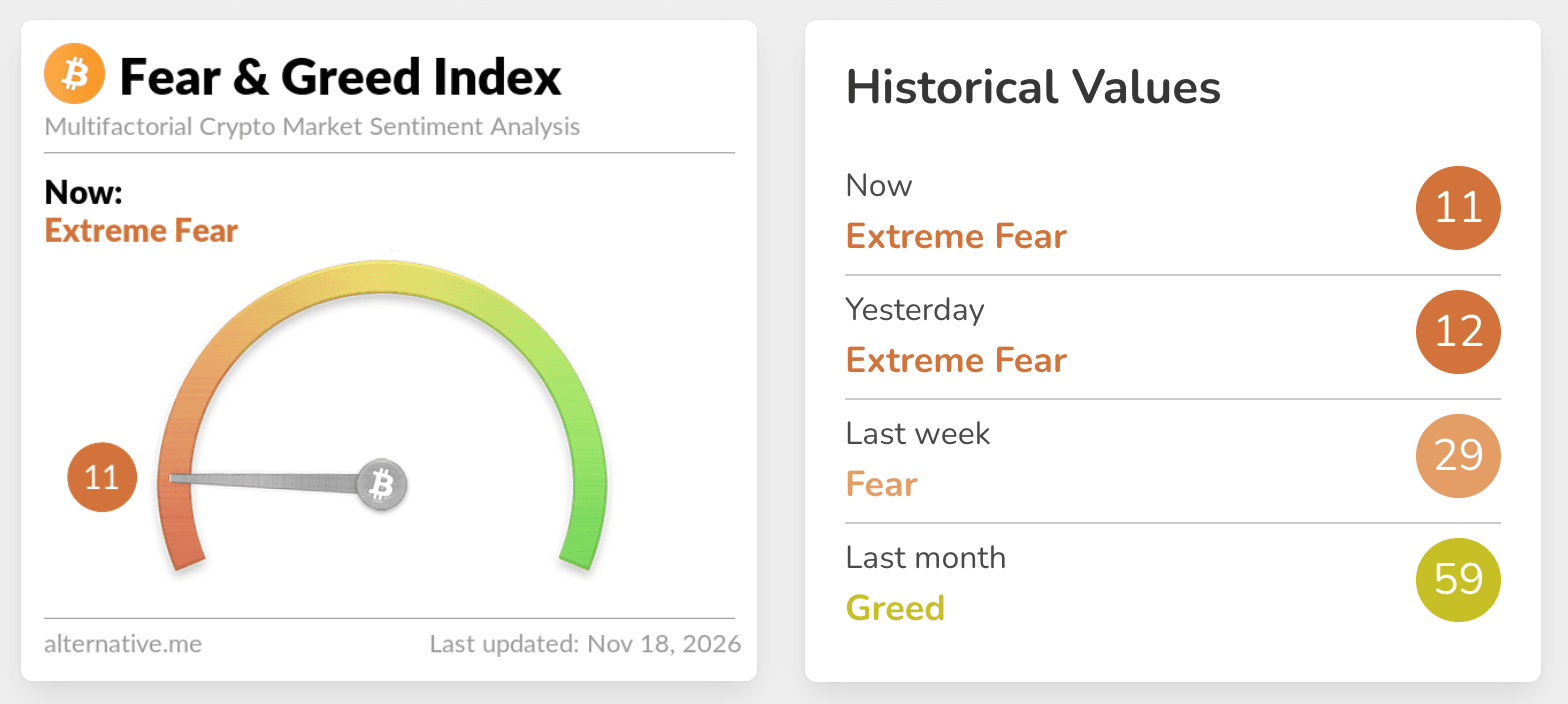
Source: Alternative
Key News Highlights:
NVIDIA Board Rejects Jensen Huang's Return Despite Record USD 115.8 Billion Quarterly Revenue
US chipmaker NVIDIA released its third-quarter fiscal 2027 earnings report on November 17, reporting record revenue of USD 115.8 billion. Revenue increased 103% year over year and exceeded Wall Street's estimate of USD 109.3 billion by approximately 5.6%. Despite the stronger-than-expected results, NVIDIA's board confirmed that it has no intention of reinstating co-founder and former CEO Jensen Huang. The decision brought renewed attention to the company's leadership transition. Chairman Harvey Jones stated at the beginning of the earnings call that the board had unanimously accepted Huang's resignation and had no plans to reappoint him. Chief Financial Officer and interim CEO Colette Kress reassured investors that NVIDIA's operations remained on track following the leadership change. Before the board made its position official, Huang had posted on X that he would be honored to return as CEO if the board believed his reinstatement would serve shareholders' best interests. US President Donald Trump and Tesla CEO Elon Musk had previously expressed support for Huang's return. Media reports also indicated that some NVIDIA employees had discussed organizing a demonstration at the company's California headquarters in support of the former CEO. On the financial side, NVIDIA's data center business generated USD 107.6 billion in third-quarter revenue. This represented more than double the revenue recorded a year earlier and accounted for approximately 93% of the company's total sales. NVIDIA also projected revenue of USD 130 billion for the following quarter, above Wall Street's estimate of USD 125.3 billion. The forecast reflected the company's expectations for continued demand across its businesses. NVIDIA shares closed 0.4% lower at $155.46 during regular trading on November 17 before rising approximately 4% in after-hours trading following the earnings announcement. In addition, the board established a dedicated committee to oversee national security and trade compliance matters. Huang is scheduled to testify before the US Congress on December 1 regarding concerns that advanced US chips may have reached Chinese entities. The earnings announcement and board decision have placed NVIDIA's revenue growth, CEO succession plans, and US semiconductor export regulations at the center of recent corporate developments.
Bitcoin Falls 12.6% in One Week and Breaks Below Its 200-Week Moving Average in a Rare Historical Event
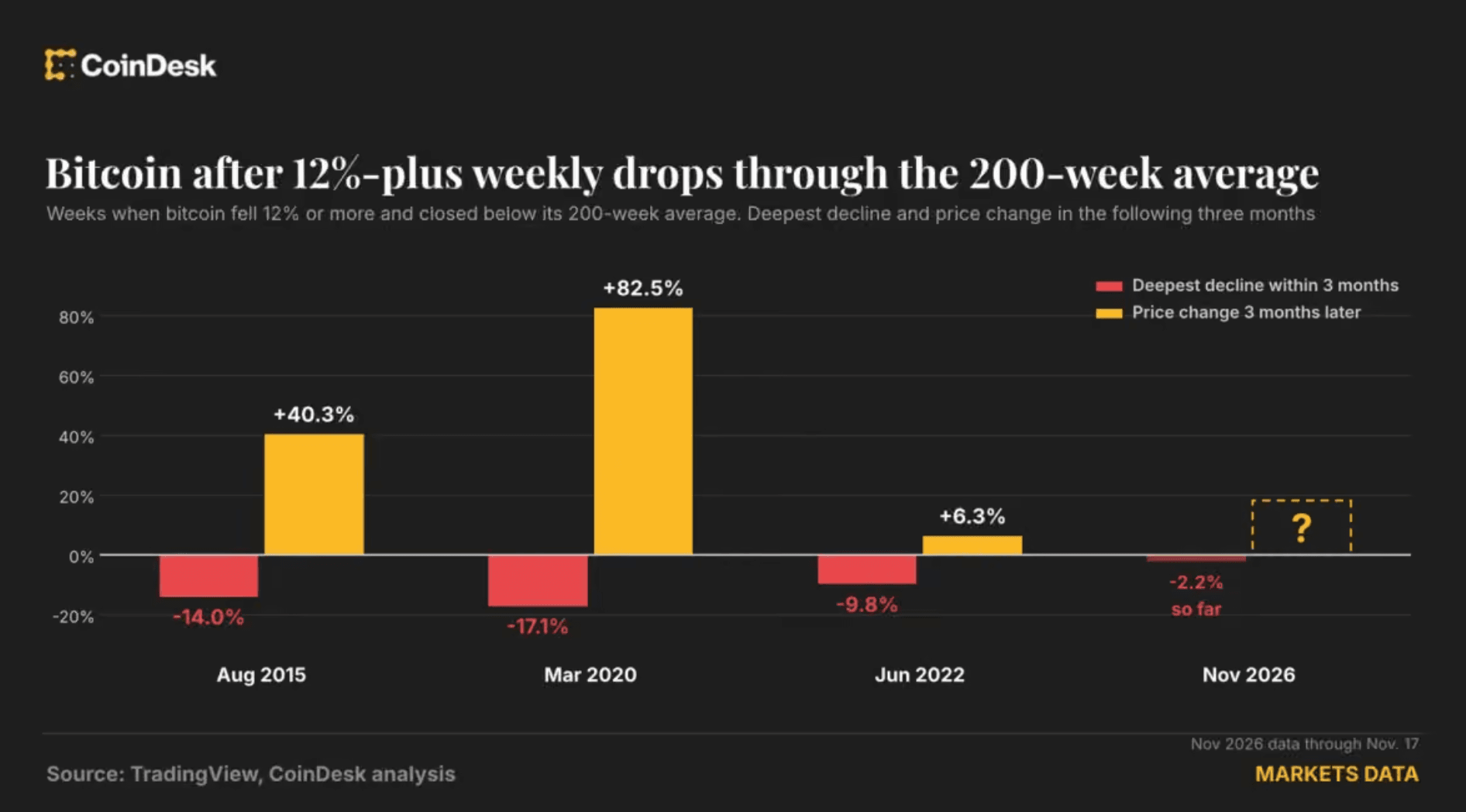
According to market data analysis, Bitcoin declined 12.6% last week and fell below its 200-week simple moving average near $68K. The move marked a relatively rare break below a long-term technical indicator that has occurred only a handful of times since 2013. Bitcoin ended the week slightly above $65K, recording a double-digit weekly loss while closing below its long-term average price. The 200-week moving average is a technical indicator calculated using the average price over the previous 200 weeks. Market participants commonly use it to assess Bitcoin's long-term price trends across different market cycles. Historical data shows that Bitcoin had experienced only three previous instances of a weekly decline exceeding 12% combined with a break below its 200-week moving average since the relevant data became available in 2013. The first occurred in August 2015, when Bitcoin gained 40.3% over the following three months. The second took place in March 2020 during the market turmoil triggered by the COVID-19 pandemic. Bitcoin rose 82.5% in the three months following that decline. The third occurred in June 2022, when Bitcoin recorded a 6.3% gain over the subsequent three months. However, that recovery was followed by another downturn amid major industry developments later that year. Historical records also show that Bitcoin did not rebound immediately after breaking below its long-term moving average in any of these three cases. Instead, prices declined by an additional 10% to 17% before recovering to varying degrees. From a statistical perspective, events involving both a sharp weekly decline and a break below the 200-week moving average are considerably less common than weekly losses of more than 12% alone. Bitcoin has recorded 77 weeks with losses of 12% or more since 2009, but only four such weeks have occurred since the beginning of 2023. This suggests that substantial weekly declines have become relatively less frequent in recent years. However, the historical sample includes only three previous cases meeting both conditions. These figures describe past market performance and cannot establish whether future Bitcoin price movements will follow similar patterns.
US Court Acquits MIT Brothers in USD 25 Million Ethereum MEV Trading Case
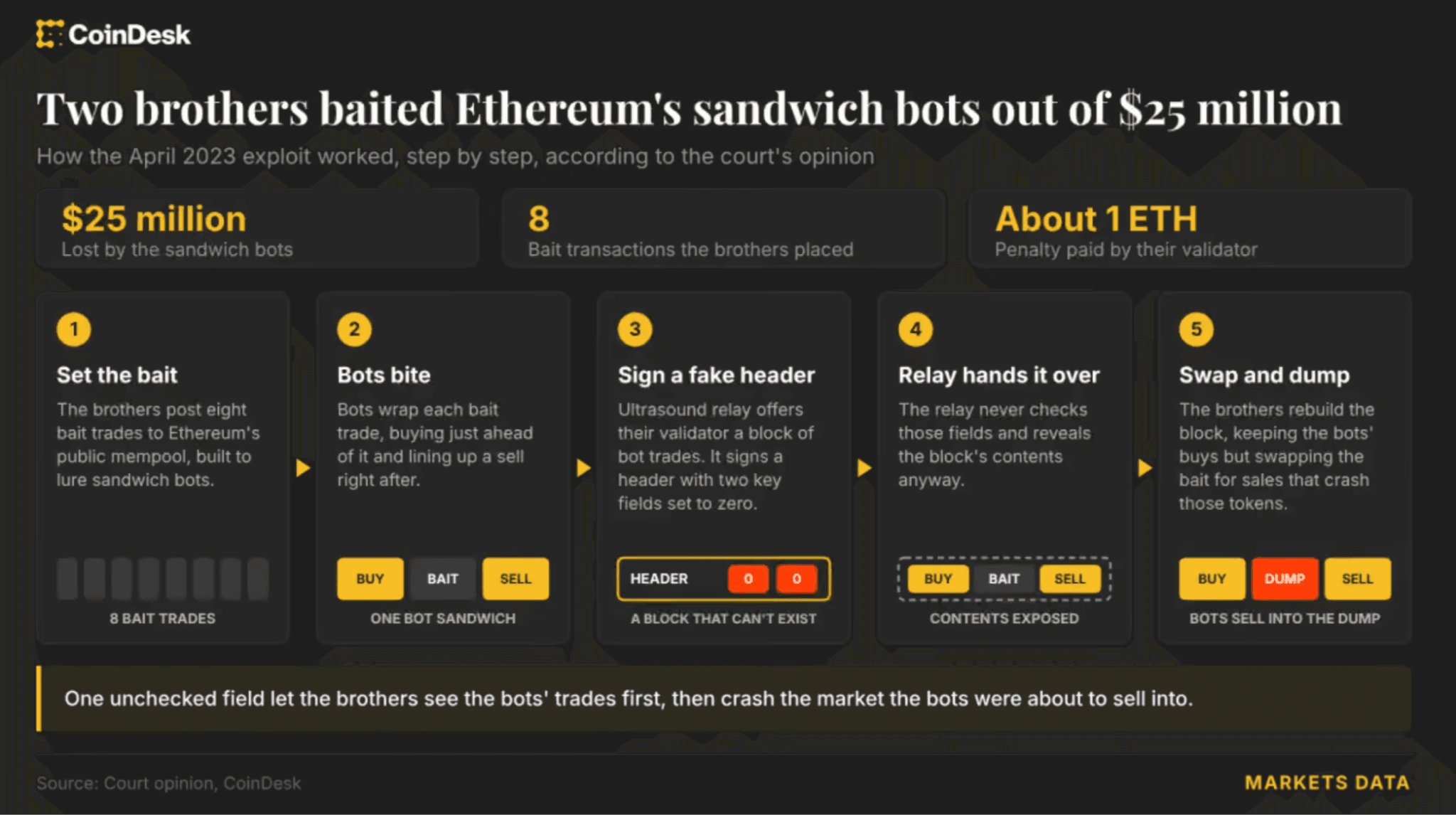
A federal court in Manhattan, New York, acquitted Anton Peraire-Bueno and James Peraire-Bueno, two brothers who attended the Massachusetts Institute of Technology (MIT), in a criminal case involving approximately USD 25 million in Ethereum transactions. The ruling brought an end to the US government's first criminal prosecution involving maximal extractable value (MEV) trading practices. According to court documents, the brothers had faced charges of wire fraud, conspiracy to commit wire fraud, and conspiracy to commit money laundering. Prosecutors alleged that the two exploited Ethereum's transaction ordering mechanism in April 2023 to obtain approximately USD 25 million in just 12 seconds. The case centered on MEV, which refers to the additional economic value that block builders, validators, or other network participants can extract by controlling the order of transactions within a block. Prosecutors claimed that the defendants created eight bait transactions designed to attract automated trading bots using sandwich trading strategies. They then exploited a weakness in the block relay system to access transaction information that had not yet been disclosed. Sandwich trading occurs when bots detect a large pending transaction and attempt to profit from the resulting price movement by buying ahead of the trade and selling afterward. Court documents showed that a validator controlled by the brothers submitted a block header containing irregular fields while receiving block data. The relay service failed to verify these fields and disclosed transaction details that should have remained protected. The brothers subsequently rearranged the transactions, causing the affected trading bots to lose approximately USD 25 million. Their validator also received a penalty of approximately 1 ETH. US District Judge Jessica Clarke ruled that a wire fraud conviction requires proof of a material misrepresentation that influenced the party receiving it. However, prosecutors failed to establish that the transactions and block header manipulation satisfied this legal requirement. Clarke also described Ethereum as a trustless and highly competitive environment without uniform terms of use. She explained that conduct violating other participants' expectations or the intended design of a system does not automatically constitute wire fraud. The case had previously ended in a mistrial in November 2025 after the jury failed to reach a unanimous verdict. The latest acquittal brought the criminal proceedings to a close. The ruling addressed the specific charges brought by prosecutors rather than establishing that all MEV trading practices are lawful. It has also renewed attention to transaction ordering, block relay mechanisms, and the legal responsibilities of participants in the Ethereum ecosystem.
CFTC Nominee Questions Public Benefits of Prediction Markets Amid Federal and State Regulatory Disputes
Two nominees for commissioner positions at the US Commodity Futures Trading Commission (CFTC) appeared before the Senate Agriculture Committee for a confirmation hearing. The discussion focused on the public benefits of prediction markets, regulatory authority, and ongoing legal disputes between federal and state governments. Democratic nominee Matthew Rowland stated that the CFTC should carefully evaluate whether certain event contracts genuinely serve the public interest. He emphasized the need to balance their economic usefulness against their broader social implications. Prediction markets allow participants to trade contracts based on the outcomes of political, economic, sporting, and other events. Their business models have attracted increasing attention from US regulators and state governments in recent years. Several states argue that event contracts offered by these platforms resemble gambling products and may therefore fall under state gambling laws. Some state authorities have filed lawsuits against operators over alleged violations of these regulations. Meanwhile, the platforms and the CFTC maintain that event contracts traded on federally regulated derivatives exchanges may fall under federal jurisdiction. The disagreement has raised questions about the boundaries between federal derivatives regulations and state gambling laws. Republican nominee Nathan Anonick acknowledged that the legal uncertainty surrounding prediction markets makes regulation particularly complex. He stated that he would follow any future US Supreme Court ruling that clarifies the division of regulatory authority. Democratic Senator Tina Smith emphasized that the issue extends beyond industry development or market sentiment. She argued that it involves established legal principles and the rights of states to regulate sports betting and related activities. The CFTC is currently involved in multiple lawsuits concerning its authority over prediction markets and has proposed regulatory rules for the emerging event contracts industry. Rowland expressed interest in contributing to the development of these rules if confirmed. Beyond prediction markets, the hearing also addressed staffing reductions and vacant commissioner positions at the CFTC. Both nominees supported increasing staff when necessary and agreed that a fully staffed commission would help establish more consistent regulatory policies. Later in the hearing, lawmakers raised questions about business relationships between the Trump family and prediction market operators. Senators asked whether such relationships could affect the fairness of CFTC enforcement actions. Both nominees stated that the law should apply equally to all companies regardless of their connections to the president or his family. The future of prediction market regulation remains subject to court decisions, federal policy developments, and ongoing state-level litigation. The broader legal disputes over regulatory jurisdiction have yet to be fully resolved.
Disclaimer: The information provided in this section is for informational purposes only and doesn't represent any investment advice or FameEX's official view.