FameEX Today’s Crypto News Recap | November 25, 2026
2026-11-25 07:03:11
Trump leaves open a pardon for Jensen Huang while the CIA faces a breach and Velocity DEX halts trading over a bug; today’s BTC is near $59K amid Extreme Fear. The cryptocurrency market continued its recent correction, with Bitcoin (BTC) trading near $59K after falling below $60K and Ethereum (ETH) declining to around $1,670. Major crypto assets remained under broad price pressure. BTC had briefly recovered above $64K amid a rebound in U.S. technology stocks. However, the price returned to its previous consolidation range as the technology stock rally faded and market risk appetite weakened. ETH also declined, reflecting the continued impact of market liquidity conditions and volatility in risk assets on major cryptocurrencies. U.S. spot ETF fund flows remained in focus. According to RootData, spot Bitcoin ETFs recorded approximately USD 231 million in net outflows, while spot Ethereum ETFs saw net outflows of around USD 64.1 million. The outflows were concentrated in several major funds, indicating continued redemption pressure on institutional investment products. The Crypto Fear & Greed Index is at 13, indicating Extreme Fear. This marked a slight improvement from the previous day's reading of 11, although overall market sentiment remained cautious. Meanwhile, U.S. technology stocks showed mixed performance. A decline in the Nasdaq Composite and falling shares of major AI companies highlighted the increasingly synchronized movements between cryptocurrencies and traditional risk assets. Across the broader industry, cybersecurity incidents involving U.S. government agencies, AI chip export regulations, on-chain real-world asset derivatives, and central bank digital asset experiments emerged as key developments. Overall, the cryptocurrency market remained in a phase of price rebalancing and position adjustments. Attention remained focused on ETF fund flows, leverage adjustments in derivatives markets, and price stability across major crypto assets.
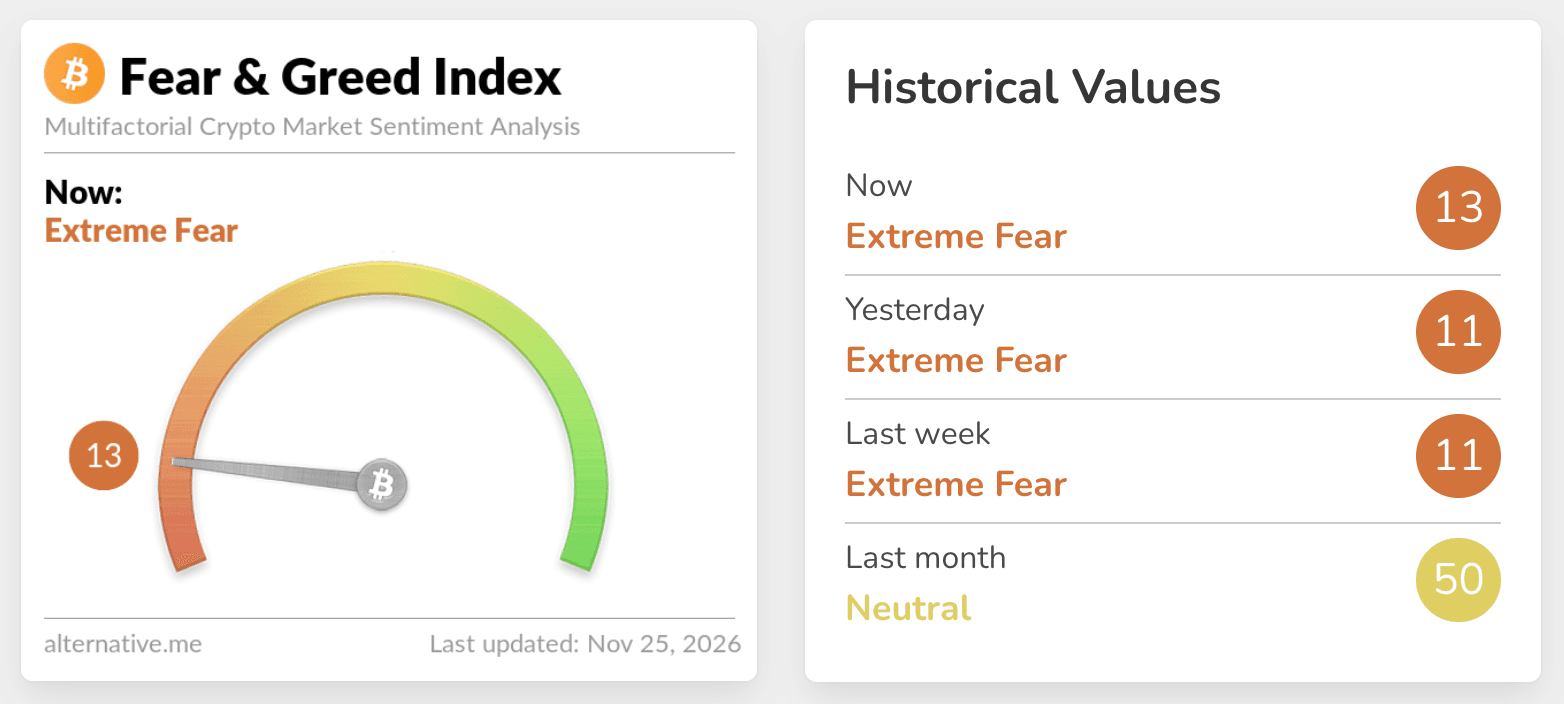
Source: Alternative
Key News Highlights:
Trump Leaves Open Possibility of Pardoning Jensen Huang as NVIDIA CEO Faces Congressional Questioning in December
U.S. President Donald Trump stated in an interview with the New York Post that he would not rule out pardoning NVIDIA founder and CEO Jensen Huang in the future, although he does not believe such action is currently necessary. His remarks followed NVIDIA's decision to reinstate Huang as CEO amid investigations involving executive conduct, national security concerns, and U.S. chip export controls. Trump had previously stated that he communicated with NVIDIA's board and played an important role in Huang's reinstatement. However, Huang told employees on November 24 that claims attributing his return solely to pressure from Trump were entirely false. He also acknowledged that his previous personal conduct had violated certain company policies. In an earlier statement, NVIDIA's board explained that it had evaluated the relevant facts and consulted senior U.S. government officials before unanimously voting to reinstate Huang as president, CEO, and a board member. According to the announced schedule, Huang is expected to attend a closed-door interview with several U.S. House committees on December 1. The questioning will cover national security concerns, technology exports, and related regulatory matters. He is also scheduled to testify before the U.S. Senate Committee on Banking, Housing, and Urban Affairs on December 3 regarding U.S. chip export controls. Several members of Congress have called for further clarification of the government's involvement in executive appointments and whether the company has complied with technology export regulations. Trump's remarks addressed only the possibility of a pardon and did not constitute an official decision. The congressional investigations and scheduled hearings are expected to proceed as planned.
CIA and Office of the Director of National Intelligence Hit by Cyberattack, Exposing Unclassified Information
According to a report by The New York Times, the U.S. Central Intelligence Agency (CIA) and the Office of the Director of National Intelligence (ODNI) recently experienced a cybersecurity breach that may have exposed certain unclassified information to unauthorized access. The incident involved computer networks used by both intelligence agencies to collect and analyze publicly available information. These systems primarily help intelligence personnel identify and organize relevant intelligence from open sources. People familiar with the matter indicated that the breach may have extended beyond the CIA and ODNI, potentially affecting information held by other U.S. government agencies. The ODNI stated that the incident had not disrupted critical intelligence capabilities and that there was no evidence of classified systems being compromised. The affected networks primarily process open-source intelligence and operate separately from government systems used to handle highly classified information. Before this incident, several federal agencies had reported cybersecurity breaches, including the Federal Bureau of Investigation (FBI), the Department of Agriculture, and the Department of Homeland Security. Some of these incidents involved unauthorized system access and the exposure of personnel records. The Financial Crimes Enforcement Network (FinCEN) is also investigating a separate cybersecurity incident, although no evidence has established a direct connection between the cases. U.S. Director of National Intelligence Jay Clayton recently stated that reported cyber incidents had increased from approximately 750,000 in 2020 to more than one million. He also emphasized the need to modernize government digital infrastructure. Authorities have not yet disclosed the full technical details of the breach, the identity of those responsible, or the complete scope of the affected information. Investigations remain ongoing.
Solana DEX Velocity Suspends Trading Over Software Bug, Assures Users That Funds Are Safe
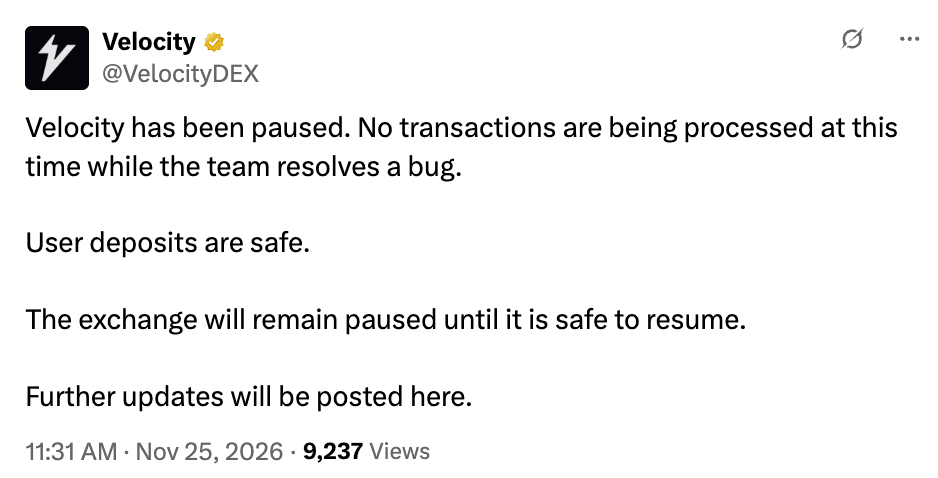
Velocity, a decentralized exchange (DEX) built on the Solana blockchain, announced that it had suspended all trading and related operations after discovering a software bug. Its development team is currently working to resolve the issue. In a statement published on X, Velocity confirmed that user deposits remain safe and that the protocol will stay paused until the team determines it is safe to resume operations. Velocity relaunched in September as a rebuilt fork of a decentralized trading protocol that had previously suffered a major security breach. According to DeFiLlama, Velocity's perpetual futures trading volume increased significantly in November, with particularly sharp spikes in activity on November 18 and 19. The data indicates that trading activity on the platform had expanded in recent weeks. Notably, Velocity's predecessor suffered a major security incident on April 1 that resulted in approximately USD 295 million in losses. The attack was attributed to UNC6862, a North Korean hacking group. The current trading suspension stems from a newly discovered software bug. There has been no indication that the vulnerability has been exploited, and no confirmed reports of user fund losses have emerged. Velocity remains temporarily suspended while its development team continues addressing the technical issue. The platform will determine when trading can safely resume after completing the necessary security checks.
Czech Central Bank Marks One Year of Bitcoin Holdings Without Disclosing Portfolio Value or Position Details
Approximately one year after the Czech National Bank (CNB) launched its digital asset pilot portfolio in November 2025, the central bank has yet to disclose its exact Bitcoin holdings, purchase prices, or current market value. According to the bank's original announcement, the pilot portfolio was established with USD 1 million and included Bitcoin, U.S. dollar-backed stablecoins, and tokenized U.S. dollar deposits recorded on a blockchain. The CNB board approved the initiative on October 30, 2025, before formally announcing it on November 13 of the same year. The program was intended to test the trading, custody, and accounting procedures involved in holding digital assets within a financial institution. The pilot funds are managed by the central bank's internal research and innovation unit and are separate from its regular international reserves. The initiative therefore differs from formally allocating Bitcoin as a central bank reserve asset. According to a CoinDesk report, the CNB uses an external custodian to safeguard some of its digital assets but has not disclosed the service provider's identity or complete transaction records. The bank's 2025 financial statements classify Bitcoin as an intangible asset and record it based on acquisition cost rather than daily market valuations. Because the portfolio contains multiple types of digital assets and the CNB has not disclosed their individual allocations, it is not possible to calculate the actual investment gains or losses based solely on changes in Bitcoin's market price. The central bank has also stated that it does not currently plan to include Bitcoin in its official international reserves or increase the size of the original pilot portfolio. The program continues to focus on digital asset custody, transaction security, accounting practices, and financial infrastructure. Its findings will serve as a reference for the central bank's ongoing evaluation of digital financial technologies.
Disclaimer: The information provided in this section is for informational purposes only and doesn't represent any investment advice or FameEX's official view.