FameEX Today’s Crypto News Recap | November 26, 2026
2026-11-26 07:03:39

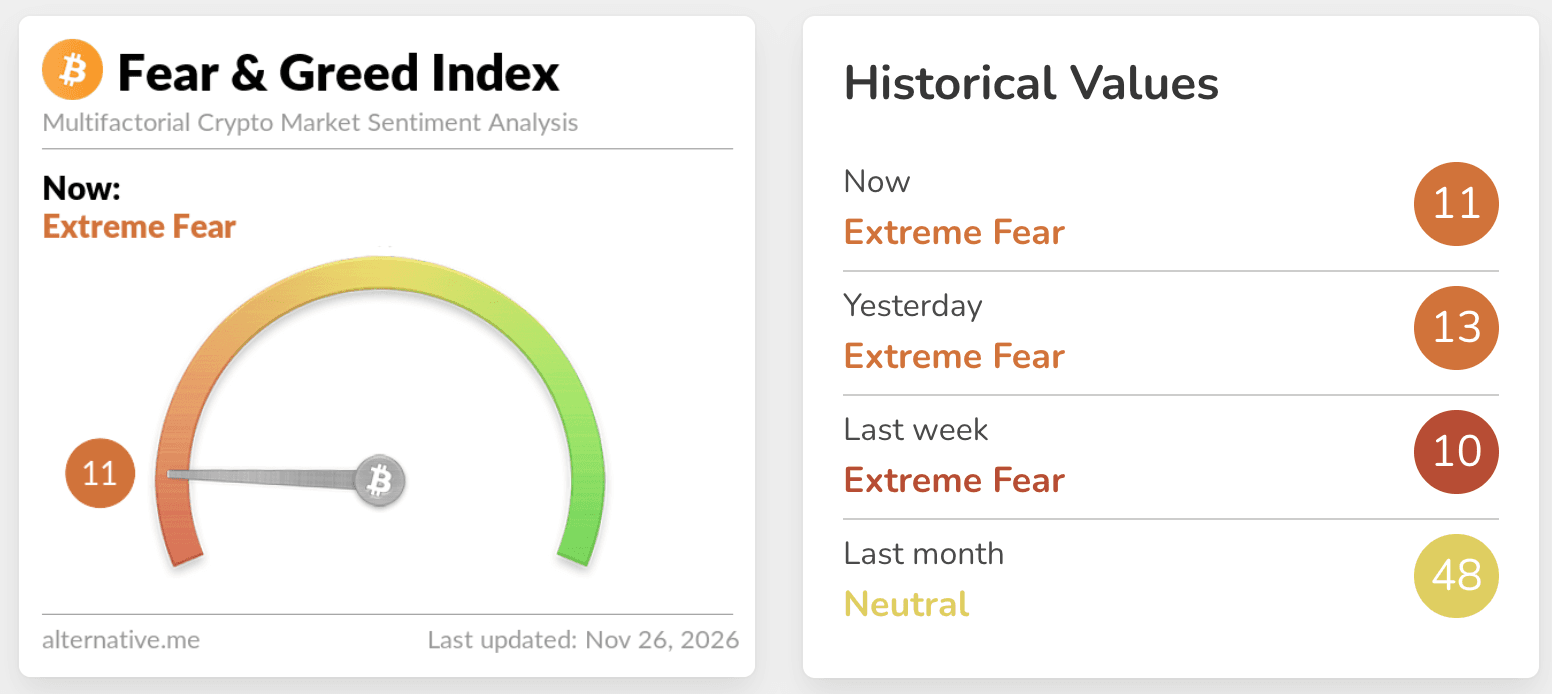
US senators urge SEC to revoke crypto exemptions as PCE tops forecasts and a Bitcoin reserve bill advances. Today’s BTC is near $60.6K amid Extreme Fear. The cryptocurrency market gradually recovered from yesterday's sharp volatility, with BTC climbing back above $60K to trade near $60.9K and ETH rebounding to around $1,700. Both major cryptocurrencies recovered from their previous session lows. The latest US October Personal Consumption Expenditures (PCE) inflation data exceeded market expectations. Concerns over potential new trade tariffs also contributed to a broader decline in global risk assets. BTC briefly fell toward $57.2K before recovering above $60K. Despite the rebound, market sentiment has improved little. Today's Crypto Fear & Greed Index is at 11 in Extreme Fear, down from 13 yesterday. Derivatives trading activity also remained elevated. According to CoinGlass data, total crypto market liquidations reached USD 725 million over the past 24 hours, including USD 407 million in long liquidations and USD 318 million in short liquidations. These two-sided liquidations typically occur during periods of rapid price movements as highly leveraged positions are forced to close. US spot crypto ETF flows also drew attention. Spot Bitcoin ETFs recorded approximately USD 453 million in net outflows, while spot Ethereum ETFs saw USD 68.5 million in net outflows. These figures indicate that fund withdrawals continued despite the market rebound. Meanwhile, the Bank of Korea raised its benchmark interest rate by 25 basis points to 3.25%. The decision brought monetary policy across major economies back into focus. Overall, the crypto market is experiencing a short-term price recovery alongside continued institutional portfolio adjustments and weak investor sentiment. These conditions reflect ongoing liquidity reallocation and leverage rebalancing across the market.
Source: Alternative
Key News Highlights:
U.S. Senators Urge SEC to Withdraw Crypto Fundraising and Tokenized Stock Exemptions
US cryptocurrency regulation has once again drawn attention from Congress as several Democratic senators urged the Securities and Exchange Commission (SEC) to withdraw two regulatory exemptions involving crypto fundraising and tokenized stock trading. According to the released congressional letters, Senators Elizabeth Warren, Chris Van Hollen and other lawmakers argued that recent SEC regulatory changes could weaken existing investor protections in traditional securities markets. The first dispute concerns the Regulation Crypto Assets proposal, which would allow eligible crypto projects to raise funds within specified limits without following standard securities offering registration procedures. Under the proposal, startups could raise to USD 5 million over four years. A separate fundraising exemption would allow qualifying issuers to raise up to USD 75 million within 12 months. The senators expressed concern that these exemptions could reduce financial disclosure requirements and regulatory oversight for certain crypto projects. As a result, investors might not receive the same level of information required for traditional securities offerings. The second dispute involves tokenized stock trading. The proposed exemption would allow eligible platforms to offer blockchain-based trading of certain US stocks without completing some registration procedures required of traditional securities exchanges. Lawmakers warned that this framework could move certain stock trading activities into a different regulatory structure. They also questioned whether listed companies would have sufficient control over the tokenization of their shares. Under the proposed arrangement, companies would have 30 days to object to certain third-party tokenization activities involving their stocks. The SEC previously stated that the exemptions were intended to provide regulatory flexibility for blockchain-based financial innovation. Existing anti-fraud and anti-market manipulation rules would continue to apply. The senators' requests remain part of an ongoing regulatory debate, and any withdrawal or modification of these measures would require further official action by the SEC.
U.S. PCE Inflation Exceeds Expectations as BTC Briefly Falls Toward $57K
The latest US inflation data released on November 25 triggered another round of volatility across financial markets. Investors focused on whether inflation would remain above the Federal Reserve's target and how the central bank might respond through future interest rate decisions. According to the US Bureau of Economic Analysis, the Personal Consumption Expenditures (PCE) Price Index rose 3.8% year over year in October. The reading indicated that consumer price pressures remained elevated. Core PCE inflation, which excludes food and energy prices, reached 3.3% year over year and exceeded market expectations of 3.2%. The core index is also an important measure used by the Federal Reserve to assess underlying inflation trends. Beyond the inflation report, investors closely monitored reports that the US government could introduce higher international trade tariffs. Some proposed tariff measures involved rates ranging from approximately 15% to 20%. US equities experienced significant declines during the session. The Nasdaq Composite Index fell as much as 4.2% intraday, while the S&P 500 dropped approximately 2.7%. Technology stocks and other risk assets faced selling pressure. Bitcoin also declined sharply during the period and reached an intraday low of $57,209. Its maximum daily decline was approximately 4.2%, reflecting similar short-term price movements across crypto and traditional risk assets. Crypto derivatives trading was also affected. Earlier 24-hour liquidation data showed total market liquidations of USD 512 million, including approximately USD 416 million in long liquidations. Large-scale liquidations became another notable market development as rapid price changes triggered forced closures of leveraged positions. The inflation report renewed attention on the Federal Reserve's December policy meeting, although the final interest rate decision remains subject to an official announcement. Bitcoin subsequently recovered part of its losses and climbed back above $60K on November 26. The rebound reflected continued two-way price volatility rather than a sustained one-directional decline.
U.S. Strategic Bitcoin Reserve Bill Advances to Full House With Proposed 20-Year Holding Requirement
US legislation aimed at establishing a Strategic Bitcoin Reserve has taken another step forward. The House Financial Services Committee formally reported the proposed legislation to the full House of Representatives, making it eligible for the next stage of legislative consideration. The bill, H.R. 8957, is known as the American Reserve Modernization Act of 2026. It was introduced on May 21 by Republican Representative Nick Begich and Democratic Representative Jared Golden. The proposal seeks to establish a long-term legal framework for the US government's ownership, management and disclosure of Bitcoin reserves. Under the proposed legislation, the Treasury Department would be required to establish a Strategic Bitcoin Reserve within 180 days of the bill becoming law. A separate reserve structure would also be created to manage other digital assets. One of the bill's central provisions would restrict the government's ability to dispose of BTC held in the reserve. The legislation would require the government to retain these Bitcoin holdings for at least 20 years. During that period, the assets could not be sold, exchanged, auctioned or otherwise transferred or disposed of. In addition to the holding restrictions, the bill would establish proof-of-reserve reporting and asset disclosure requirements to improve transparency around government digital asset holdings. The House Financial Services Committee previously approved the legislation on September 16 by a vote of 28 to 21. It formally reported the bill to the full House on November 24. The proposal builds on the Strategic Bitcoin Reserve executive order issued by the US government in March 2025. Unlike the existing executive order, the new legislation seeks to establish a more permanent legal foundation through congressional approval. However, committee approval does not mean the bill has become law. It must still pass the full House and Senate before receiving the president's signature. With the current congressional term scheduled to end in January 2027, the remaining legislative window is relatively limited. The bill therefore remains under consideration, and its final outcome has yet to be determined.
Galaxy Withdraws Bitcoin Bear Market End Call as Only Two of 13 Bottom Indicators Are Met
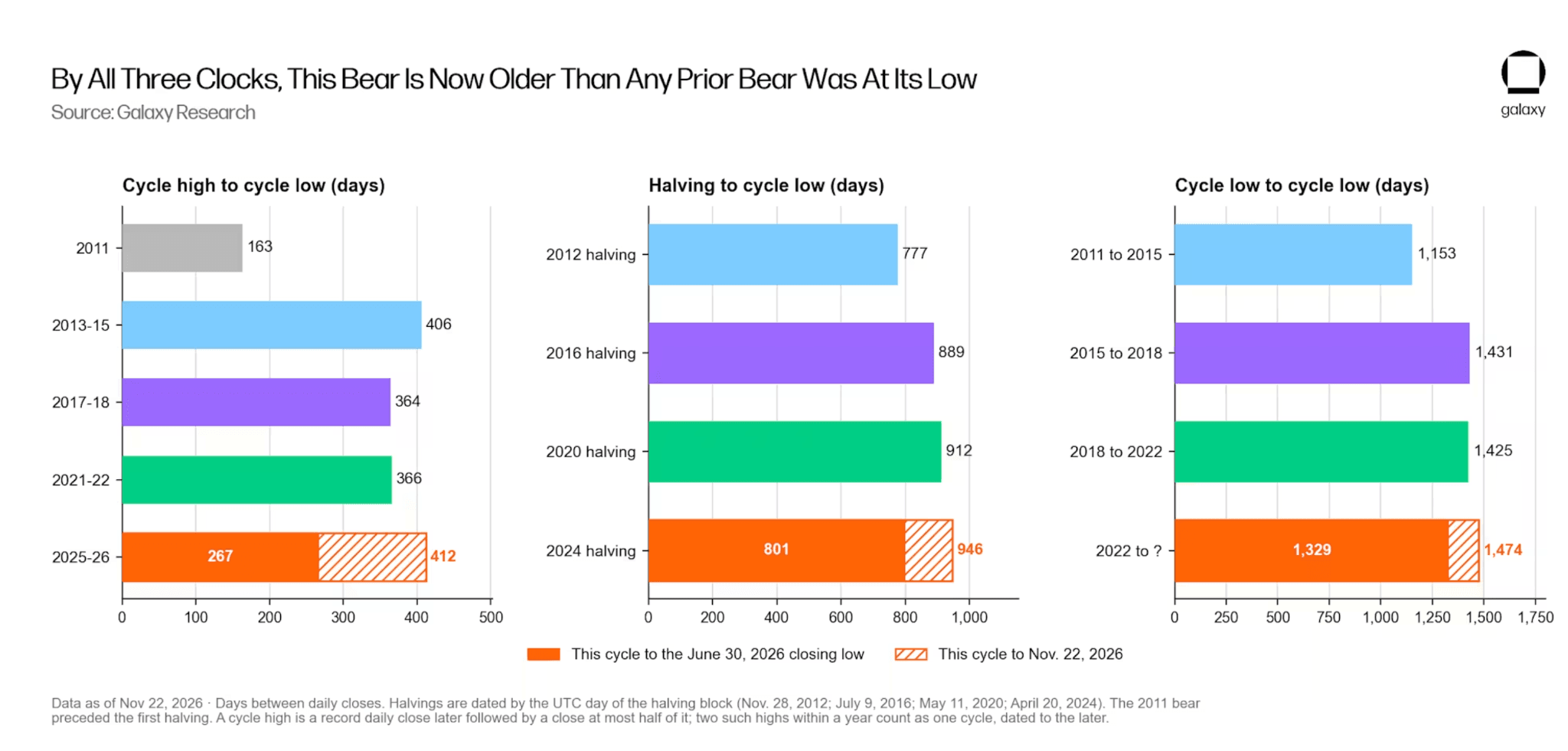
Galaxy Research has reassessed the Bitcoin market cycle and withdrawn its October conclusion that the bear market had ended in June. In its latest report, Galaxy Research Head Alex Thorn explained that the technical conditions supporting the earlier conclusion were no longer valid after BTC fell below key long-term moving averages. The report noted that Bitcoin had reclaimed its 50-week moving average in September and remained above that level for seven consecutive weeks. However, BTC closed below the 50-week moving average during the week ending November 8 and subsequently fell below the 200-week moving average the following week. Bitcoin later reached $55,100 on November 21 and broke below its previous intraday low. This development prompted the research team to reassess its earlier technical outlook. As of November 22, BTC recorded a weekly closing price of $61,104. The 200-week and 50-week moving averages stood near $68,159 and $74,401, respectively. This placed Bitcoin below both long-term technical indicators. Galaxy also noted an important distinction between intraday lows and daily closing prices. Although BTC had established a new intraday low, it had not recorded a daily close below the June 30 closing low of $58,525 as of the report's data cutoff. The research team further examined historical bear market drawdowns, on-chain valuations, holder behavior and market sentiment. Its findings indicated that the current cycle had already experienced a prolonged correction, but several conditions historically associated with major bear market bottoms had not yet emerged. Of the 13 bottom indicators tracked by Galaxy, only two had met their respective criteria. These included BTC trading below its 200-week moving average and more than 12 months having passed since the previous cycle peak. From an on-chain valuation perspective, Bitcoin's realized price stood near $53,205 at the time of the report. Previous bear markets had experienced extended periods when BTC traded below its realized price, but the current cycle had not yet shown a comparable valuation pattern. Galaxy emphasized that historical bear market data remains limited and that previous cycle durations or drawdown levels cannot reliably determine future price movements.
Disclaimer: The information provided in this section is for informational purposes only and doesn't represent any investment advice or FameEX's official view.