FameEX Today’s Crypto News Recap | November 27, 2026
2026-11-27 07:09:14

Ripple's XRPL lending vote nears its threshold as BTC's dormant supply hits 68.5% and Japan partners with SEAL. Today’s BTC is near $61.7K amid Extreme Fear. The crypto market has shown signs of a partial rebound following its recent decline. Bitcoin (BTC) has recovered from a previous low near $57K to around $61.7K, while Ethereum (ETH) has climbed above $1,750 with a 24-hour gain of 2.89%. Although BTC has returned above $60K, it remains well below its all-time high of approximately $126K in October 2025. This indicates that the market is still trading within a range shaped by the recent sharp correction. ETH has recorded a relatively stronger short-term recovery, reflecting differences in the recent price performance of the two leading cryptocurrencies. Market sentiment remains cautious, with the Crypto Fear & Greed Index at 12, indicating Extreme Fear. This is slightly higher than yesterday's reading of 11 and unchanged from last week's 12. However, it remains significantly below last month's neutral reading of 51. In the derivatives market, attention remains focused on leveraged positions around key BTC and ETH price levels, particularly the potential liquidation pressure on long and short positions. Traditional markets have also recorded notable price movements. Spot gold rose 2.81% to $3,666.56 per ounce, silver gained approximately 7% to $44.32 per ounce, and WTI crude oil climbed to $86.57 per barrel. On the macroeconomic front, the European Central Bank is scheduled to release the euro area's October consumer inflation expectations for the next one and three years. Meanwhile, Ripple's proposed lending feature on the XRP Ledger is approaching the required validator approval threshold. The share of Bitcoin supply that has remained inactive for over a year continues to rise. Japan's crypto industry cybersecurity organization has announced an expansion of international security cooperation, while Ethereum developers have confirmed a revised testing schedule for the Glamsterdam upgrade.
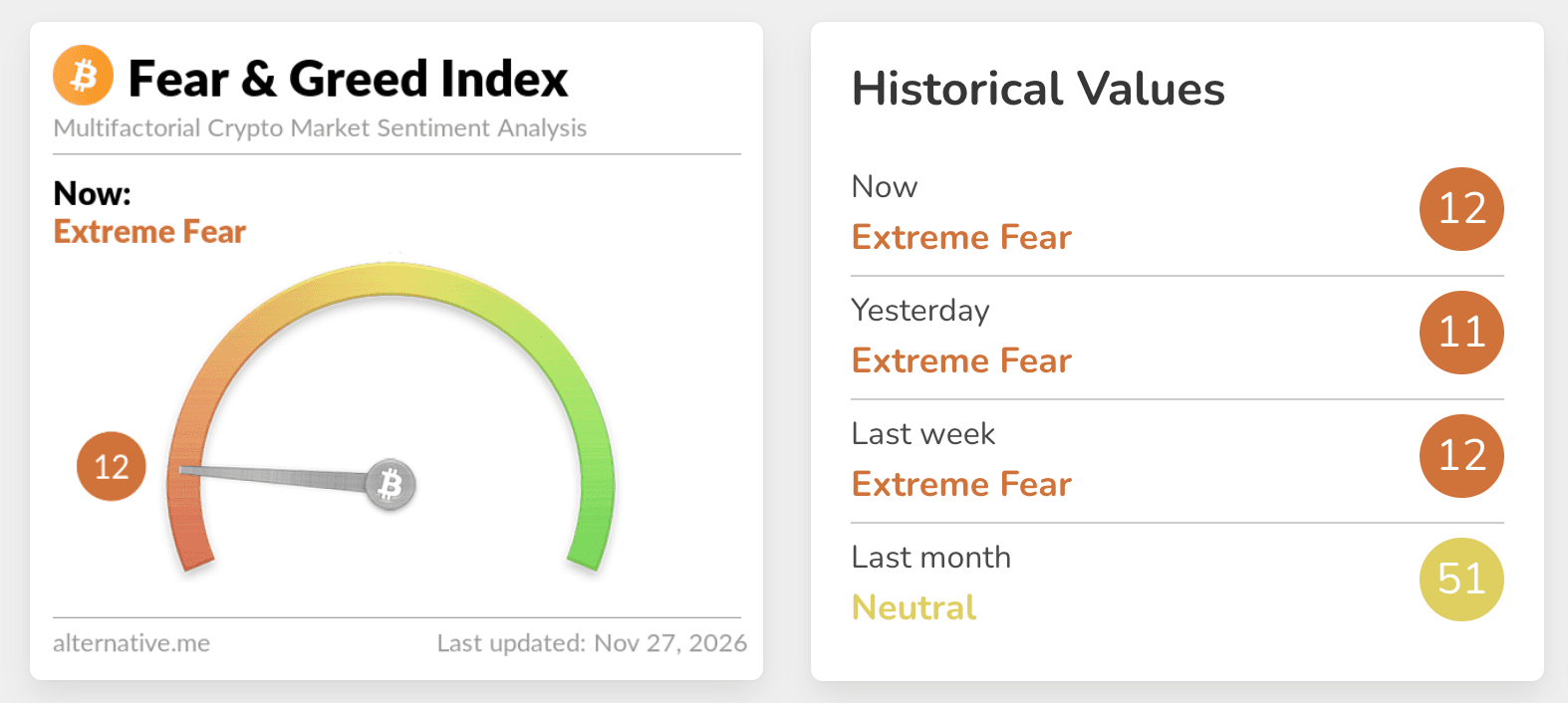
Source: Alternative
Key News Highlights:
Ripple's Lending Plan Nears Activation Threshold as XRP Ledger Stablecoin Supply Reaches USD 837 Million
Ripple's proposed native lending feature on the XRP Ledger has gained additional validator support, bringing the proposal within one vote of meeting the threshold required to begin the activation process. Under the XRP Ledger's governance rules, amendments must receive support from at least 29 of the network's 35 main validators and maintain that level of approval for two consecutive weeks before taking effect. The proposed lending system consists of two separate components: vaults for holding deposited assets and a lending mechanism for issuing loans. Each component requires its own validator approval. The vault amendment has already secured 29 votes and could activate on December 9 if the required support remains in place. The lending amendment currently has 28 votes and needs one additional validator to begin its two-week activation period. According to DefiLlama, the XRP Ledger holds approximately USD 837 million in stablecoins, while existing decentralized finance applications on the network manage around USD 30.5 million in assets. Under the proposed framework, users could deposit XRP or stablecoins into designated vaults and receive tokens representing their share of the deposited assets. Lending brokers could then use those assets to provide fixed-term loans to businesses and other borrowers. These loans would not require borrowers to provide collateral on the XRP Ledger. Depositors would therefore face potential losses if borrowers failed to repay their loans and would depend on the brokers' credit assessments and loss-absorption arrangements. Certain vaults could also restrict access to participants who meet specific identity verification or authorization requirements. Even if the vault amendment activates first, vaults would only be able to accept deposits and issue share tokens until the separate lending amendment takes effect. Actual lending activity would remain unavailable during that period. The latest progress marks another step toward implementing native lending infrastructure on the XRP Ledger, although the full lending system still requires further approval before becoming operational.
Bitcoin Supply Inactive for Over One Year Rises to 68.5% as Long-Term Holding Data Shifts
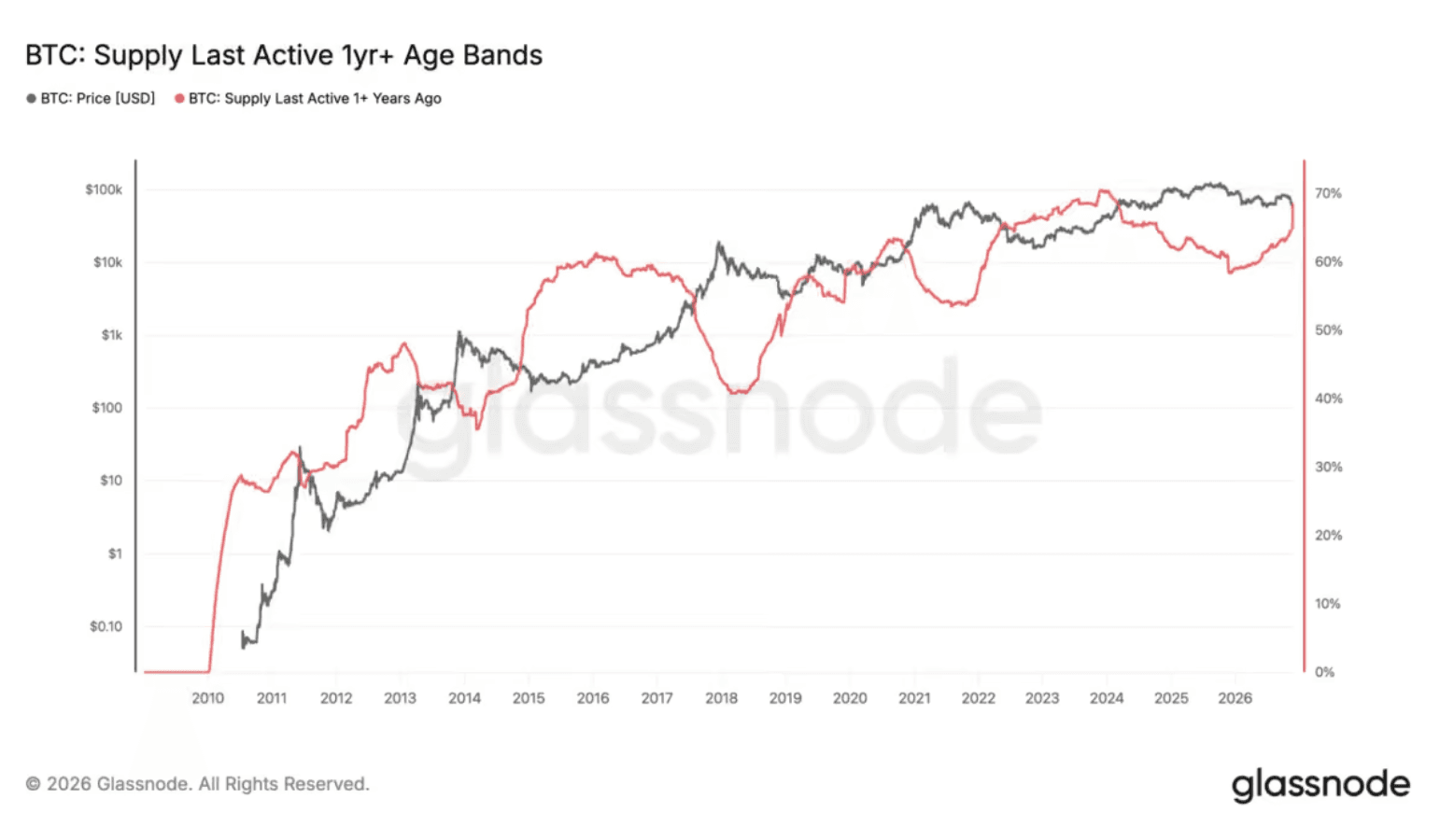
According to Glassnode's on-chain data, the share of Bitcoin's circulating supply that has remained unmoved for at least one year has increased to 68.5%, up from 62% in July 2026. This indicates that a growing portion of BTC has remained inactive on-chain despite recent price fluctuations. The metric, known as Supply Last Active 1+ Years, measures the percentage of Bitcoin's circulating supply that has not moved on-chain for more than a year. BTC is currently trading near $60K, down approximately 30% since the beginning of the year and more than 50% below its October 2025 all-time high of around $126K. Despite continued price pressure, the share of inactive supply has gradually increased. This shows that some holders have not transferred their assets to other on-chain addresses during the market correction. Historical data from Glassnode shows that the metric approached a low of 58% when BTC returned to the $60K level in early 2026 before beginning to rise again. Similar patterns have appeared during previous market cycles. Some BTC acquired during periods of falling prices gradually entered the one-year inactive supply category as the holding period increased. Conversely, the share of inactive supply declined during the later stages of the 2017 and 2021 bull markets as previously held coins began moving on-chain again. These historical changes provide insight into Bitcoin holding periods and on-chain asset movements. However, the metric alone cannot confirm whether the market has reached a price bottom. The latest data primarily shows that a growing share of Bitcoin's circulating supply has remained inactive for extended periods even as BTC trades significantly below its all-time high. This measure has also become an important on-chain indicator for monitoring recent changes in Bitcoin's holding structure.
Japan's Crypto Security Group Partners With SEAL to Strengthen Cross-Border Cyberattack Response
Japan's crypto industry cybersecurity organization JPCrypto-ISAC has signed a memorandum of understanding with the US nonprofit Security Alliance (SEAL) to strengthen cyberattack detection and security incident response across the digital asset industry. Under the agreement, SEAL will help JPCrypto-ISAC develop an incident response support framework and provide professional resources and technical assistance for handling security incidents. The two organizations will also share cyber threat intelligence to improve the identification, reporting, and response to cross-border attacks. JPCrypto-ISAC was established in 2025 with 16 founding members. Its primary role is to help Japanese crypto companies collect, analyze, and share cybersecurity information. The organization's representative director, Naoji Noda, emphasized the growing importance of international cooperation and information sharing as cyber threats increasingly extend across national borders in the Web3 and digital asset sectors. Before the partnership was announced, two Japanese crypto exchanges had disclosed a data breach involving their third-party email service provider Arara. The incident exposed hundreds of thousands of customer email addresses. Arara estimated that the breach could affect up to 380 companies across its customer base, highlighting how security incidents involving third-party service providers can impact multiple participants in the crypto industry. Japan's crypto sector has also experienced major asset thefts in the past. In May 2024, hackers stole BTC worth approximately USD 305 million at the time from a Japanese crypto exchange. US and Japanese authorities later attributed the attack to North Korean hackers. The new partnership between JPCrypto-ISAC and SEAL will cover threat intelligence exchange, incident response support, and the sharing of cybersecurity resources. The agreement further expands cooperation between Japan's crypto industry and international cybersecurity organizations.
Ethereum Schedules Glamsterdam Upgrade on Hoodi for December 15 as Developers Retain Gas Pricing Changes
Ethereum core developers have scheduled the Glamsterdam upgrade for activation on the Hoodi testnet on December 15, nearly two months later than the originally planned October 26 deployment. The upgrade includes several changes to Ethereum's underlying protocol. Among them, EIP-8037 and EIP-8038 introduce adjustments to how Gas fees are calculated for certain computational operations and state access. During earlier testing, developers discovered that the revised Gas pricing rules could cause some existing smart contracts to run out of Gas during execution. This could result in failed transactions or contract operations and prompted the team to postpone the Hoodi testnet upgrade. At the Ethereum All Core Developers Consensus meeting on November 26, developers confirmed the revised testing schedule and reached broad agreement on retaining the current EIP-8037 specifications. Some developers warned that further changes to the Gas pricing proposal could create compatibility issues for other deployed smart contracts and increase uncertainty surrounding the mainnet rollout. Ethereum researcher and core developer Ansgar Dietrichs also noted during the meeting that continued delays in technical decision-making could push the Hoodi deployment into 2027. Glamsterdam was deployed to the Sepolia testnet on October 6, while Hoodi serves as the final testing stage before the mainnet upgrade. Other major components of Glamsterdam include enshrined proposer-builder separation, block-level access lists, and Gas pricing adjustments that more accurately reflect actual execution costs. These changes are intended to advance Ethereum's layer-1 scaling roadmap. The Ethereum Foundation previously indicated that mid-January 2027 would be the earliest feasible date for a mainnet rollout. However, the final schedule will depend on the resolution of outstanding technical issues and the results of further testing. Some high-severity smart contract compatibility issues have already been resolved or are expected to be addressed by mid-December. Other medium-severity issues may remain under review until January 2027. Developers will continue monitoring testnet performance and evaluating the remaining requirements before proceeding with the mainnet upgrade.
Disclaimer: The information provided in this section is for informational purposes only and doesn't represent any investment advice or FameEX's official view.