FameEX Today’s Crypto News Recap | August 17, 2026
2026-08-17 07:14:00
Washington tightens restrictions on Kalshi as RWA tokenized stocks gain traction and Ethereum moves ahead with Hegotá; today’s BTC price is near $63K in Fear sentiment. The Crypto Fear and Greed Index stands at 31, keeping the market in the Fear zone. Bitcoin’s 7-day implied volatility has fallen to 25%, indicating that short-term volatility expectations have continued to ease. However, on-chain data shows that the substantial buy-side support previously built below the market price has steadily weakened since June. The underlying support structure has become noticeably thinner. Fund flow data also points to diverging demand across crypto assets. U.S. spot Bitcoin ETFs recorded net outflows of USD 390 million last week, led by Fidelity’s FBTC. In comparison, spot Ethereum ETF flows remained relatively stable. Although these products posted a combined net outflow of USD 2.26 million last week, recent data shows that Ethereum ETFs have outperformed Bitcoin ETFs in net flows relative to fund size for two consecutive months. Looking at potential liquidation pressure, if BTC moved above $65,917, it could trigger approximately USD 315 million in cumulative short liquidations across major CEXs. A decline below $60,392 could expose roughly the same amount in cumulative long liquidations. This suggests that substantial leveraged liquidity remains concentrated around both key levels. On the macro side, expectations for further Federal Reserve rate hikes are being reassessed. Goldman Sachs has argued that the market may be pricing in an overly hawkish path as inflation continues to cool. Any adjustment in rate expectations could have broader implications for liquidity conditions across risk assets.
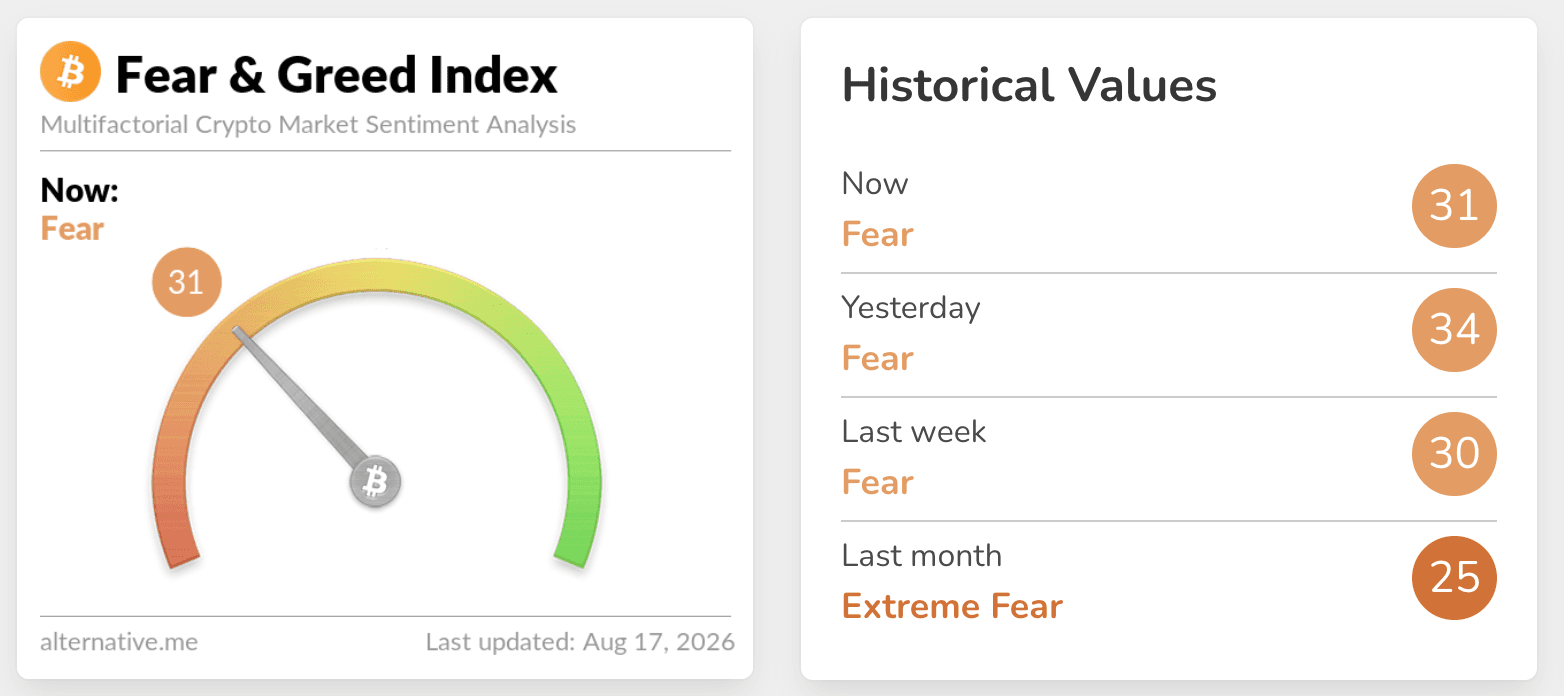
Source: Alternative
Key News Highlights:
Washington Court Orders Kalshi to Halt Multiple Prediction Market Contracts
A Washington state court has ordered prediction market platform Kalshi to stop offering several categories of event contracts in the state. The court also rejected Kalshi’s argument that federal commodities law overrides Washington’s gambling laws. Under an order signed by King County Superior Court Judge John McHale, the restrictions cover contracts tied to sports, elections, politics, entertainment, culture, technology, science, and certain contracts involving specific people or topics. Contracts related to commodities, climate, economics, and finance are excluded from the injunction. Washington Attorney General Nick Brown said the enforcement action follows a recent court ruling that found Kalshi’s operations in the affected markets to be in violation of state gambling rules. Kalshi must introduce IP address and residency-based geofencing by August 19 to prevent Washington residents from purchasing contracts covered by the injunction. The platform must then deploy GeoComply’s multi-source geofencing system by September 2 to strengthen location verification. The amended order follows a preliminary injunction granted by the court in July. Judge McHale found that the Commodity Exchange Act does not prevent Washington from applying its own gambling laws to these activities. Kalshi continues to argue that the U.S. Commodity Futures Trading Commission has exclusive jurisdiction over its market. The dispute therefore remains centered on the division of authority between federal derivatives regulation and state gambling law. The Washington Court of Appeals has denied Kalshi’s request to stay the injunction, so the geofencing requirements remain on schedule.
RWA Tokenized Stock Holders Surpass 1.31 Million as Monthly Transfer Volume Reaches USD 23.13 Billion
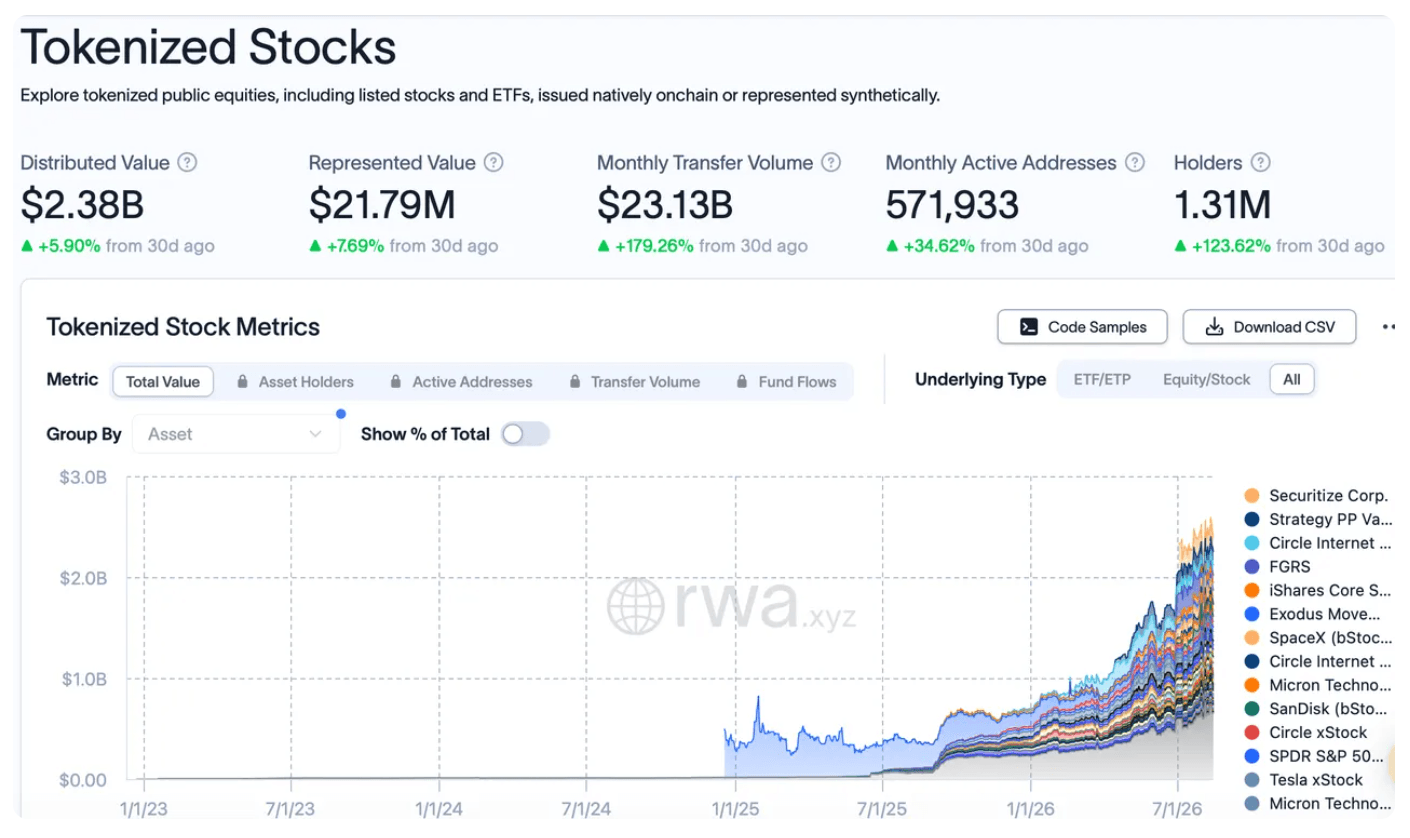
Latest data shows that the number of tokenized stock holders has risen to 1.31 million over the past month. That figure has more than doubled from the previous level, while overall use of related on-chain assets has expanded at the same time. Monthly transfer volume for tokenized stocks increased by approximately 179% to USD 23.13 billion, pointing to a sharp rise in the movement of equity-linked assets on-chain. Monthly active addresses also climbed 34.62% to nearly 572,000, indicating that more blockchain addresses are interacting with these products. Total distributed value rose 5.9% over the same period to approximately USD 2.38 billion. By platform, Ondo currently accounts for about USD 872 million in distributed value and remains one of the larger tokenized equity providers by this measure. RWA.xyz data also shows that some individual tokenized stock products issued or managed by firms such as Securitize and Ondo have reached values ranging from tens of millions to more than USD 100 million. Recent growth has also extended into private-market and pre-IPO products. Several major crypto platforms introduced blockchain-based products linked to private company shares or pre-listing market exposure earlier this year. Some early offerings were canceled and refunded because there were not enough underlying shares available to meet demand. Even so, related assets continued to build on-chain circulation after the companies entered public markets. This expansion is taking place alongside broader growth in real-world asset tokenization. Standard Chartered has previously projected that the global tokenized RWA market could reach approximately USD 4 trillion by the end of 2028. Tokenized equities have become one of the asset categories showing sustained growth in on-chain activity.
Ethereum Developers Review 66 Proposals as Hegotá Upgrade Focuses on Native Privacy
Ethereum core developers are reviewing 66 proposals to determine the final scope of Hegotá, the network’s next major upgrade. Several of the proposals are focused on bringing stronger native privacy capabilities directly into the Ethereum protocol. FOCIL, or Fork-choice Enforced Inclusion Lists, is currently the only Ethereum Improvement Proposal confirmed for inclusion in Hegotá. One of its main goals is to strengthen the network’s censorship resistance. FOCIL would allow a committee of validators to create inclusion lists that require certain pending transactions to be added to blocks. This could reduce the ability of a single block builder to exclude specific transactions. Other proposals under consideration include Frame Transactions, Keyed Nonces, and Recent Roots for Frame Transactions. These proposals could provide protocol-level building blocks for native privacy applications. They address transaction structure, nonce management, and access to recent block roots, giving privacy applications more functionality directly at the protocol layer. Ethereum Foundation contributor Toni Wahrstätter said these features could reduce the need for some privacy applications to rely on intermediary infrastructure. Core developers currently expect Hegotá to launch in 2027. Proposals that are not selected for this upgrade may still be reconsidered for future network upgrades. Before Hegotá, Ethereum is expected to prioritize the Glamsterdam upgrade. Its main areas of focus include scalability, Layer 1 improvements, and a better network user experience. According to the public roadmap, mainnet deployment is expected to move forward in the second half of 2026. Upcoming core developer meetings will continue to narrow the 66 candidate proposals and gradually define Hegotá’s final specifications and privacy-related features.
Trezor and SafePal Data Breaches Put More Than 54,000 Wallet Users at Phishing Risk
Two separate data breaches have recently affected more than 54,000 cryptocurrency wallet users. The incidents have renewed concerns over the security of personal information linked to hardware wallets and self-custody products. Trezor said a breach involving its logistics service provider exposed personal data belonging to approximately 14,000 customers. The affected group includes some users who received products between May 10 and August 8 in the United States, the United Kingdom, Sweden, Colombia, Brazil, Italy, and Portugal. The exposed information could be used to create more targeted emails, text messages, or other forms of social engineering. As a result, these users may face an increased risk of phishing attacks. SafePal also disclosed a separate security incident in which unauthorized parties accessed order information belonging to nearly 40,000 customers. The exposed data included names, addresses, and some purchase information. Attackers could use genuine order details to make fraudulent messages appear more credible. SafePal said it identified and removed more than 30 fraudulent websites and phishing links connected to the incident. Both breaches primarily involved personal and order information. Reports did not indicate that users’ private keys were directly compromised. However, personal information obtained by third parties could still be used for follow-up scams or identity fraud. The incidents come as the crypto industry continues to explore how more advanced AI models can help developers identify security vulnerabilities. User data protection, supply-chain security, and protocol security have therefore become closely connected parts of the industry’s broader cybersecurity discussions.
Disclaimer: The information provided in this section is for informational purposes only and doesn't represent any investment advice or FameEX's official view.